

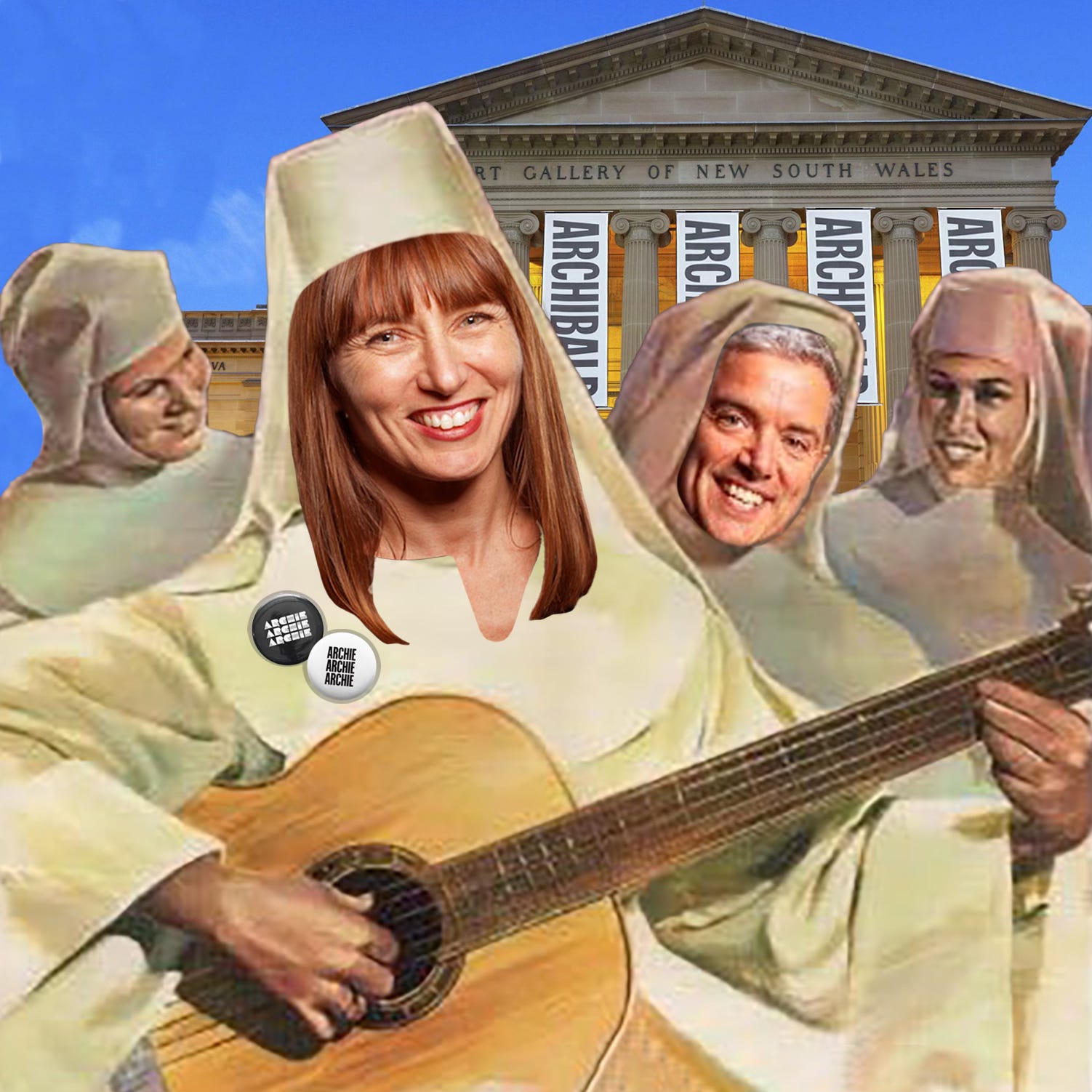
At a time when our art institutions and funding bodies have become beacons for social justice rather than art it’s only to be expected that the Archibald Prize will reflect this trend. But on reflection, perhaps “reflect” is too soft a term. It would be more accurate to say “embrace” or “reinforce”, or “plunge head over heels into” a fantasy that sees the public gallery as a sanctuary in which all minorities and special interest groups are given their day in the sun.
Well, not all minorities. I wondered aloud last week if Chinese-Australian artists would play a more visible role in this year’s Archibald Prize. The answer is that they are completely absent - which justifies the effort behind the inaugural ACAR Art Prize, with which I’ve been involved. It’s a good indication of prevailing attitudes when Peter Godwin wins $100,000 and is ignored by every major media outlet with the exception of the Australian Financial Review, while Sean Layh winning the $3,000 Packing Room Prize at the AGNSW is treated as a massive scoop by newspapers, TV and radio.
I’ll save a critical overview of the Archibald for the time being and use this editorial to look more broadly at what the prize represents today.
If anything, the 2026 event is even more obsessed with Indigenous artists, artists with disabilities, and celebrities. The result is outstandingly mediocre, a sideshow rather than an art show. Rather than the best possible exhibition, the trustees have aimed for the most inclusive one. The media responds by treating the Archibald as a dependable bit of ‘colour’ to spice up the news pages - a slice of light entertainment.
This year’s selection has already had the fire-and-brimstone treatment from Christopher Allen in The Australian, and I can only marvel that he’s still able to summon up reserves of indignation.
As for the Sydney Morning Herald, I shouldn’t be surprised when I find some new travesty, but the paper seems to have developed an insatiable appetite for humiliating itself. Along with all the usual newsy piffle, the Herald got Michaela Boland to write an assessment of the show that is so far off the planet I felt embarrassed for the writer. Michaela made her name as a dogged arts reporter, but she’s no critic – which should have been obvious from a previous attempt last year. Aside from being a small anthology of clichés (“There’s life in the old girl yet”, “Something for everyone”), the piece tells us that “five years after his death, Nicholas Mourzakis [sic] has breathed life into neurologist Jack Wodak.” If I’m sceptical of this astonishing, supernatural feat, it’s because I believe Mourtzakis is still with us.
It was bizarre to read that the previous Archibald was “kaleidoscopic chaos”, but this year is “a cogent and accomplished show”. Let’s be realistic: last year was a mess, and this year is a bigger mess. A once-proud journal of record spreading blatant misinformation.
And if Michaela’s musings didn’t provide sufficient stimulation, the SMH followed up with an incisive piece by Linda Morris, telling us the show is no longer dominated by “men in brown suits”, with today’s entries distinguished by their “vibrancy” and “splashes of colour”. To this revelation, I’d add that the show is no longer dominated by artists with basic skills, but open to any old tat that comes along.
What have we gained from this liberatory celebration of deskilling? In its early years the Archibald may have suffered from the conservatism of the trustees, but today it has become so facile, so stupidly populist, so desperate for attention, that it resembles one of those TV game shows in which anybody can have a go at making a fool of themselves while a studio audience laughs and claps on cue. The Archibald has been reinvented for a facile age that sneers and yawns at aesthetic ambition.
For many it has become wearisome to think of art as something with a history and a tradition that aims to lift us momentarily out of the humdrum routine of our lives. That’s all too hard, too dull, too heavy. Better to view art as a passing distraction, a source of quirky images to post on social media.
It may be uncool to say this, but I’ve always imagined the role of our public institutions, and indeed the press, as one of safeguarding those values upon which our communities have been built. Instead, we now have galleries, media and entire government departments prostituting themselves, trying to be popular with a younger generation who will inherit a world in which they’ll never be able to afford a house, are saddled with crippling higher education debts, and forced to endure a natural environment ruined by our carelessness and greed. I won’t speculate on employment prospects in a world run by AI.
For governments (and here the NSW state government is the gold standard), the solution to these generational problems is that old favourite: “bread & circuses”. Rather than encourage a critical, engaged, inquiring frame of mind, the preference is for young people not to think too much. Scott Morrison doubled the price of an Arts degree, and in four years, the Albanese government has not managed to correct this blatant injustice.
A favourite tactic is to make everything more ‘accessible’, taking money from museums and galleries – the repositaries of collective memory – and spending it on the ephemeral pleasures of parties, festivals and sport. Don’t worry if you haven’t got a home, a job or an education, let’s have some fun!
The complicity shown by the media is partly explained by the fact that corporate ownership is not focused on public benefit, but on the wellbeing of owners and shareholders. This creates an editorial imperative to go easy on anyone who provides advertising revenue or simply holds out the carrot of an ‘exclusive’ (self-serving) story. Exhibit A this week is an ecstatic Daily Telegraph feature on Powerhouse Parramatta, titled ‘Western Sydney’s new era begins…’ The ludicrous boast that the Parramatta venue will attract 2 million people a year is dutifully repeated, along with furphies about jobs, tourism and economic development. Not a single critic of the project was consulted for an opinion or quoted.
This piece was treated as news, and put behind the Telegraph’s paywall, but it really should have been categorised as “Partner Content”, the coy term the paper uses for paid propaganda articles pretending to be features. There are at least five warm & cuddly stories about Powerhouse Parramatta classified as “Partner Content” - a term that suggests your client is happy with the treatment they’re getting. There are numerous other stories praising the glorious achievements of the Kazakhstan, sorry… Minns government, all presumably paid for with funds provided by the taxpayer. It’s good to know your money is being put to work so productively, and the Telegraph is telling it like it is - for a suitable fee.
One wonders if the payments to the Telegraph are being factored into the funds lavished on the Powerhouse, or if they’re coming from some other part of government expenditure. It would be interesting to know how these payments compare with the $300,000 taken from the Australian Design Centre that is forcing the closure of that organisation.
The media used to see its role as keeping government honest, but today it serves as a paid branch of government public relations. It was hardly any different at the Sydney Morning Herald when I was there, with editorials devoted to the wonders of government policy, although these gushes were not identified as “Partner Content”.
What passes as a craven editorial policy soon becomes internalised, as journalists realise what they need to do to please management. To make matters less onerous, there’s a natural tendency among many of today’s journos to believe that any member of a sacred minority cannot be criticised or investigated. The result is an endless procession of stories telling us, in the immortal words of Devo, it’s a beautiful world we live in. The galleries serve up the fatuous content, the government gives it a tick of approval, and the media sings its praises. The only missing element is the public, which is frequently uninterested or downright hostile about the way their taxpayers’ dollars are being spent.
Neither should we neglect the staggering hypocrisy involved, as Arts Ministers pour money into every marginal project, approve galleries’ efforts to turn themselves into offices for social justice, and then penalise the same institutions for not getting the desired attendance numbers or a higher level of private donations.
It’s an institutionalised version of that old adage involving a cart and a horse. Rather than responding to the constantly evolving nature of public taste and opinion, our cultural masters like to issue instructions on what we are allowed to like. If the masses don’t respond with shouts of glee, the fault lies with them, not with those arty missionaries who have done all the right things, morally and politically.
In the decay of the Archibald into a debased artefact of popular culture, the public’s perennial preference for a skilfully painted portrait that captures a likeness is satisfied by a group of dull photo realist pictures. The field is thereby cleared for the ghastly mixture of show biz frivolity and obligatory inclusiveness that makes up the rest of the selection.
I say this while recognising that criticism of the Archibald is completely superfluous. The trustees were apparently so pleased with last year’s efforts they have doubled down on all fronts. It may seem like a great idea to include as many Indigenous artists as possible, but is Adrian Jangala Robertson such an outstanding talent that he needs to be seen in all three prizes? Are we so charmed by a group of artists with disabilities that every year we need to include four or five of them?
This is the message one takes from the AGNSW foyer, which has turned over an entire wall to an installation called Pet Palace by artists from the Little Orange Studio in Campbelltown, “celebrating the animals we love and the unique bonds between pets and their owners.”
With the Young Archies on one wall (dominated by kids with Chinese surnames!) and the Pet Palace on the other, along with Mike Newsome’s childrens’ playground in the basement of the other building, the AGNSW is starting to resemble a glorified child-minding centre. It’s the most devious strategy yet to attract ‘the young demographic’.
The gallery is aware that all the attention lavished on so-called “neurodivergent” artists exerts a form of moral blackmail on the viewer. We’re supposed to think it’s wonderful that the AGNSW devotes so much space to these marginalised artists, but the degree of devotion sets up a false equivalence between artforms, suggesting that works by untrained, amateur artists, with or without disabilities, are to be viewed in exactly the same way as those by professional artists who may have spent months on an Archibald entry. It’s flattering for the amateurs and profoundly disappointing for the professionals. The gallery congratulates itself for helping the disabled artists while alienating those who believe art is a matter of superior skill, talent and insight, not mere self-expression. It’s a blow against the privileged ones! You don’t have to be a visionary to paint your cat or dog.
I’ve had a longterm interest in what used to be called Outsider Art or L’Art brut (‘Raw art’), once helping with a campaign for a specialised museum in Parramatta, but this work fares awkwardly when placed in a conventional fine art context. We need to accept the laboriously titled “neurodivergent art” as a special category, and make value judgements within that category. Instead, the Archibald – and the AGNSW in general – wants us to believe it’s all just “art” and art is fun for everyone.
For a fraction of the money squandered on the bloated Powerhouse project, the state government could have established a functioning Museum of L’Art Brut, relieving the AGNSW of its overpowering sense of responsibility. Much better spend some money on the artists with disabilities than on Lisa Havilah’s “associates”. The government might also have found its funds better spent in turning Martin Sharp’s house into a museum. It would have been a fitting tribute to the Australian artist who, 13 years after his death, remains our best-known international export.
Having spent more than a decade seeking support from government and private enterprise, the trustees of Sharp’s estate have finally consigned the home and contents to the auction block. It’s yet another black mark for a city that not only has a dearth of public museums but specialises in mistreating the existing ones.
Not the smallest part of the ongoing madness is that hundreds of millions have been spent on “venues” and function centres such as Carriageworks, the Cutaway at Barangaroo, White Bay Power Station and the gutted Powerhouse Ultimo. It’s hardly likely these vast empty interiors will be hosting parties and performances, day after day. An exhibition space would make fuller use of a building, but for Arts Minister John Graham and his myrmidons, galleries and museums don’t suit their passion for the night life.
One of the unsung outcomes of the AGNSW’s reign of virtue is that a lot of wellknown artists have begun asking themselves if it’s worthwhile entering these prizes. The Wynne, known as a prize for landscape, is almost devoid of conventional landscapes this year. There is the predictably high percentage of Aboriginal art (which is landscape by definition, if not by recognition), a good deal of urban images, and a very ropey selection of sculptures and ceramics.
The Archibald too, is lacking many of the artists who used to appear with some regularity. I don’t know whether they’re entering and being rejected or have simply given up. Either way, it must be a miserable experience to have worked hard on a portrait only for it not to be selected. It must be catastrophic to find the show packed with works of dubious merit that tick the right ‘identity’ boxes. Next comes the obvious question: “Is my painting inferior to that?”
In the next art column I’m going to take a closer look at this year’s Archibald and try to find a few positives beyond the odd splash of colour. If I had to make a prediction as to a likely winner, I’d nominate Loribelle Spirovski for her portrait of singer, Daniel Johns. Spirovski had one of the best entries in last year’s show and also features as a subject this time around, in a portrait by Tsering Hannaford. As the stock phrase goes, she’s having a moment. I only hope I haven’t put the mozz on her.
In what’s been another busy week, I haven’t been able to apply myself to new exhibitions or movies. By way of feeding the beast, I’ve posted catalogue essays on three paintings for a forthcoming Menzies auction: two by Jeffrey Smart, one by Fred Williams. The film review is also an historical piece, looking at William Wyler’s 1949 movie, The Heiress, which I introduced at the Cinema Reborn festival last week. I realise the fashionable view is that History is (mostly) boring – as a headline in the SMH informed us earlier this year, but I’ve always had a sneaking fondness for it.
Susan Sontag many years ago wrote that ,initially she thought of postmodernism as a kind of playroom attached to the side of the museum but a bit later on suddenly realised that the museum had vanished leaving nothing but the playroom
It does seem that playroom or perhaps playpen? is now the literally correct term for our institutions
Brilliant.
Like you, I am angry at what the ideological barbarians who select these finalists, are doing to Australian art.
I particularly feel for the many excellent Australian artists who are routinely being excluded from these prizes.
For example, landscape artists in Tasmania have been producing superb work in recent years - but they get no recognition at all.
Thank God for you, John. We need your voice more than ever.