
Fred Williams: Pond in Landscape (1965)
A catalogue essay for Menzies: Important Australian & International Art (7 May 2026)

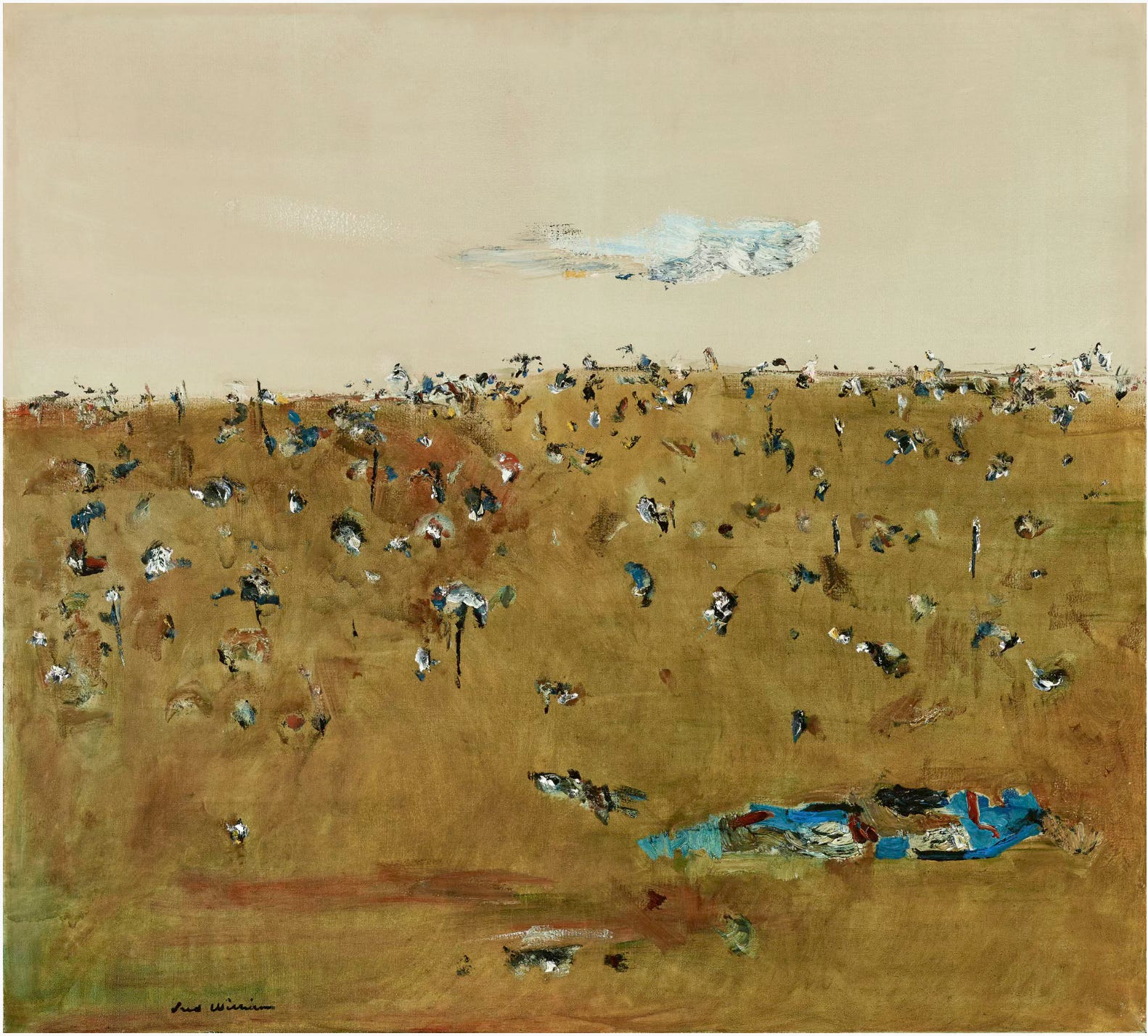
In January 1965, Fred and Lyn Williams returned from seven months in Europe, where they had pursued an exhausting schedule, absorbing more art than most travellers would see in a lifetime. Williams had won the coveted Helena Rubinstein Travelling Art Scholarship in 1963 and was determined to make the most of the opportunity. Fred and Lyn drove all over Britain looking at Gothic cathedrals, spent three weeks in Paris, and a solid two-and-a-half months in continental art museums.
The trip was a testimony to Williams’s voracious, broadranging appetite for art, even for medieval stained glass or classical sculpture, which bore no apparent relation to his own work. Whereas many artists visit museums looking for an idea they can adapt and use, Williams wanted to see everything, absorbing experiences that might never find their way into one of his pictures. This vast store of visual information makes it difficult to pinpoint influences, as Williams would work intuitively, painting in the landscape but drawing on his recollections of the art he had studied in museums.
In some of Williams’s pictures one may catch glimpses of Cezanne or Courbet, but his primary focus is the landscape itself. A barnstorming tour of Europe had confirmed his belief that Australian scenery represented a new, virtually untouched subject for a painter. Before setting off overseas he had been producing the most original and dynamic works of his career in the You Yangs series. When he got back, he simply picked up where he had left off.
Patrick McCaughey describes the moment in his monograph on Williams: “When he returned home in January 1965 it was as though he picked up the brush the morning after the last paintings of the year before. That says a lot about the nature of his art and the certainty of his direction. He literally carried his vision with him intact, feeding off his own art; one painting stimulating the next, one series provoking its counterpoint.” [i]
In the period from 1963 to 1968, Williams would reinvent Australian landscape painting, one innovation following another. The uncanny aspect of his work was the way it felt distinctively Australian, even though he had dispensed with all those recognisable features of the bush that had made artists such as Arthur Streeton and Hans Heysen into national icons. Both were given knighthoods for images that stirred local pride and love of country. They were the best of what a later generation of artists would derisively call “the gumtree school”.
At a time when abstraction appeared to be an unstoppable force, Williams was wary of associating himself with the traditions of nationalistic landscape but equally unwilling to abandon his connections with observable reality. His solution was to paint recognisable landscapes, drawing upon studies made en plein air, creating detail through gestural touches with a spontaneous, abstract appearance.
In pictures painted in the You Yangs, in Upwey and Lysterfield, Williams had dispensed with the last vestiges of the Claudean legacy. No heroic gum trees towered over his flat fields. No endless blue horizons shimmered in the distance. The trees in Williams’s paintings were small and straggly, hardly more than a swipe of the brush topped with a blob of paint. The grounds he preferred were usually brown or ochre, a far cry from those bucolic idylls where sheep grazed in grassy fields.
Williams’s scenes were instantly familiar, in a way that made Streeton and Heysen’s pictures look like stage sets. Williams had captured the flat, disorderly nature of Australian topography, in which trees and scrub fought for moisture under the rays of a burning sun. At first glance this was a harsh, featureless environment, but Williams had learned from his study of the old masters, how to instill a sense of rightness into paintings that flirted with formlessness.
His bestknown procedure was to lay two strands of piano wire across a canvas, dividing the picture plane into four segments. This showed how he should cluster his tiny dabs of paint to create the most subtle of compositions.
One can see this method at work in Pond in Landscape, where one strand of wire would have run diagonally from the top left-hand corner of the painting, just touching on the edge of the pond in the foreground, before exiting on the right-hand side, towards the bottom. The other piece of wire seems to have run from the top right-hand corner and exited towards the bottom on the left, grazing the right edge of the roughly brushed cloud.
There is an empty space where the wires crossed, and the faintest trace of a line that carves up the ground into proportions that echo the classical ratio of the Golden Mean. Indeed, if one were to superimpose the famous diagram of the Fibonacci Spiral over the rectangular plane of the earth, it’s an almost perfect fit, with the pond slotting into the area where the tip of the spiral turns in upon itself.[ii]
This is one way that Williams was able to impose a near-classical order on the rampant disorder of the bush. Such a precise underlying structure is the reason his paintings have a timeless dimension. The way Williams constructed a picture is not fundamentally different from how an artist of the Renaissance might have mapped out a fresco or an altarpiece. His revelation was that these methods worked just as well in depicting an Australian landscape devoid of the striking, dramatic features that attracted famous Romantics such as J.M.W. Turner or Caspar David Friedrich.
The modernity of Williams’s work asserts itself in the forms of the pond and the cloud, which mirror each other in the top and bottom planes of the picture, providing visual anchors for sky and earth. The artist has made no attempt to reproduce the characteristic textures of cloud or water, painting these features in the manner of an Abstract Expressionist, with crude swirls of pigment and brushstrokes left clearly visible. The cloud is not exactly white, but a dirty pale blue with a tinge of yellow and grey. The pond is a patchwork of blue, white, black, brown, and grey. It is not inserted into the earth but plastered defiantly on top of it.
Williams was not concerned with integrating the features of the landscape into a naturalistic vista. If it were not for the cloud, the sky in the painting would be a void, with none of the features we associate with the sky in a conventional landscape. Constable famously believed the sky to be “the chief organ of sentiment”, but in this picture, Williams has left the sky purposefully blank, as if to avoid symbolic or emotional connotations.
It’s the ground in Pond in Landscape that receives the bulk of his attention. The earth is loosely brushed in, with a thinned-down application of paint that appears darker or lighter in a haphazard manner. The deliberate lack of depth throws the black-and-white spots of paint that represent trees and shrubs into sharp relief. Williams has presented these features as a scattering of calligraphic marks written on the landscape.
One of the most seductive features of the work is the sheer physicality of this mark-making. It’s thrilling to follow the swipes and smears of the brush, the blobs of paint flicked spontaneously onto the canvas. The basic geometric structure of the work consists of nothing more than two rectangles, but the details are electrifying, as if a swarm of angry insects has descended on the dull, brownish expanse of the landscape.
For most artists, this dirty, washy brown would be a colour to avoid, but Williams knew it would serve as a perfect foil for the vivid black-and-white daubs of paint he would apply to the picture. He also knew the surface could be animated even more effectively by including the tiniest flecks of blue and yellow in the black-and-white mix. We don’t know whether this was a matter of calculation or instinct - simply going with something that ‘felt right’ or adding a detail the painting seemed to ‘need’.
With Williams, more than any other Australian artist, it’s impossible to find that point where the head dominates the heart or vice versa. In his recently published Diaries[iii] he reveals himself to be sceptical of art theory and of art with a political agenda. He comes across as a supremely practical painter, more concerned with the way a painting is made rather than subject matter, relying chiefly on the judgement of the eye in deciding what succeeds and what doesn’t. A theory for Williams was an airy, intangible proposition, but a technique could be tried and tested in the studio. If he stuck doggedly to landscape in an age of abstraction it’s because he believed that centuries of knowledge accumulated by artists should not be thrown away in pursuit of a fashionable new idea. Art may come and go, but the landscape would endure. In paintings such as Pond in Landscape he aspired to transcend art’s perpetual search for sensation and make works that seem as fresh today as they did in the 1960s.
FRED WILLIAMS
(1927-1982)
Pond in Landscape 1965
oil on canvas
96.5 x 106.5 cm
signed lower left: Fred Williams
inscribed verso: POND IN LANDSCAPE
[i] Patrick McCaughey, Fred Williams 1927 -1982, 2008 revised ed. (orig.1984), Murdoch Books, Sydney, p. 165
[iii] Patrick Mccaughey (w. John Timlin) ed. The Diaries of Fred Williams 1963-1970, The Miegunyah Press, Melbourne, 2025
Brilliant and enlightening. Thanks, John.
It’s so hard to describe what happens in a real work of art, but you’ve done it here. Williams seems to get under the skin of the country and you’ve slipped in alongside him. Wonderful!