

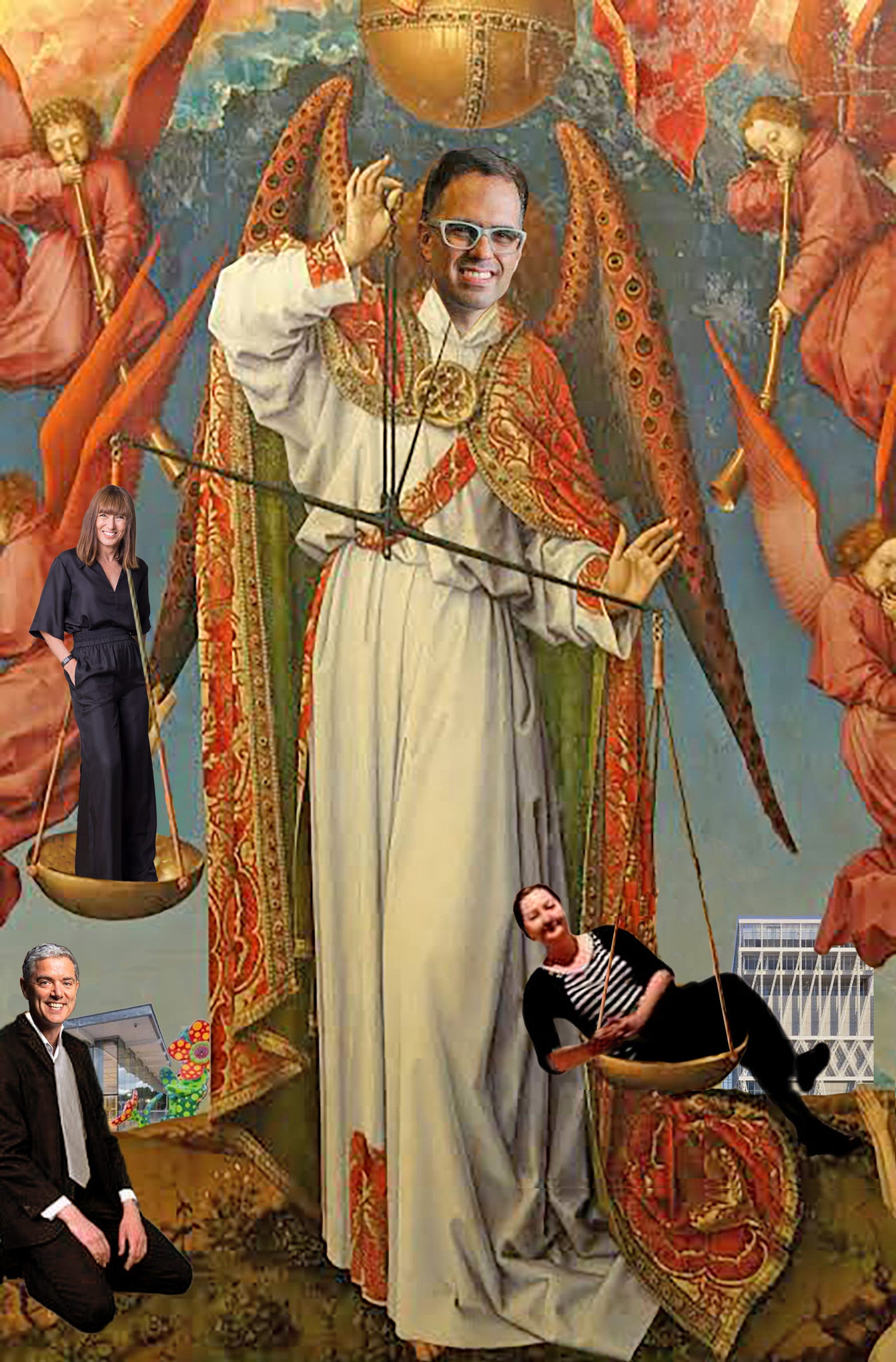
This year’s NSW State Budget reveals a government for whom the arts are no more than a means to an end: a short-sighted strategy for building electoral support in Sydney’s western suburbs at the expense of most of the state’s arts institutions, large and small. It’s not as if the Minns government hasn’t had plenty of warnings about the cynical and patronising nature of these tactics, or their potential to backfire massively. Labor has made a deliberate choice to ignore well-meant criticism. Instead, it has responded by doubling down on its follies, issuing self-serving press releases, and paying for propaganda articles in newspapers that should be writing investigative pieces.
We hear a lot of talk about ‘social cohesion’ from state and federal governments but when it comes to the arts, they seem determined to foster division. There are two aspects to this phenomenon that need to be isolated and skewered. First is the brainless, insensitive belief that the arts can be reduced to some form of social, political or community activity, with no consideration of aesthetic quality. The second is a dangerous readiness to underestimate the role of arts and culture as a means of mass communication.
The ruling idea is that the arts are a soft, feel-good, spongy sort of thing that may be used to demonstrate how much the government cares for young people, ethnic minorities, Indigenous Australians, and so on. Short of handing out cake, their preferred method of pleasing these groups is to put on street festivals and parties, to emphasise events in which everyone can hold hands and dance around in a circle, as opposed to boring museums in which visitors are expected to restrain their natural exuberance and quietly contemplate whatever is hanging on the wall.
The government’s emphasis is on action, not contemplation; on entertainment and participation, not education. We don’t need to know the history of anything, simply enjoy the experience of the moment. Much better a rave party than a retrospective.
The idea that some works of art may be better than others is implicitly viewed as elitist, if not colonialist and white supremacist. This even extends to a distrust of skill or competence. The belief seems to be that audiences are less interested in seeing something done well than in feeling pleased that anyone can be an artist, a musician, a poet or a dancer. It would be fascinating to apply this logic to the NRL or the cricket. Let’s put anybody out on the park on a Saturday and see how the fans love it.
We see this tendency at its most pronounced in the defunding and destruction of the Australian Design Centre, an organisation that existed for 62 years, providing an outlet for countless artists from all over Australia, while ticking every ‘inclusiveness’ box. Twenty years ago, the old Australia Council made it a policy objective to raise the status of the applied arts, which they saw as a community asset and a valuable cultural export. Their counterparts at Creative Australia and Create NSW have so little interest in this area that they have killed a thriving public platform, leaving Sydney as the only capital city in Australia without a crafts and design centre.
The crafts, more than other areas of the visual arts, put a premium on skill. Although one might get away with a clumsy, amateurish painting or sculpture which still has charm or expressive force, a badly made pot or textile will always look like an artistic failure.
And so we come to this year’s Budget, which is divided into five individual papers and a guide that explains how to read those papers. In terms of arts and culture, the most relevant summary is found in a separate document titled: Overview: Supporting families, securing our future. If you think that sounds like propaganda rather than hard data, you’d be close to the truth. The first thing we encounter is a colourful Indigenous painting called Regeneration by Josie Rose, “a Gumbaynggirr woman who expresses her Gumbaynggirr cultural heritage through art.” We are told the design “embodies both creative and cultural expression. The inspiration for her artworks comes from a deep place of spiritual connection to her family, community, culture and respect for Mother Earth.”
Josie also gives us a story to go with the picture:
“A long time ago in this place we know now as New South Wales, this place was known by many names. The names known by the people who tended the land and nurtured it as it nurtured them….” plus another three paragraphs. It’s a Creation story for New South Wales.
There follows a five-paragraph Acknowledgement of Country, which I’ll spare you. Next comes a truly scary picture of NSW Treasurer Daniel Mookhey, grinning through clenched teeth. From here on, the document is embellished with pictures of happy, smiling, multicultural families, workers, schoolchildren, dogs, police… Everyone looks simply ecstatic to be living in New South Wales. How fortunate we are!
The bare facts tell a less entrancing tale. The $1.21 billion expended on the “arts, culture and creative industries sector” represents a decline from last year’s $1.35 billion. If we factor in rising costs, the $140 million reduction becomes even more significant. Furthermore, the $1.21 billion includes $537.2 million devoted to capital works and infrastructure.
Most institutions must have realised that Daniel Mookhey, like the majority of his parliamentary colleagues, has zero interest in arts and culture, and pitched their claims at building projects. To please Arts Minister, John Graham, requests were tweaked to fit his pet obsessions. The State Library, for instance, is being given $22.5 million to develop its rooftop bar area (for parties) while undertaking necessary repairs. The Australian Museum will receive $2.4 million for what Limelight says will be “a new First Nations Gallery designed to present Indigenous histories and cultures through a community-led approach,” as well as digitisation of the collection and building maintenance. Another $9.5 million goes to Museums of History NSW for maintenance across various properties. One big winner is Qtopia, which receives $12.1 million to help turn the former Darlinghurst Police Station into an LGBTQI+ museum and cultural centre. There’s also $2.6 million for Walsh Bay and $2.2 million for Sydney Observatory (which is officially part of the Powerhouse).
[In the first version of this piece I’d written that “the Art Gallery of NSW will get $4.6 million for the ‘Naala Nura courtyard garden project’,” but the gallery tells me the project is fully funded by philanthropic donations, and that a “misleading implication” in the Budget Papers was fixed in Paper No.3, devoted to infrastructure. This means that the government gave even less money to the AGNSW than originally believed.]
When we subtract all the money spent on maintenance and infrastructure the Arts Budget is looking a little slender. I asked AI if the AGNSW or the Australian Museum had received any increase in their operational budgets for the coming year and was informed that both institutions had suffered a net decrease in their core budgets, the AGNSW dropping by 2.4%, and the AM by 4%. In the Budget papers these decreases are disguised by the funds allocated to capital works and infrastructure, but the decrease means less money for exhibitions, events and other projects. This is turn entails more belt-tightening, and more money needing to be raised from visitation, or from private and corporate sponsors.
This is the AGNSW’s reward for meekly accepting last year’s draconian cuts, which saw a substantial reduction in staff numbers and programs.
When we start to look at those areas where funds have been most generously distributed, it’s a predictable picture of the government’s ideological preoccupations. Along with capital works, these are the “key spending areas” this year:
Contemporary Music Strategy: $29.3 million allocated to Sound NSW.
Vibrant Precincts: $29.1 million for the Office of the 24-Hour Economy Commissioner.
Creative Communities: $26.8 million earmarked for programmatic rollouts.
Some decoding is in order:
Sound NSW is “a dedicated government agency within the NSW Department of Creative Industries, Tourism, Hospitality and Sport, committed to the growth, development, and promotion of contemporary music across New South Wales.” Please note, when the government talks about “contemporary music”, they don’t mean compositions by Philip Glass or Elena Kats-Chernin, they mean rock bands, hip hop, music fests, pubs and clubs. Their webpage is full of pictures of people on stage holding guitars.
The Vibrant Precincts program feeds into the “contemporary music” strategy, supporting “changes to the state’s planning system through a new State Environmental Planning Policy (SEPP). Its goal is to boost the night-time economy, support live music and arts, and reduce red tape for local cultural and community activities.”
When I read this, I thought of my local pub, which has been permitted to trade all night long, allowing people to drink, play the pokies and do drug deals to their hearts’ content until they decide, at perhaps 3 am, to leave this congenial environment. They get into their hotted-up cars, turn on the stereo full bore, and go roaring off down the street. As an added extra, prior to departure they might engage in a brawl or a foul-mouthed shouting match on the footpath.
The NSW government approved the pub’s application for extended opening hours because they were good for the local neighbourhood economy, although the only other business open at that time is the all-night service station. The rest of us are (boringly) trying to get some sleep. John Graham has apparently decided that sleep is not beneficial for the state’s vibrant night-time economy, but I just can’t get the hang of sitting up playing the poker machines every night.
As for Creative Communities, this is a much trickier proposition, being a 10-year ‘arts, culture and creative communities’ policy, with five pillars – just like the federal government’s National Cultural Policy! You’ll be pleased to learn that the first pillar is to Prioritise First Nations Culture – that beloved “First Nations First” principle that sounds so good on paper. The four other principles are: ‘Support sustainable growth’, ‘Advocate for culture’s value’, ‘Embrace the wider creative industries’, and ‘Global reach’. I’ll spare you the blurbs for these noble aims.
What’s important to recognise is that Creative Communities serves as a conduit for channelling funds into the Minister’s pet programs. It allows the government to direct money anywhere it desires, into the western suburbs, First Nations projects, or indeed, the night-time economy. If I were of a narrow frame of mind, I’d also suspect it allows for extra tax-payers’ money to be handed over, indirectly, to the Powerhouse, which will play host for a good deal of this activity.
As it stands, the Powerhouse is already one of the winners in the Budget, receiving a handy $207 million over the next four years to help pay for the monumental act of vandalism called Powerhouse Ultimo, which the government prefers to call a “revitalisation”. It’s a description that bears comparison with Putin’s “special military operation” in Ukraine.
The Powerhouse is the fulcrum of all arts funding problems in NSW. Over the past decade it has absorbed a gargantuan amount of public money with very little to show for it. When CEO Lisa Havilah was recently obliged to suspend her “Associates” program, which has handed at least $2.6 million to a small group of people with whom she had previously declared possible conflicts of interest, it was the first minor setback in what has been a campaign of pillage and plunder that puts Genghis Khan and the Mongols to shame. Nevertheless, I imagine it’s only a passing irritation, and Lisa will find ingenious ways to keep paying the people she likes. After all, most of them have lifestyles to support.
Not much ingenuity should be required, because – as this Budget makes clear – the government are right on board with everything she wants to do. What we don’t see in the Budget is the amount of money the state government is paying the Daily Telegraph to write puff pieces on the Powerhouse project. According to ever-helpful AI, the Tele has published hundreds of positive articles on Powerhouse Parramatta over the past decade. Some of these pieces are classified as Partner Content (ie. paid advertisements), but many are simply allowed to run as news, as part of a gung-ho “championing” of the western suburbs – where a large part of the newspaper’s readership resides.
Even when Powerhouse Parramatta finally opens later this year, it will be a hungry beast that needs to keep sucking on the public teat because most of Ms. Havilah’s programs and policies have a high probability of being unsustainable. The government persists in claiming the building will attract 2 million visitors in the first year, which is pie-in-the-sky, but even if it did achieve that feat, the numbers will plummet dramatically after everyone has paid a visit, while the running costs will keep clicking over like the meter on a distressingly long taxi ride.
Judging by the volume of propaganda we’re already seeing in the Telegraph and elsewhere, we can be sure that Powerhouse Parramatta will be acclaimed as a massive success for the first 3-6 months, or until reality bites.
It’s all part of the NSW government’s signature policy of punishing success and rewarding mismanagement. This has seen the most successful and well-run regional galleries suffer huge cuts or be defunded altogether. For meekly submitting to budget cuts and making do with less, the AGNSW gets a further cut. For bringing in audiences and working within budgets, the Australian Museum gets a cut. Let’s not mention the Museum of Contemporary Art, which should rightfully be in intensive care by now.
To sample how the more privileged institution is treated, I’m going to draw on only one set of figures former Powerhouse curator, Kylie Winkworth, has sent me, looking at Powerhouse Publications. In the 2022-23 annual report, we learn that sales from three publications earned a grand total of $13,000, against costs of $349,000, up from $211,000 in 2021-22. This doesn’t count the salaries of five people working in publishing. The following year, publications were down to two, at a modest outlay of $248,000, against sales of $12,000.
Even I can do these the sums. Over two years that’s $597,000 in costs minus $25,000 in revenue, for a total loss of $572,000. Not many state-sponsored organisations would be allowed to hand in such figures and continue to expect huge sums of money of public money, no questions asked. This example from one Powerhouse department is repeated across the entire organisation if one looks carefully at expenses versus revenues. The issue of salaries and many of the fanciful new roles and positions that have been allotted to people with no museum experience whatsoever, is worthy of a study in its own right.
The ‘arts and culture’ component of the Budget conforms to the same thinking that has characterised John Graham’s every move as Minister for the Arts. The overriding belief is that art and culture are phenomena that have value as a means of social control. It’s assumed that history and heritage are of no interest to the bulk of the electorate, so one need not spend money supporting traditional museums and art galleries. These old things can be left to gather dust in a corner, assisted by a few wealthy donors who haven’t kept up with the latest trends. The real funding priorities are lifestyle-and-event-generated: rave parties, festivals, rock or hip hop concerts, poetry slams, cooking classes, gardening, sport, sport and more sport. The most spectacular example may be Premier Minns’s Trumpian affection for UFC cage fighting, which he has subsidised to the tune of $16 million. At least he didn’t erect a huge stadium on Macquarie Street.
Lisa Havilah’s “vision” for the Powerhouse rings all the Minister’s bells because it dispenses with the institution’s charter and responsibilities as a museum. The Powerhouse is being reinvented as a venue, a function centre, in which exhibitions are of mere entertainment value. The new form of exhibition will be less concerned with scholarship or aesthetics, than responsive to all the things currently considered cool, from Indigenous knowledges to science fiction to celebrities. The major difference will be the expense, with a proposed show on shopping malls projected to cost 3-4 times more than the NGV’s Cartier blockbuster.
At the same time, this reinvention of culture is completely bound up with a doctrinaire version of identity politics that presumably proceeds from the Labor’s Hard Left faction, with which John Graham is aligned. This leads to that sacred obligation to put First Nations First which has seen such disproportionate amounts of money and space devoted to Indigenous projects of mediocre quality and minimal public interest. One unhappy side-effect is that this favouritism casts a demeaning reflection on the very best Indigenous art, allowing detractors to believe all Aboriginal projects owe their visibility to identity rather than quality. This is one way ostensibly ‘inclusive’ policies exacerbate social division.
The Minister has also been happy to allow the committees of Create NSW to be colonised by special interest groups who believe that only work of a particular political stripe is worthy of support. An event such as the Bankstown Poetry Slam, for instance, has become a funding favourite, even if some of the participants recite poetry that sounds remarkably like militant, offensive hate speech. It’s a ‘community’ event that helps mould angry subcultures.
The Night-Time Economy, another of Mr. Graham’s ministerial portfolios, has become inextricably entwined with the Arts. Millions of dollars of arts and culture funding are devoted to promoting this nebulous entity, which is supposed to make us feel excited that NSW is packed with vibrant nocturnal activities, even if it only means hanging out in pubs and clubs for ever longer periods. The greatest beneficiaries of this fabulous Night-Time Economy are entities such as lobby group, ClubsNSW, and the Australian Hotels Association, who have an active interest in promoting drinking and gambling. Under the guise of fun for all, there are big profits for groups who are willing to donate to any political party which looks after their interests.
Naturally, none of this rampant politicisation of the cultural sphere is recognised or admitted as such. It’s all hidden beneath of blanket of public welfare and well-being embroidered with little pink elephants and smiley faces. Decisions are allegedly made on the basis of quality although few might agree with the way this term is interpreted by the ‘experts’ and bureaucrats the NSW Government uses for its committees and assessments.
Mr. Graham and his minions obviously believe they are the supreme rulers of arts and culture in NSW, able to reward friends and punish enemies at will. In most cases they don’t appear to be motivated by any special animus – they simply don’t value organisations such as the regional galleries or the Australian Design Centre and feel no need to spend money in these areas.
But when it comes to the things the government truly loves, such as Powerhouse Parramatta, festivals in the western suburbs, ‘contemporary music’, or the night-time economy, there are no bounds to its largesse. It’s a breathtaking display of arrogance, that in political terms translates into a form of totalitarian behaviour in which the ruling party pays no attention to its critics or its victims; being ready break promises at will, or to mislead parliament and press, as has consistently been the case with the Powerhouse.
If there is a reckoning ahead, it won’t come from a zombie media, which has allowed itself to be snowed and bribed into submission. That corpse will only spring to life when this cavalcade of neglect and waste has finally careered off a cliff. The spectre on the horizon is the startling rise of One Nation, a group that is already displaying an unusual interest in arts and cultural funding. By ignoring the claims of the many for those of a chosen few, the government has provided a generous supply of ammunition for a populist party that will never be convinced by NSW Labor’s blatantly duplicitous spending priorities.
The Minns government should be able to understand that every virtuous act of “inclusion” is also an act of exclusion for those who don’t fit an approved set of ideological guidelines.
When the ranks of the excluded far exceed those of the chosen, this presents a volatile scenario for a disgruntled mass audience. By adopting a set of extreme, intransigent and undemocratic attitudes towards art and culture, the NSW government has left itself vulnerable to a growing political movement that doesn’t feel the need to hide its decisions behind a mask of hypocrisy. One Nation’s own brand of hypocrisy is as the voice of the common people, bankrolled by Gina Rinehart.
It would be ironic if the government became a victim of its own hubris for abandoning those people with an interest in the arts who habitually vote Labor, only to be invariably betrayed. This time the betrayal has been so far-reaching it has the potential to mobilise a popular audience who know nothing about art but have an absolute conviction that their taxpayer dollars should not be spent on projects that claim to be all sweetness and light but give off a sickly whiff of corruption.
But isn’t this just like a lot of government spending. A bunch of people with little knowledge
or understanding of the industry or area that they are meant to be working with and helping,
being heavily influenced by the loudest, best connected and most persistent lobby groups in the room. And then when they’ve really lost the plot putting a call into PWC or KPMG and asking for
“advice” from so-called “industry experts” who've magically anointed themselves as such
fifteen minutes earlier.
Great article John. Glad someone is exposing these rorts