

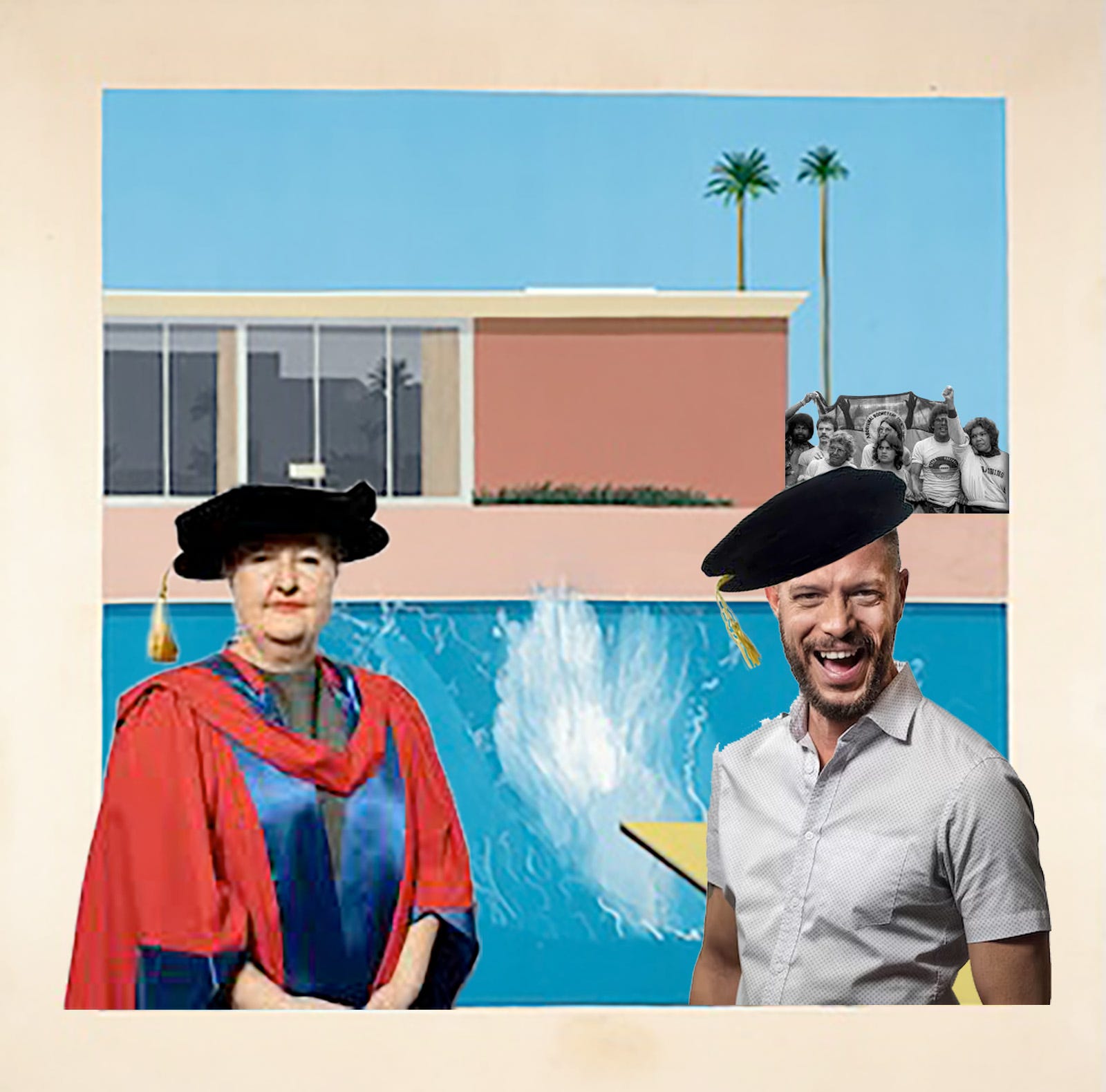
Over the past week I’ve been travelling and caught up with other work, but the longer I wait to post an editorial the more potential subjects keep multiplying. Firstly, there’s the death of David Hockney, arguably the last great modern artist known and admired by the general public. I met Hockney a few times, spending an afternoon at his house in the Hollywood Hills about ten years ago, but this is no great boast. Almost everybody met Hockney. He was garrulous, big-hearted, and so deaf as to be largely unimpeded by anyone else’s contributions to the conversation.
When he came to Melbourne for an exhibition at the National Gallery of Victoria in 2016, Hockney sat patiently all day, doing interviews with anyone who wanted to talk with him. He loved to talk, but he was also a true democrat who made no distinctions between a big media platform and a student newspaper. In this, he was the opposite of many well-known artists I’ve encountered, who might spare ten minutes for journalists or agree to one or two ‘exclusives’ with tame reporters or artworld sycophants.
Hockney’s huge show at the Fondation Louis Vuitton in Paris last year, which I was lucky to catch, was a fitting summation of his career. It was no surprise that some parts were much stronger than others, but the display of sheer creative energy was astonishing, as was the artist’s love of colour. One came away feeling staggered by his inventiveness and prodigious work ethic, uplifted by the sense of joie-de-vivre that runs through his career from start to finish.
Now that he’s gone it feels more painfully evident than ever that Hockney was the last great optimist in world art. He celebrated life in all its aspects, from the changing of the seasons to the glass of water on his bedside table. He smoked for pleasure, well aware that it was damaging his health and shortening his life.
It’s ominous that we’ve lost such a free spirit, such a stubborn beacon of positive thinking, at a time when contemporary art has grown bleakly political, moralistic and censorious. Hockney, who was also the most famous gay artist in the world, was the moral antithesis of an era that has turned sexuality and gender into an ugly jumble of legal and cultural proscriptions. He believed people should be free to smoke, and free to follow their own sexual inclinations. He wasn’t in the business of inflicting strictures and punishments on those with different opinions. In Hockney’ worldview, artists were better off staying in their studios and getting on with the job.
I couldn’t help but think of Hockney and his ‘live & let live’ attitudes when I returned to the topic I’d been trying to discuss for the past few weeks, while continually getting waylaid by other news.
It’s been over a month since I drove up to the wilds of Wahroonga to see Juno Gemes’s survey at the Grace Cossington Smith Gallery, at Abbotsleigh GSC. The show, Juno Gemes and Robert Adamson on the Hawkesbury River, was also a tribute to the artist’s husband, the much-loved poet who died in 2022. It included photographs from many different series, drawn from a career of more than 50 years, showcasing the publications Juno and Bob had worked on.
One of the couple’s most consistent preoccupations was the rights of Aboriginal people. Both husband and wife saw themselves as activists as well as artists, with Juno’s work in this area being collected into a hefty volume published at the end of 2024, titled Until Justice Comes: Fifty Years of The Movement for Indigenous Rights. Photographs. 1970-2024. It’s a landmark publication which documents every major event in what became known as The Movement – the battles fought by Aboriginal people for land rights, justice and welfare reforms, recognition and respect.
Juno was present at the protest marches in Brisbane during the 1982 Commonwealth Games, the march for reconciliation in 2000, the apology to the stolen generations in 2008, the handing back of Uluru in 2010, and virtually every other notable occasion in the recent chronicles of Aboriginal Australia. She has documented cultural initiatives in art, theatre and dance; and social initiatives in law, health, education and social justice. She has photographed many leading activists, from Chicka Dixon and Gary Foley to Mum Shirl and Maureen Watson. In fact, it’s hard to think of a notable figure in the broad-based field of the Movement that doesn’t appear in these pages.
As Professor Fred Myers writes, there is “something personal” in these photographs, which portray Aboriginal communities and families in a relaxed, intimate manner. Juno, who describes herself as “a fellow traveller”, won the trust of the people she photographed, creating unusually warm and positive images. She says she undertook this work because Aboriginal people were virtually “invisible” in the mainstream or portrayed in ways that emphasised their difference from the rest of Australian society. Juno literally ‘closed the gap’, removing the veils of exoticism and difference, revealing the essential similarities between black and white Australians.
When we see all those things we hold in common it’s much easier to understand that Aboriginal people have had a raw deal. Sympathy grows from a sense of shared humanity, a recognition that for decades, Aboriginal protesters have been fighting for goals that merely brought them in line with things the rest of Australia took for granted.
Having accepted the need for equality and an end to discrimination based on racial stereotypes, the next phase was to acknowledge those unique aspects of Aboriginal culture that need to be preserved and nurtured. Here, the most important development has been the growth of an Indigenous arts industry which has met with huge national and international success. It’s a recognised fact that mainstream Australia is willing to drop all its ingrained prejudices when a fellow Aussie of any creed or colour does well on the world stage. This applies to Aboriginal athletes such as Evonne Goolagong Cawley and Cathy Freeman - or Nestory Irankunda, born in a Tanzanian refugee camp but now the Socceroos’ pride and joy. To a certain extent, this sense of national pride also applies to artists such as Emily Kame Kngwarreye and John Mawurndjul.
From here it’s easy to allow Aboriginal creation stories a place on the school curriculum, as part of the broader history of this country. There has also been a general acceptance of the signs and symbols of Aboriginal identity, such as the flag designed by Harold Thomas, which – aesthetically speaking – is a big improvement on the official national flag.
I dare say most people were even willing to accept the ceremonial value of the ‘Welcome to Country’ and other acknowledgements, until those rituals began to get out of hand, with every speaker on a program eager to display their own virtuous sentiments. Nowadays, a practice that began with good intentions too often devolves into a festival of hypocrisy in which those who may have never spoken with an Indigenous person swear their undying love and esteem.
This kind of symbolic acknowledgement has become a sacred obligation in official circles, but its main attraction may be that it absolves authorities from having to do anything practical to improve the living conditions of Aboriginal people. It’s cheaper and easier to waffle on about how much you adore the elders rather than deal with chronic problems of health and housing, the incipient violence of many communities, and the difficulty of making school more attractive to kids.
It was bad enough when mainstream white society embraced this trend towards ‘symbolic’ action – “signs taken for wonders,” to use T.S. Eliot’s phrase. Even worse has been the tendency of a new generation of Aboriginal activists to use the rhetorical overkill as a springboard for political statements and actions that don’t bring black and white Australians closer together but threaten to undo all the sympathy and support built up over previous generations.
And so it is, we arrive at an online publication such as Blue Art Journal, which has been supported by a “major grant” from Creative Australia, by Sydney University and the Australian National University, as a first-ever local publication dedicated to Australian and international First Nations art. There’s no question this is a worthwhile basis for a new journal as there are hundreds of academic publications devoted to more obscure topics. The controversial aspect is that Blue Art Journal, so far, appears to be open only to Indigenous contributors.
In the words of Daniel Browning, formerly of the ABC’s Radio National, now inaugural Professor of Indigenous Cultural and Creative Industries within the School of Art, Communication and English at Sydney University: “At long last we collectively get to decide what language is used, and how the critique is framed – the record that is made of the work that is being done by the keepers and creators.”
It’s that “we” which should give us pause. It is obviously meant to signify self-determination for Indigenous writers and artists, freedom from oppressive norms imposed by non-Indigenous editors and publishers. But in a milieu in which government arts policy is dominated by the principle of ‘First Nations First’, this cry of freedom sounds unconvincing. Today, most arts institutions go out of their way to support Indigenous projects. The very existence of the new journal or indeed, of Daniel Browning’s professorship, suggests that Indigenous culture is no longer suffering quite so grievously from discrimination or marginalisation.
If we were to analyse the last year’s tally of successful grant applications and the make-up of exhibitions in public galleries, the obvious conclusion would be that Indigenous artists are doing commensurably better than say, Jewish or Chinese artists, let alone that despised category of Old White Blokes.
If we go on to ask who are the writers and curators that have made the most outstanding contributions to the greater acceptance of Indigenous art, we can’t overlook names such as Howard Morphy, Fred Myers, Judith Ryan, Vivien Johnson, Wally Caruana, Luke Scholes, Ian McLean, Peter Sutton, and so on. We also need to acknowledge the efforts of photographers such as Juno Gemes and Penny Tweedie, and many of the great photographers of the past. None of these figures are Indigenous, but their contributions to public awareness of Indigenous culture have been monumental.
I’ve already written about Clotilde Bullen’s essay, ‘Seeing Ourselves: The power of critical Blak arts writing’, in the first issue of Blue Art Journal. It’s a piece that complains about having to use “the language of the coloniser”, but offers no solutions, giving the impression that ‘Blak art criticism’ must always be profoundly supportive rather than critical, with value assigned by a group of gatekeepers.
Given the propaganda and clubbish implications of this proposed form of “criticism”, it was fascinating to learn that the freshly minted Professor Browning had taken Bullen’s text as foundational for a lecture called ‘The Critic’, delivered at the Samstag Gallery on 27 February, in association with the 2026 Adelaide Biennial.
As the Art Gallery of South Australia, for the first time in decades, didn’t invite me to fly down and review the Biennial, I wasn’t on hand for the lecture. I subsequently asked Samstag if they had recorded the event or could provide a transcript but have yet to receive a reply. So rather than delay any longer and be met with further silence and obfuscation, I’ll draw on a report of proceedings I received via email. My correspondent writes:
Professor Browning proposed that only Indigenous writers (using the now de rigueur designation ‘Blak’) should write about Indigenous art and artists, and that non-Indigenous writers should not write about Indigenous art because they “don’t understand it”. And meant facetiously or not, that “old, white men” should not write at all; they were critical, too critical.
It was clear to this writer that Professor Browning, although he coyly refrained from identifying his targets, had one particular “old, white man” in his sights - namely one who had criticised Bulleen’s essay for its failure to establish any significant principles of criticism.
Although every mainstream cultural event in this country begins with a fulsome appreciation of Aboriginal elders – past, present, future and emerging – it seems that this sentiment is not reciprocated. It’s ridiculous enough to sneer at someone for being “old”, when there’s roughly ten years in age difference. Does Professor Browning, now in his 50s, consider himself a whippersnapper? The voice of a younger generation? It’s positively jaw-dropping to find an Indigenous speaker using “old” and “white” as terms of abuse. Imagine the outcry had I stood up and said some “old, black man” shouldn’t be given an academic post!
To use age or race as a way of sneering at someone with whom you have a disagreement is a pathetic tactic under any circumstances. To do so in a public forum in these woke days, while taking it upon oneself to speak on behalf of Indigenous Australia, is an act of intellectual cowardice. If I am mis-characterising Professor Browning’s remarks, I’d love to hear from him. As I haven’t been permitted to listen to his lecture it’s always possible I’m on the wrong track.
If Professor Browning did say such facile and insulting things, even for a cheap laugh, what does that reveal about the quality of his thinking, or the way he is approaching his new role at Sydney University? Does the university endorse this kind of public comment?
As for ‘Blak’ criticism, I don’t recall Clement Greenberg stipulating that only white Jewish intellectuals living in New York should be allowed to write about Abstract Expressionism. I don’t recall the leading feminist critics saying men should not be permitted to write about women’s art. Surely the point about criticism is that it needs to be inclusive of many viewpoints, with writers willing to argue their corner rather than accept an imposed orthodoxy. It’s one thing to say we need more black critics to write about Aboriginal art, more female critics to writes about feminist art, and so on, but not that others should be excluded. This is the logic of cancel culture. Criticism needs to be a constant conversation, an argument, a debate – not a closed shop. When entrance to that shop is determined along racial lines it sounds suspiciously like a form of Apartheid.
This attempt to build a wall around Indigenous art, dividing writers into accredited insiders and illegitimate outsiders is utterly contrary to the spirit and practice of criticism. It is an exercise in insularity and empire building. As a tactic, it undermines any attempts to broaden the acceptance base of Indigenous art: it asserts that only Aboriginal people can understand this work or write about it. The art becomes shrouded in mystique, an aura of exclusivity. The only role for the rest of us is that of consumers. We are expected to buy these mysterious works and give grants to the ‘Blak’ writers who tell us what to think.
This is completely at odds with the spirit in which so many Aboriginal artists speak about their work. One of the most common things one hears from artists in the communities is that their work is intended to help the whitefellas learn about their culture and respect it. I’ve yet to hear any artist add the proviso: “if that’s OK with the Blak critics”.
Neither is this the only occasion on which Professor Browning has held forth on the subject of “criticism”, having hosted a forum at Sydney University on 30 April, called Parallax: Art criticism and the 2026 Biennale of Sydney, which featured five writers, but nobody, as far as I know, who had posted anything especially critical of the Biennale. Professor Browning acted as moderator.
This is yet another event which has not been made available online. If the Power Institute or Chau Chak Wing Museum has a recording or a transcript, I’d love to hear about it.
The difficulty of locating these bold political statements online reminds me of the way Lisa Havilah, CEO of that monster we call the Powerhouse, insisted that Samstag remove her public talk of 2021, ‘Unmaking the Institution’, in which she outlined her ideas about how to “break” a museum with breathtaking candour. That act of public disclosure, quickly taken down from the site, gave a good indication of the vandalistic policies that would soon be put into action. It seems Professor Browning has taken note of this faux pas and made sure his more provocative comments remain strictly between friends.
As for Lisa Havilah, even though the NSW government is already spending a fortune hyping the opening of Powerhouse Paramatta later this year, she suffered a minor reversal last week.
You know things are looking grim when the Sydney Morning Herald, which can normally be relied upon to publish gushing praise of the Powerhouse project, reports that Ms. Havilah has had to discontinue the “Associates” program which has channelled $2.6 million of taxpayers’ money into the pockets of a handful of her friends and colleagues - including artist, Agatha Gothe-Snape; celebrity chef, Kylie Kwong; photographer, Zan Wimberley; novelist, Ceridwen Dovey, and former publisher, Julie Gibbs - after a parliamentary inquiry called for “greater transparency and accountability”.
The “associates” rort is old news. The new revelation in Linda Morris’s story was: “Conflict-of-interest documents that were released show chief executive Lisa Havilah declared prior and current professional relationships with Wimberley, Gothe-Snape and two other associates in January 2022.”
In other words, for the past four years, Ms. Havilah has been handing very large sums of money to four people with whom she had declared conflicts of interest.
Should we be surprised that the CEO is now refusing to comply with an SMH Freedom of Information request.
“Citing prejudicial business interests, private information and commercial-in-confidence in its determination, the museum rejected the public interest argument for a full breakdown of the trio’s remuneration. That decision is now under appeal. The museum also stated disclosure would expose them to the ‘risk of harm or of serious harassment or serious intimidation’.”
This excuse is also worthy of scrutiny. The Powerhouse is claiming that to disclose the amount of money given to Gothe-Snape, Kwong and Wimberley, along with a description of what they actually did to earn such bountiful remuneration, would expose the poor things to the “risk of harm or of serious harassment or serious intimidation.” From whom? The curators? The angry proletarians of the western suburbs? One Nation supporters? Indignant tax-payers? Maybe Ms. Havilah is merely thinking of legal harm or harm to their reputations. It may be best if that determination were left to the Independent Commission Against Corruption. With the ‘Pink Ladies’ story of corrupt and self-serving activity within the City of Parramatta Council being widely ventilated in the media, it might be worthwhile looking into another piece of local infrastructure.
If I can say one thing in defence of Professor Browning’s apparent unwillingness to expose himself to public scrutiny, it’s that he doesn’t seem to have been handing out millions of dollars to his “associates”. In fact, the professor’s probity and integrity are so highly regarded he has just been appointed to the Board of the Adelaide Festival, where he may be relied upon to prevent scandals such as the implosion of Writers’ Week 2026 that followed the cancellation of Randa Abdel-Fattah’s involvement. I’m only guessing, but I suspect Professor Browning would be right behind Ms. Abdel-Fattah and other notable ‘decolonisers’. He might also make sure that no “old white men” sneak onto the program and lower the tone.
What I don’t get is the enormous difference between the up-front way a previous generation of Aboriginal activists conducted themselves on the soap box, and today’s preference for saying snippy things in discreet addresses hosted by sympathetic institutions. Those earlier activists were mostly free agents with hardly a dollar to their names. Today’s new breed of spokesperson seems to be a highly paid professional or the recipient of generous public funding. The activists of the past argued for land rights, healthcare, justice and welfare, but their successors are preoccupied with theoretical concepts such as ‘decolonisation’. The earlier activists fought hard to overcome government intransigence, their contemporary counterparts benefit from a cultural regime that has taken ‘First Nations First’ as its motto.
It hardly needs pointing out that the grass roots battles fought by The Movement Juno Gemes documented so thoroughly, bear little resemblance to the tortuous political obsessions of the present. The awards, titles and institutional credentials may be more impressive, but the heart and soul have gone astray.
My most recent posts have been a second and final look at the Biennale of Sydney and a review of the impressive German arthouse film, The Sound of Falling. Having not been invited to participate in Professor Browning’s Sydney University forum on ‘Art Criticism and the 2026 Biennale of Sydney’, I had no choice but to write another piece for my own site. As for The Sound of Falling, it has nothing to do with the current state of arts bureaucracy in Australia, where there is not much falling, but a great deal of rising. I’d like to think it may not be that way forever.
Throwing those heavy drapes WIDE open again. I absolutely love reading about this stuff and pointing my friends to your analyses. Why aren't any ABC journalists picking this up? I'm guessing most 'taxpayers' wouldn't have a clue what's going on. The hypocrisy is gob smacking. (Oh - don't worry, I think I've just answered my own question...)
Don't feel personally excluded by Prof Browning, John. He long ago made a point of excluding my writing on Aboriginal art when guest editing the annual Artlink Indigenous issue.
And you missed the great man launching Blue in Sydney, where he revealed that criticism of the APYACC mob was racism. Apart from that, it emerged that the Blak world doesn't really need its Black origins any longer.