

Less than a month into the year, the cancellation of Adelaide Writers Week has provided a prime example of the way the Australian arts ‘community’ (for want of a better word), is poisoning itself with politics. It’s the cultural equivalent of smoking a carton of fags a day – an addiction that will destroy your health and wellbeing, making you the kind of person everybody else wants to avoid. When it comes to audiences, the political tub-thumping is a distinct turn-off.
I say this in full recognition that we are political beings, and a vigorous exchange of views is part of the lifeblood of any liberal democracy. What we’re seeing in the arts is something quite different: a fiesta of intolerance and ideological rigidity. There are issues such as climate change that tap into widespread public concerns, but the angry “antizionist” push is purely divisive because the overwhelming majority of Australians are oblivious to hair-splitting distinctions between ‘anti-Zionism’ and ‘antizionism’. According to one of my readers, “One is a conversation about Jewish statehood, the other is bigotry”. In practice, both are used as a thinly disguised code for antisemitism – and this, just like Islamophobia – is a place where culture goes to die.
It’s a tired observation that the tendency to judge artists not by their work but by ethnicity, religion or sexual preferences, has generated negative reactions, creating rifts where none previously existed. Yet even this doesn’t explain the moral confusion and lack of open-mindedness on display in Adelaide.
Australia’s arty types urgently need to remember Kant’s categorical imperative: Do unto others as you would be done by. In other words, try affording your perceived opponents the same consideration you claim for yourselves in this laidback country. Part of the public grief and outrage over Bondi was the thought: “Such things don’t happen here!” The rising level of aggression and hatred that goes under the banner of ‘free speech’ only makes it more likely that such violent acts will occur with greater frequency.
My recommendation to anyone consumed by the traumas of the Middle East is to remember there are many other subjects that invite attention from artists. For instance, when did engaging with nature become less important than political activism? Where politics can be narrow and toxic, nature is expansive and inspiriting. If you’re feeling exhausted from shouting slogans at demos, try a week in the bush to restore a sense of proportion.
I was impressed by the ecstatic feedback that followed a review of Mary Tonkin’s show of bush landscapes at the S.H. Ervin Gallery recently. It felt as if this was exactly what people had been hanging out for. Likewise, there has been a huge response to the first iteration of the Australia China Art Residencies Art Prize, which has taken landscape as its theme, partly as a way of avoiding politics, but also because it’s a subject that unites the Australian and Chinese artists who are taking part. It may be a cliché, but the Earth is our common inheritance, regardless of how we choose to divide it up into nations or private property. To be human is to be part of the natural world long before we are adherents of any creed or country.
The history of civilisation on this planet has been a war on nature we’ve only recently begun to recognise as a war on ourselves. For a thousand years we’ve been firm in our belief that we are not an organic part of the natural world, but its masters. For the environmental historian, Donald Worster, this is the difference between Arcadian and Imperial ecology. The latter views the natural world as a kind of factory turning out goods for human consumption - and this is still the ruling idea of our time, as we continue to burn fossil fuels and drive other species to extinction.
In the past, the sheer abundance of nature seemed to promise an endless harvest, but industrial progress and population growth have seen us burn through resources at an alarming rate. In the early Middle Ages, the ‘green and pleasant land’ of England was one big forest. Nowadays the jungles of the Amazon are disappearing just as rapidly.
Artists and writers have always been in the forefront of the Arcadian view of ecology. William Blake mocked the progressivist idea that a ‘New Jerusalem’ was being created by the “dark, satanic mills” of the Industrial Revolution. Wordsworth showed his contempt for science when he wrote: “We murder to dissect”.
For more than ten years I’ve been involved on a voluntary basis with a project of the Australian Wildlife Conservatory that has taken 24 artists to four remote locations around Australia. The artists have made work that was exhibited and sold a year later, raising funds for the organisation. Almost a million dollars has thereby accrued to AWC coffers.
These trips, which I’ve been able to share, have been the among the very best experiences I’ve had in decades of writing about art. The fifth and last excursion saw six artists spend a week at Newhaven, an AWC property on the edge of the Great Sandy Desert. Those artists – Sophie Cape, Nicolette Eisdell, Pamela Honeyfield, Michelle Hungerford, Charmaine Pike and Ana Pollak – made work for a show held at Sydney’s Defiance Gallery last September. For the first time, a version has travelled to Victoria, where it may be seen at Sofitel Melbourne on Collins for the next couple of months.
The exhibition has been undertaken in the spirit of charity, largely thanks to Emily Choo, Senior Partnerships Manager, and Clive Scott, Arts Ambassador Sofitel, who have been instrumental in bringing the hotel on board, affirming a longstanding connection with the visual arts. The paintings are for sale, with the money going back to the AWC. In brief, it’s a project on behalf of endangered Australian species, for which everyone has given freely of their time and effort.
I’ve written about the AWC projects on many occasions, but after spending a year observing the skewed priorities of the local art scene I feel a greater urgency about this topic. Conservation is an issue everyone can get behind, not one that causes sharp divisions. Within an expanded understanding of the landscape genre, artists make works that respond to a particular environment, celebrating the need for wilderness in a world given over to the Imperial view of ecology.
Wilderness, almost by definition, is land untouched and unspoiled by human agency. The AWC is trying to return substantial parts of Australia to the conditions that existed before feral cats and other invasive species wreaked havoc on age-old ecosystems. They are restoring populations of marsupials brought to the brink of extinction, and reviving fragile environments damaged by cattle and camels. For these sanctuaries to exist, the AWC has to own the property, ensuring that it can’t fall into the hands of mining companies or cattle stations. At Newhaven, the AWC works in collaboration with the traditional owners, the Ngalia-Warlpiri, on the removal of feral animals and fire management. It’s a partnership that works to the benefit of both parties and the land.,
The Judeo-Christian tradition has bequeathed us a negative view of wilderness – being the wasteland in which Moses and the Israelites wandered for 40 years before reaching the Promised Land, Canaan – nowadays the lands of Israel and Palestine. The wilderness was a testing ground for the Israelites’ faith and belief, and they came perilously close to blowing the whole thing.
The idea that wilderness – be it desert or forest – was merely an obstacle to human progress, only began to be questioned during the Romantic era, notably by Jean-Jacques Rousseau, who had lofty ideas about ‘the state of nature’. But it would not be until figures such as Henry David Thoreau and John Muir came along, that the idea of preserving wilderness for its own sake became a serious proposition. Thoreau’s famous line of 1851, “in Wildness is the preservation of the world”, was an intensely radical idea, going against the grain of an era of rapid expansion and development, in which the pioneers established themselves as folk heroes.
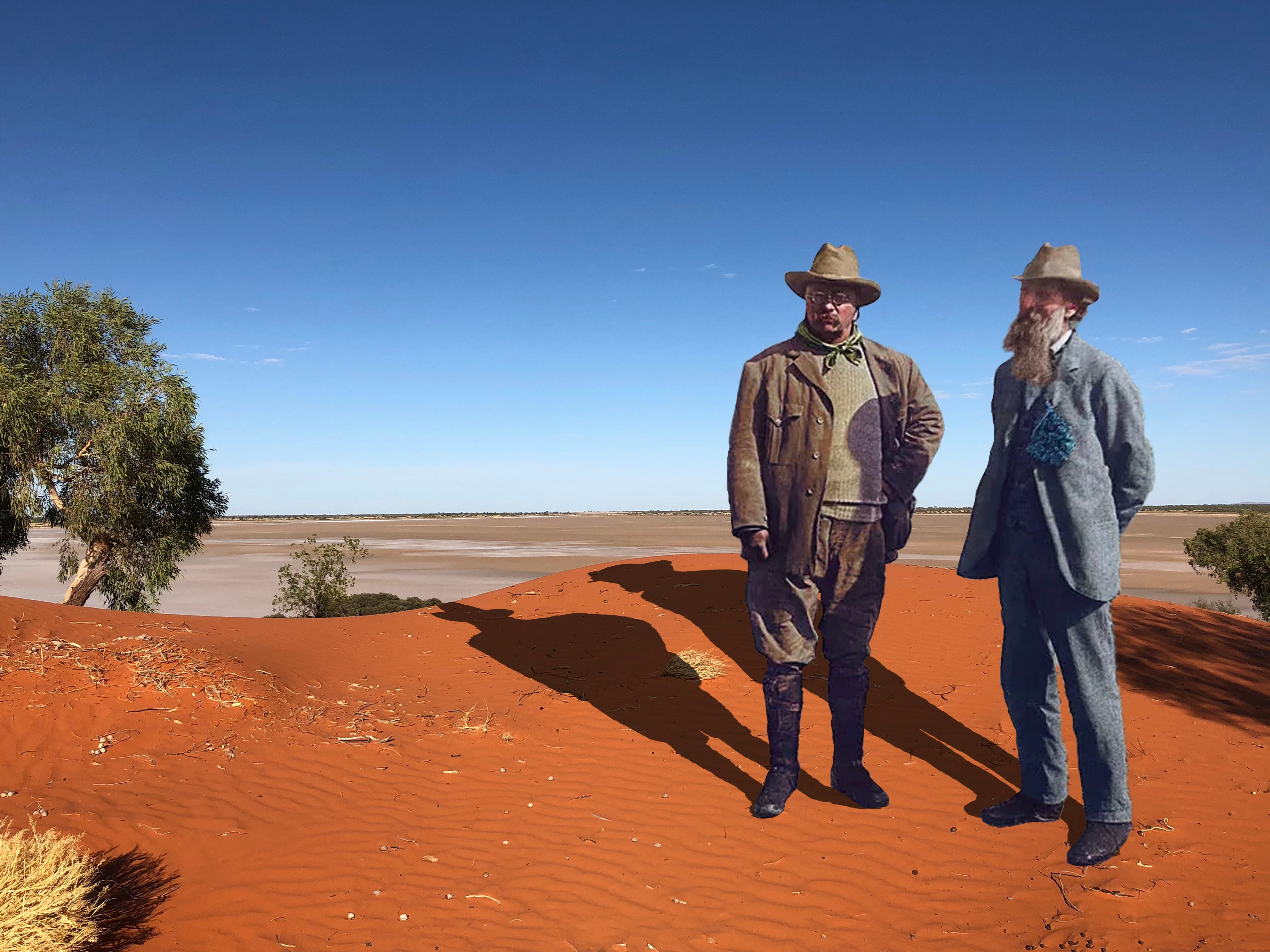
Muir (1838-1914), who played a leading role in the creation of America’s first great National Parks, saw nature as a temple, sacred to God. He was a vehement opponent of the materialism that most Americans embraced as the key to achieving national greatness.
It’s been 136 years since Muir and Teddy Roosevelt gave us Yosemite National Park, and in that time the exponents of wilderness have fought a losing battle against the forces of rampant development. Today we are probably no longer at a crossroads, but beyond a crossroads, in which environmentalists are scrambling to save what they can from the wreckage. Every year brings higher temperatures, catastrophic floods and fires, the shrinking of the Amazon and the polar ice caps. The new ideal of a ‘Promised Land’ is not a fertile region that can be cultivated and exploited, it’s a place where humans do not tread, or at least, where a small population of Indigenous people have found ways of living in harmony with nature.
Scientists agree that the health of the planet requires such areas of wilderness, where biodiversity can flourish. This is the mission of organisations such as the AWC, and it should be far more attractive to artists than the angry political wrangles that are turning the cultural arena into a battlefield. A more desirable metaphor would be a garden, perhaps a wild garden.
What distinguishes the artists in the show at Sofitel on Collins, and Mary Tonkin at the S.H.Ervin Gallery, is a willingness to “go to Nature in all singleness of heart”, as John Ruskin advised in his magnum opus, Modern Painters, “and walk with her laboriously and trustingly, having no other thoughts but how best to penetrate her meaning, rejecting nothing, selecting nothing, and scorning nothing.”
Ruskin’s prose was often a deep shade of purple, but he was capable of flights of eloquence and was never anything but sincere in his beliefs. It’s that kind of sincerity, the direct experience of nature, which has such value and profundity for artists.
Some will argue that artists can be political partisans and lovers of nature at the same time, but few of us can realistically balance two extremes within our psyches. Others simply dismiss activities such as landscape painting as relics of another era.
John Berger, perhaps unwittingly, sparked a reaction against landscape in Ways of Seeing when he analysed Gainsborough’s Mr and Mrs Andrews, as a celebration of private property. It’s important we recognise that landscape today is less concerned with private ownership of a piece of land than collective responsibility for the fate of the planet. Talk to any dedicated landscapist and it’s clear they are thinking of the bigger picture, not one small corner. They are concerned, as Ruskin advises, with the “meaning” of nature, even if they have no answers that may be expressed in words. The solution lies in what they put on canvas or paper, although it’s a solution that seems to change from day to day, like the weather. The greatest works of art are born from uncertainty rather than ideological conviction. When we approach a subject in a spirit of curiosity, struggling with our own doubts, we are more likely to produce a work of value than when we set out to signal allegiance to a fixed concept. Most works of political art are created with a moral purpose and thoughts of an audience, but landscape can be a journey of exploration in which the artist serves as their own audience and critic.
To be lost in the wilderness is to find ourselves separated from our beliefs and convictions, being prepared to ask fundamental questions about the most important things in life. The psychologists speak of a phenomenon called ‘The Wilderness Effect’, which says that spending two or three days in a natural setting has a positive impact on our mental and bodily health. Spend two to three weeks, and the benefits are allegedly multiplied. But who has the time? For me, a week is an optimum communion period. Were I to spend three weeks in the bush, I’d be pining for my books and laptop.
With the Newhaven trip, Kathryn Millis and Anna Howard have made a documentary which is screening with the show. It reveals how the experience of a week spent working in this remote landscape had a powerful emotional impact on the artists. Private traumas rose to the surface and were dissipated by the steady, solitary engagement with the landscape during the day, and the company with others in the evenings.
The lesson of Newhaven is that the artist’s ideal experience of nature is one of inwardness. It’s the antithesis of being part of a crowd in which everyone seems to share the same mind. A stint in the wilderness encourages self-awareness, and that’s something we desperately need to cultivate before AI does all our thinking for us.
The art column this week looks at Ron Mueck: Encounter, at the Art Gallery of NSW, a show of 15 figurative sculptures, some exceptionally large, others tiny. I’m no longer surprised by anything from this artist, but if you’ve never experienced Mueck’s work close-up, you’ll be astonished by the fastidious detail and the strange, sad aura these works possess. The film being reviewed is Park Chan-wook’s No Other Choice, a black comedy about a middle manager in a paper factory who loses his job and plots a novel way back into the workplace, over the dead bodies of his peers. In the age of AI, it’s ‘kill or be killed’ - an excellent reason to get back to nature.
The greatest works of art are born from uncertainty rather than ideological conviction. When we approach a subject in a spirit of curiosity, struggling with our own doubts, we are more likely to produce a work of value than when we set out to signal allegiance to a fixed concept.
So true!👍
Wonderfully succinct article John. Goes to all I have been attempting for the last ten years.