

We’re only a week into 2026, and the shockwaves are already spreading. Nobody is lamenting the downfall of Nicolás Maduro, but the manner of his unseating should make everybody nervous. It’s almost unthinkable, but we’re watching the United States revert to the Age of Imperialism – when the great powers took it upon themselves to conquer and exploit the weaker nations, spreading their version of ‘civilisation’. The major difference this time is that Trump has been brazenly honest in admitting it’s a grab for Venezuela’s oil reserves. Unable to sustain the fiction that he came, like Simón Bolivar, as a “liberator”, he’s already talking like a gangster, threatening anybody who stands in the way of his big takeover.
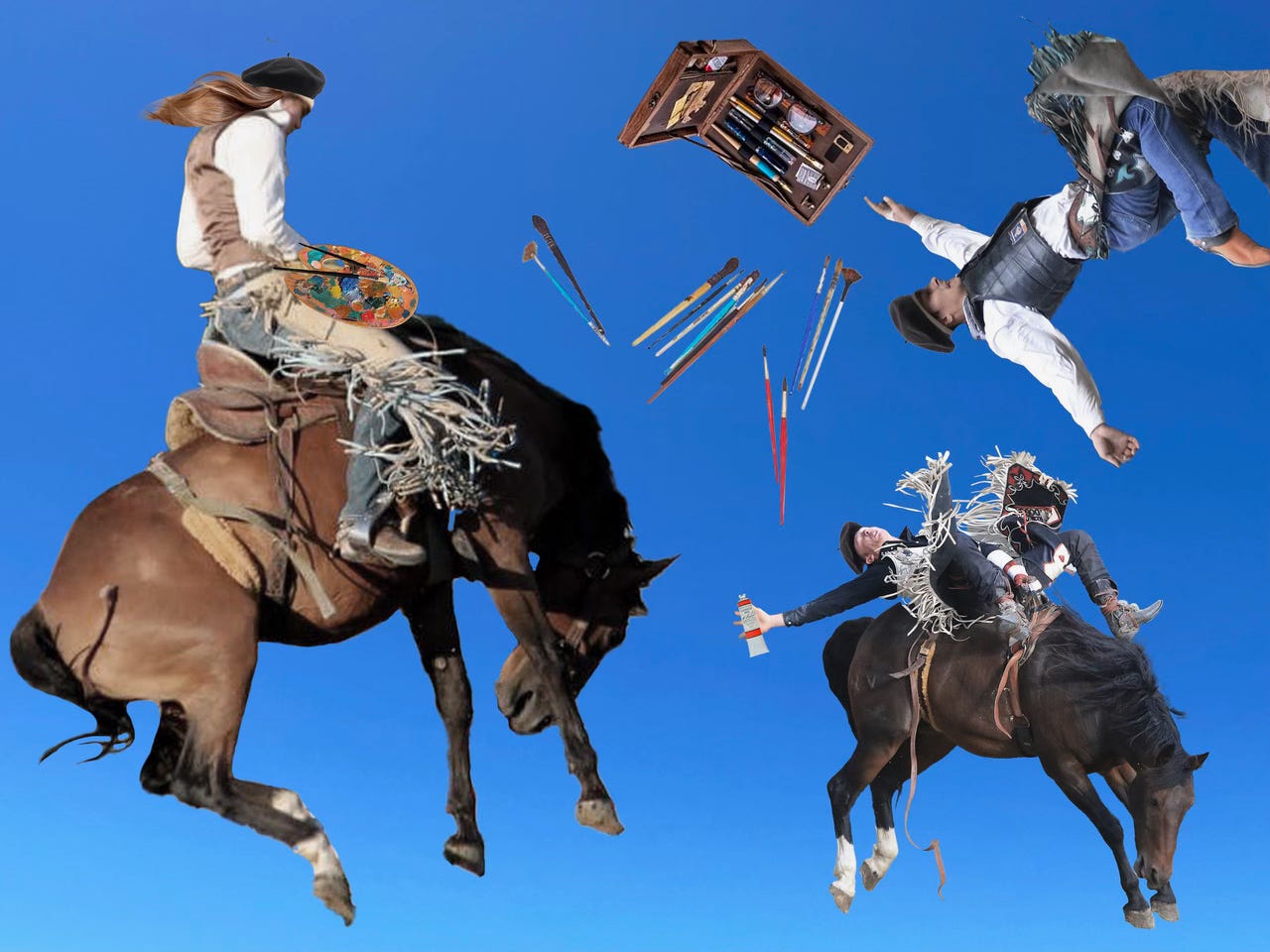
2026 is the Lunar Year of the Horse but it’s shaping up as a bucking bronco. We may find ourselves hanging on with white knuckles as the political and economic outlook grows more unstable.
Faced with such terrifying portents it feels almost frivolous to ask: “Where does this leave artists?” Nevertheless, that’s precisely what I’m going to explore, as this site is chiefly dedicated to the cultural perspective – or rather, to arguing that culture is one of the essential aspects of life. Although politicians seem to believe it’s an easier target for cuts than health, welfare or education, (let alone sport), when culture is diminished the whole quality of life suffers.
I don’t know if artists should be comforted by the thought that the arts tend to flourish in times of repression and instability, but the new year is sure to generate a wave of artworks responding to the political and moral challenges of our times. Amid a volume of banal demagoguery, the best and smartest practitioners will rise to the challenge.
Whatever political issues occupy the spotlight this year, for artists the biggest threats will probably come from a contracting market. While works of art may not be directly affected by Trumpian economics, many wealthy collectors will view art as a luxury they cannot afford. As the financial outlook tightens, the commercial galleries will be among the first businesses to feel the pain.
This will hasten the migration of the art market online – a trend that’s already accelerating, as a new generation of collectors feels no special need to view the actual work before they buy. The danger in this approach is that the best works often photograph poorly, while mediocre ones look brilliant. Do these online daredevils care? Probably not.
From the dealers’ point-of-view, it will be harder to justify the cost of rent and staff. Some will consider closing their galleries and acting as agents, hosting occasional pop-up shows. Artists will feel the pinch in having to balance slender sales against the costs of materials, studio rental, framing, photography, transportation and storage. Some will consider relocating from the city to the regions, others will work at a day job – or work longer hours at their day job.
The artist’s predicament is made harder by the scaling back of part-time teaching positions, as technical colleges and universities abandon art courses. It’s a vain hope to apply for a grant from a government funding body, many artists believing their chances are next to zero. In the eyes of those I’ve spoken to over the past year, the funding bodies are widely regarded as “a joke”. It’s been well documented on this site, and in The Australian, that approximately a third of those who sit on selection committees are also grant recipients. Creative Australia has created the perception of a clubby group of people giving handouts to each other and rejecting anything that doesn’t align with their ideological preferences. When queried, the organisation insists its processes are “robust”. Well, “impregnable” might be a better term.
Meanwhile, Create NSW, showing an unprecedented concern for the “privacy” of grant recipients, has chosen to conceal the identities of those who are awarded sums of public money. This secrecy about how taxpayers’ largesse is bestowed should be considered a scandal, but the media doesn’t appear to see a problem.
At a time when the market is faltering and artists need all the support they can get, government is pursuing its own opaque agenda. It’s partly because budgets have been shot to bits by large-scale infrastructure projects which have blown out by billions of dollars; partly because the current crop of politicians see the Arts as a very low priority. This would be more understandable if the NSW government wasn’t simultaneously pouring hundreds of millions into a Powerhouse project that is the mother of all white elephants.
This year will see many funding issues come to a crisis point. The Australian Design Centre is facing closure after state and federal governments removed both grants – while praising the organisation for its great work! The Museum of Contemporary Art is in scarcely better shape and will struggle to keep the doors open without an injection of funds. Further examples could be multiplied. I’ve been writing about the arts for decades and have never known government bodies to act in a more high-handed, foolish and destructive manner. Their decisions simply do not make sense, being apparently designed to alienate audiences and waste vast sums of money. It’s no surprise that these brutal, stupid policies come with a complete absence of accountability.
What a torrent of sins are committed in the name of fairness and social justice. Where did we get the idea that art’s mission was to right all the historical wrongs? Who decreed it was the sacred duty role of the state to support self-consciously ‘marginal’ enterprises instead of well-established ones?
Ultimately it does no-one any favours to allocate funding in relation to ethnicity, sexual preferences or religion. Being black or white, gay or straight, Christian or Muslim, does not automatically confer any degree of artistic talent, but to assume that minorities are somehow more ‘deserving’, is a sure-fire way of stirring up anger and resentment among the most open-minded people in Australia – namely artists.
Maybe I’ve led a sheltered life, but I can’t recall meeting any artist who was overtly racist or homophobic. Old-school misogyny is largely a thing of the past, and until recently, antisemitism or Islamophobia would have been strictly taboo.
It’s time museums and funding bodies stopped pretending they are doing something heroic with ideologically constipated policies that equate quality with identity. If we lose our willingness – or ability – to make judgements in terms of aesthetic quality, this opens the door to mediocrity on a grand scale. When we can’t say a work of art is good or bad, there’s little incentive to keep looking.
This should not be a controversial view, but the artworld today is so hopelessly stitched-up, so full of self-imposed political protocols and taboos, that almost nobody wants to give an honest assessment of a work of art. Not long ago this was the job of the critic, but nowadays the newspapers and magazines are stuffed with profiles and puff pieces that treat every artist as a genius.
In such a milieu artists are more necessary than ever, as a wedge against a depressing orthodoxy. The club of favourites is very small, a fact that is verified on a weekly basis. This week’s instalment was an announcement from Arts Minster, Tony Burke’s office that he is extending the appointment of APYACC artist, Sally Scales, to the Council of the National Gallery of Australia for another three years – as if there were no more experienced or qualified Indigenous candidates. He’s also adding Ben Quilty to the Council, which is not exactly a left-field choice. Whatever we might think about Ben – and opinions are very mixed – it would be hard to deny that he is a firm institutional favourite.
Perhaps the most interesting aspect of these appointments, is that NGA director, Nick Mitzevich, has announced he intends to hold the controversial APYACC show that was canned when the “white hands, black art” controversy broke out early in 2023. Contrary to what you may have read in the papers, a great deal of damaging testimony has never been released to the public, so claims that the group are “exonerated” are somewhat premature. As Sally Scales has work in this show it’s a strange move to appoint her to the Council. Meanwhile, Dr. Nick is also rumoured to be working on another Ben Quilty show, which might conventionally be seen as a good reason not to have Ben in the boardroom. Apparently, the phrase “conflict of interests” is not part of the NGA vocabulary – although it may have taken its lead from Creative Australia, where committee members simply leave the room when their own projects, or those of colleagues and family, are discussed. It would be a rare occurrence that you came back into the room and your fellow committee members said: “Sorry, we hated it”.
Where Dr. Nick and Tony Burke, are concerned it’s apparently considered an advantage to have people on the NGA Council who are also taking part in its exhibitions.
Unless you’re one of the golden ones who are so generously supported by institutions, the only recourse for an artist today is Emersonian self-reliance. In his famous essay of the same name, published in 1841, Ralph Waldo Emerson argued for the value of “individualism, personal responsibilty and non-conformity”. In the current climate that might mean: “Don’t go around mouthing empty slogans, jumping on bandwagons, or tailoring your work to fit the trends.”
The majority of practising artists have no choice but to fall back on their own resources, making work that may or may not find an audience. As there are always more artists than dealers can handle, many will be obliged to look beyond the commercial gallery model. This means establishing a presence online, entering art prizes, or working with others on co-operative projects. The main thing is not to believe the (art)world owes you a living.
More than most other people, artists put a high value on their freedom – on creativity and personal vision. This assertion of creative freedom is a more radical gesture than devoting oneself to well-defined causes and issues. Political conviction is the prerogative of every citizen, but artists do not have to shape their work to fit in with their politics. There may be more integrity in a painting of a landscape or a vase of flowers than another conceptual masterpiece telling us that racism is bad.
An artist such as David Hockney is not famous and successful because he’s making statements, it’s because so many people respond warmly to the spirit of his work. The colour, the inventiveness, the scale and the humour counts for more than the subject. Hockney’s paintings are defiant assertions of personal freedom, whether they depict a lover, a landcape or a sausage dog. Look at one of his shows and you see a man who loves what he does, and this is one of most powerful impressions one can take away from the experience of art.
One can always tell the difference between those works made with care and passion, and those churned out in mechanical fashion. A true artist may live in obscurity and never sell a work, but that depth of commitment is something that can’t be taken away from them. For many, the fulfilment of making work is the whole point of the exercise. If you’re lucky enough to make a living from art, it’s a colossal bonus.
Artists are necessary for the health of a society in the same way that bees are necessary for the natural environment. Artists help sustain our capacity for imagination. They invite us to step outside ourselves and explore other worlds. We need a significant group of people whose existence doesn’t revolve around a weekly pay packet, even if that means they are relatively poor. For the most impoverished artist there’s always the sustaining fantasy that one day your work will be ‘discovered’ and you’ll become rich - but that’s a bit like fantasising about winning the lottery.
When I find myself complaining about the complacency and corruption that has taken such a death-grip on our culture I’m reassured by the thought that artists have something that can’t be measured in dollars and cents, government grants and appointments, or patronage by public galleries and private collectors. No matter how lop-sided the playing field, they have their own vital core of inspiration that keeps ticking, even when the world turns into the dark and crazy place we’re looking at in 2026. The bad news will come along no matter what we do, the good news is that in the most barren and difficult circumstances, creativity will always find a way to flourish. Happy new year, in spite of it all!
A wonderful summation of where the art world is heading whether we like it or not. One way or another, artists always face some sort of "Academy" but in the end it is the artist's honesty that counts most;
"Political conviction is the prerogative of every citizen, but artists do not have to shape their work to fit in with their politics. There may be more integrity in a painting of a landscape or a vase of flowers than another conceptual masterpiece telling us that racism is bad."
Wonderful.
Hi John,
I've enjoyed your commentary throughout the year. All the best for 2026.
I’d like to thank you for this article. You managed to say, plainly and without fuss, what many artists feel but rarely articulate without sounding either bitter or didactic.