

Last weekend found me in Port Kembla, for a two-venue exhibition by Eldred Wisdom. He may sound like a character from a tale by Tolkien, but Eldred is one product of New Zealand that has never had any connection with Peter Jackson. Now in his mid-80s, and in poor health, he resides today in a retirement home near Christchurch, but a large body of his work remains in Australia, where he lived for many years.
The joint exhibition at Alchemy Creative and DuckPrint Fine Art, which I opened on the weekend, was drawn from an archive that has been left in the care of master printmaker, Tom Goulder. After it became apparent that public galleries weren’t prepared to host a show by anyone unlikely to be a crowd-puller, Goulder and his near neighbours in Wentworth St. Port Kembla, took up the task. Dozens of works, mostly small scale, are being exhibited, allowing an in-depth view of a unique, eccentric, underrated artist.
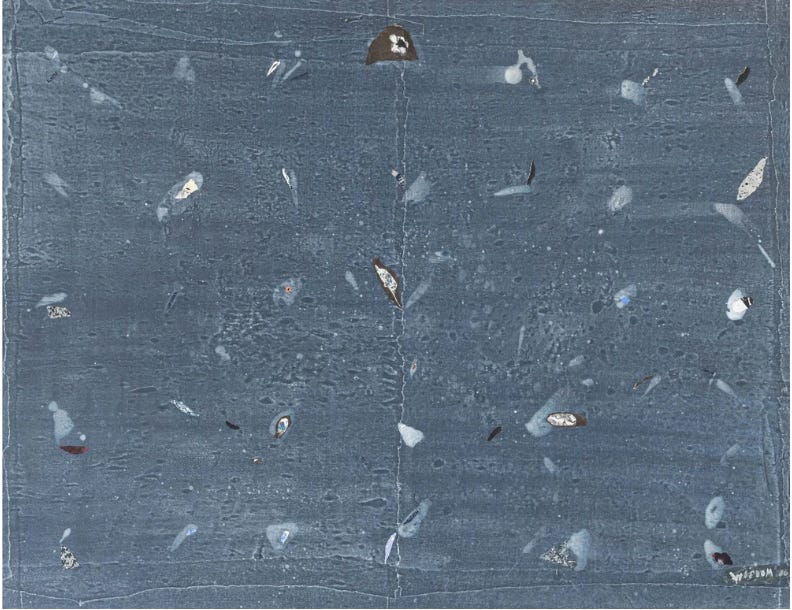
I got to know Eldred roughly 30 years ago, when he lived and worked in an old garage in Camperdown, producing rigorously abstract canvases that incorporated tiny twigs, pebbles, eggshells, leaves and fragments of torn paper embedded in surfaces that had been worked, layered and reworked.
His work was unusual, but so intense and obsessive it became an addiction for those who took the time to look. I asked Hendrik Kolenberg, then Curator of Prints and Drawings at the Art Gallery of NSW, whether he’d pay a visit. Being one of those rare curators who actually listens to well-meant advice, Kolenberg met Eldred, loved what he saw, and put up a group of works for acquisition. That modest proposal was shot down by director, Edmund Capon, in one of his mischievous moods, and nothing came to pass. To this day, Eldred’s only work in an Australian public collection is a piece in the National Gallery of Australia, acquired by founding director, James Mollison. Don’t go looking for it on the gallery walls.
Quite by coincidence, Kolenberg, who is now a full-time artist, following his retirement from the AGNSW, is holding an exhibition of his own this week, at Sydney’s Gallery LNL. Although figurative in inspiration, Kolenberg’s paintings, prints and drawings are every bit as muted and introspective as Wisdom’s.
All of this goes completely against the grain of our times, which finds art institutions increasingly obsessed with work that makes overt political statements, or identifies strongly with some approved interest group. To give an example, one couldn’t do better than look at Tony Albert’s survey at the Museum of Contemporary Art, the subject of last week’s art column. Tony ticks every box and has been lavishly rewarded, whereas a figure such as Eldred is treated as a perpetual outsider.
This was partly to do with a hermetic approach to artmaking which treats each tiny canvas as a world unto itself. Last weekend we discussed where it all originated. The systematic arrangement of motifs suggested the compositor’s art, harking back to early days when Eldred worked at a newspaper. His pictures resemble cuneiform tablets, although they also conjure up miniscule lifeforms seen through a microscope.
What’s important about an artist such as Eldred Wisdom is his devotion to the most fundamental creative processes: finding beauty in small things, transforming the detritus of nature and everyday life into something new and unexpected. This, for me, is ultimately more worthwhile than any amount of art making political statements, even when I agree with the sentiments expressed. The latter appeals to our egos, flattering us that we are on the right side of history. The former plunges us into the unknown, requiring us to use our imaginations to establish a relationship with a work. We lose touch with the self as we enter more deeply into the process.
All political art, regardless of its inclinations, is propaganda. If this is the only thing one requires from a work of art, then you might feel we are living in the best of times. On the other hand, to go beyond the tepid pleasures of political self-gratification is to open up a field of infinite discovery. This is what I value in Wisdom’s work, and that of countless other artists. Spending time with a work of art that doesn’t trade in slogans can only increase one’s sensitivity to the world around us. It may, quite possibly, make one politically more sensitive as well – ready to look at things more deeply and ask better questions.
That’s the art content this week. Having momentarily risen above the grubby field of politics, I’m obliged to return to earth because some topics are too big to ignore. For “big”, think of the bloated Powerhouse project. For “politics” reflect on the warped priorities of the NSW government.
It’s not that I haven’t already written volumes on the PHM, but if one looks away for a few weeks, the outlandish acts keep multiplying. There seems to be no official restraint or sense of responsibility, no matter how many follies and extravagances are brought to light.
As we’ve been informed by endless press releases, puff pieces and paid advertorials, the Pharaonic mega-project known as Powerhouse Parramatta is due to open towards the end of 2026 – undoubtedly in a blaze of glory. The word on the grapevine, however, is that the grand launch may not take place this year as there are too many loose ends still searching for a knot.
To be consistent, CEO Lisa Havilah is probably chasing a high-priced, celebrity knotting consultant to add the finishing touches. Preferably one with their own TV show, who tied the tin cans on the back of Taylor and Travis’s car when they headed off on their honeymoon. If no suitable candidate is available, she can always fall back on one of those reliable “Creative Associates”, who creamed millions from the taxpayer before a parliamentary inquiry prompted Ms. Havilah to turn off the tap. It must be traumatic to find the gravy suddenly withheld after years of gluttony, but one can be sure the Supreme Leader is still finding ways to support her loyal retainers.
As previously noted, when the Sydney Morning Herald begins writing critical articles about the PHM, the problems must have reached monumental proportions – which is not to say the paper won’t revert to gushing praise next week. This is the way of the media nowadays, recycling every press release in the most uncritical fashion while inserting the occasional dash of criticism just to demonstrate the errr… integrity of the reporting. Even though there is now sufficient evidence that the PHM is a colossal drain on the public purse that has zero chance of ever paying its way, the published stories are still heavily weighted in favour of “fun for all the family”.
We’ll be watching this see-saw approach with interest as launch day for PHM Parramatta draws closer. The process is so far advanced and has absorbed so many millions of dollars (there’d be no change from $2 billion if everything over the past decade were included in the bill) that the government cannot allow it to fail – or at least for it to be perceived as a failure. That realisation will sink in, gradually at first, and then in an almighty implosion when the building has been open for about six months. By that stage, Lisa Havilah may be demolishing a museum in some other unsuspecting part of the world.
This is why Linda Morris’s most recent SMH report is an eye-opener. Only a few weeks ago we learned that NSW Treasurer, Daniel Mookhey, known for his complete disinterest if not contempt for the arts, had allowed yet more funds to be channelled into the PHM, while pulling money from the operating budgets of the Art Gallery of NSW, the Australian Museum and other institutions.
Suddenly we find: “NSW Treasury has been brought in to scrutinise the operating budget of the new Powerhouse Museum as contracts show the institution has burned through more than $70 million in the lead-up to its headquarters’ grand opening.”
As a result, the PHM has a new acting chief operating officer in Treasury executive, Cassandra Wilkinson, who should have plenty of receipts to examine. It’s another matter altogether whether she chooses to hold anyone accountable, as previous history encourages the suspicion that this is yet another way of creating the appearance of responsible management while the torrent of taxpayers’ money continues to flow. Ms. Wilkinson, please note, is married to former Labor MP, Paul Macleay, who left the Ministry in 2010, after misusing a parliamentary computer. It’s hard to imagine she will do anything to embarrass the government.
One of the most interesting – and typical – of the newly revealed PHM expenses, is the hiring of interior designer, Yasmine Saleh Ghoniem, who hosts the ABC’s Grand Designs Transformations. Ms. Ghoniem will be providing “interior design advice” for the bargain price of only $333,520.
Admittedly, Ghoniem is one of more than 50 designers engaged by Ms. Havilah - who doesn’t do anything by half-measures when the public is paying. What’s noteworthy about this particular appointment is that it looks like a continuation of the supposedly discontinued “Creative Associates” program. As you may recall, the Great Leader handed at least $2.6 million (which is only the figure to which the PHM will admit) to a group of “creatives”, undaunted by the fact that she had previously declared conflicts of interest with some of them. The lucky recipients of this pot ‘o’ gold included artists, Agatha Gothe-Snape and Brook Andrew; celebrity chef, Kylie Kwong; photographer, Zan Wimberley; writer, Ceridwen Dovey and former publisher, Julie Gibbs.
The latter deserves a special mention for her lavishly funded “Culinary Archive”, which looks set to produce a thousand-page anthology of old Australian restaurant menus and other gripping memorabilia. It’s accompanied by a collecting program that has acquired items such as wooden spoons and whisks from famous cooks such as Margaret Fulton, and Gibbs’s ex-husband, Damien Pignolet. According to Leo Schofield, they’ve got everything except a bread roll from the Last Supper. If you have one to spare, the PHM will pay generously.
In pursuing such programs with her usual bulldozer-like finesse, Ms. Havilah showed sovereign contempt for her own curators, who were perfectly capable of doing whatever these outside consultants were supposedly doing, while being paid much smaller salaries and working full-time. As a museum of design, the PHM has – or should have – curators who are well-informed of the latest design trends and innovations, and able to provide first-rate advice.
Another intriguing detail of expenditure was as follows: “a Sydney workshop specialising in solid timber crafting was paid $2 million for shop drawings, material samples, and off-site fabrication of bedheads, wardrobes, and specialised joinery for the apartments in the museum’s eastern wing.”
The studio apartments, we are told, “will house visiting scientists, researchers, and artists from Australia and overseas collaborating on Powerhouse research and programming.”
The idea that the PHM should function as a hotel as well as a museum, has long been part of Ms. Havilah’s “vision”, albeit a hotel that doesn’t raise any revenue from its operations. She seems to believe that a 21st century museum has a more urgent need for guest accommodation than for properly equipped galleries to exhibit the permanent collection.
Now we learn that these guest apartments are being fitted out with custom-built bedheads and wardrobes, and a further $162,833 worth of rugs. It wouldn’t be surprising to learn she had installed a heated pool, sauna and gym, and perhaps a swingers’ bar. The CEO might be well advised to pursue her next job with a luxury hotel chain, although she’d never enjoy the free hand and bottomless expense account the NSW government has provided.
One wonders if Accor or Hilton would approve a $700,000 ‘welcome’ sculpture by Indian artist, Bharti Ker, for the lobby. Ker is a wellknown figure on the international circuit but a controversial choice because an Australian artist might have been expected to be given such a commission. The selection reflects the CEO’s well-documented attempts to win over the western suburbs’ sizeable Indian community, although one can only be sceptical about whether the Indians will be seduced by a large bronze sculpture.
More worryingly, according to Linda Morris’s report, Ker’s Tree of Life is one of “four major international major artworks or installations destined for the taxpayer-funded museum.” As far as I know, there has been no announcement as to what the other three might be, or how much has been budgeted for them. Take another step back, and the question arises: “Why does such a museum require four major contemporary art commissions anyhow?” The PHM used to be known as a showcase for applied arts and sciences, but under the Havilah regime it has become an expensive cultural stew that wants to be all things to all people. One of those things is a contemporary art museum – a role already filled by the Museum of Contemporary Art and the Art Gallery of NSW, not to mention dozens of other private and public galleries.
It appears the NSW Ministry of the Arts is willing to fund PHM Parramatta’s whim to acquire high-priced works of contemporary art, while cutting back allocations to more appropriate institutions. This is one way the PHM has managed to clock up a bill for $70 million (and rising) prior to opening day.
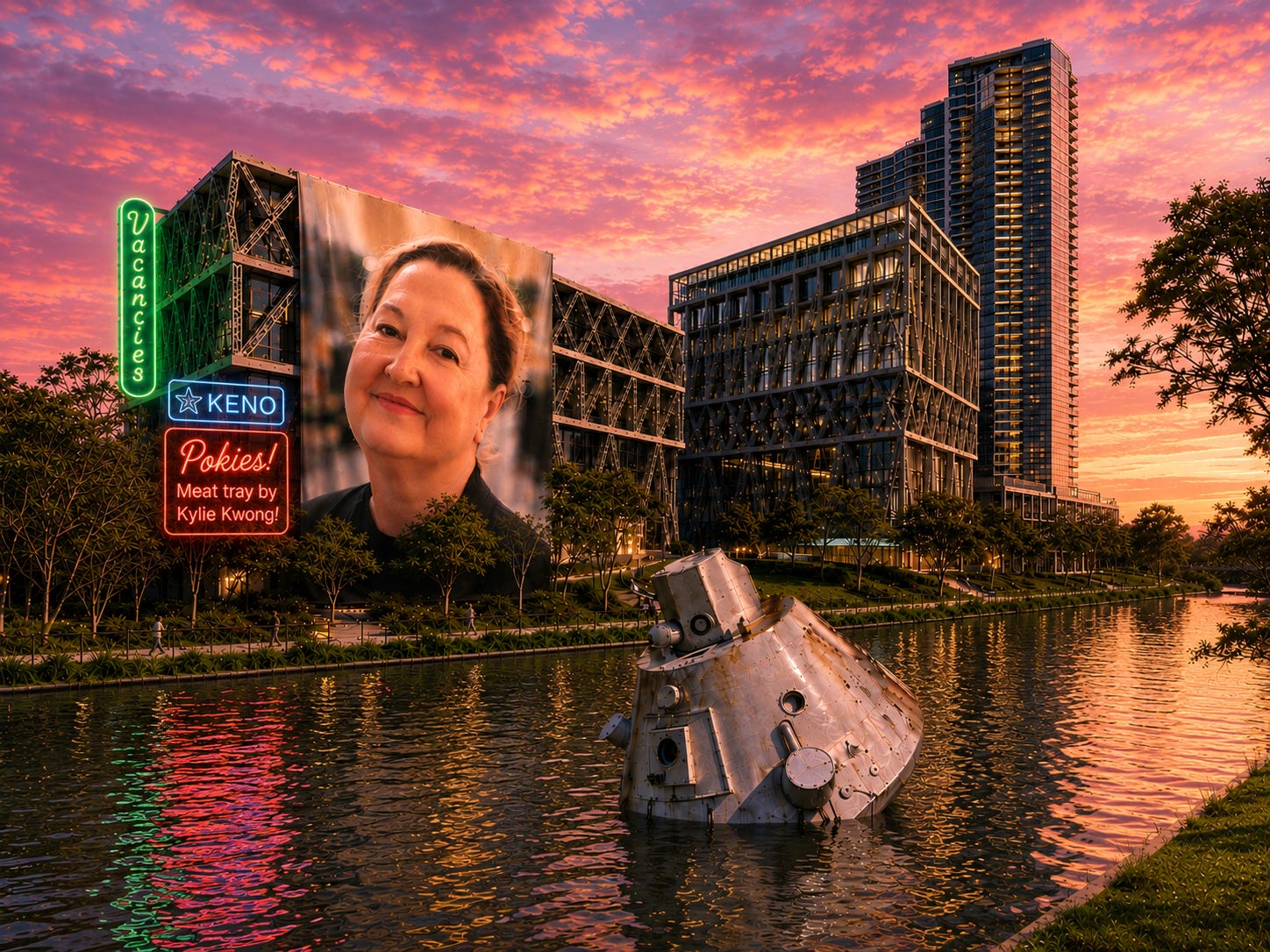
Another component of that bill was trumpeted on the ABC news site in a story by Declan Bowring, who told us about boilerplate #1224 - the proposed “centrepiece” of the PHM’s Task Eternal, the $18 million space exhibition that will launch the new building. This attractive object is a 4.5 tonne test command module used in 102 ignition tests to make sure the Apollo space capsule was safe.
In plain English, this is a spaceship that never went into space. If you google BP-1224, you’ll find a page of pictures of the capsule in its longterm location: on the grounds of the Harris County Youth Center, in Webster, Texas, three miles from Space Center Houston. The old boilerplate is of such vital historical importance that it was left outside in a park. To bring this sacred object to Sydney a “custom-built steel cage and cradle” were required, for a journey lasting 43 days. Now the conservators in Castle Hill are giving it a new coat of white paint and “reinstating” the original NASA logo, which was most probably never there in the first place.
The curator in charge of the project is Jaklyn Babington, whose former experience is in the field of contemporary art. With a wave of her magic wand, Queen Lisa has invested Jak with newfound astronomical expertise.
The ABC’s reliably bland piece of reporting was unsullied by comment from anyone who might have had a more critical opinion of the boilerplate. On a group email from those involved with the Powerhouse Museum Alliance, which includes former PHM curators with many years of in-house expertise, I learnt that the boilerplate had allegedly been sitting outside in the rain for 20 years where it copped its share of graffiti.
Former PHM director, Lindsay Sharp, recalled travelling in the USA and the USSR between 1985-87, searching for space material that might be shown at the museum. “There’s no way I would have accepted an object as pathetic as this porker,” he writes. “They probably scraped the barrel just to get something.”
Whether or not Lindsay’s opinion is justified, it would have been interesting to solicit his views and take them back to the PHM curators for comment. In Olden Days, about five years ago, this was standard practice in what passed as “journalism”. For today’s ABC, such tactics are increasingly taboo because a contrary opinion might hurt someone’s feelings. It’s so much nicer to click on “Mood Booster” in the ABC website’s menu bar and read a series of heartwarmers.
I thought boilerplate #1224 would conclude this week’s recital of PHM extravagance, but reckoned without one last Linda Morris scoop, telling us:
The spending spree includes $3 million for public relations, marketing and advertising consultancies, including eight short films for placement on a luxury global digital channel originally launched as a brand by LVMH Moet Hennessy Louis Vuitton, and the engagement of the bespoke London public relations specialists Bolton & Quinn.
The big news, however, is that the Powerhouse has commissioned a documentary about its move. Production commenced in 2021 and is still underway, having been extended by two years because of construction delays. The contract price is $2.5 million, which will be offset by tax mechanisms, so the PHM will only pay $1.7-1.9 million. Another great saving!
The filmmakers, Felix Media, will present the PHM with “a 60-minute feature which it can shop to SBS and ABC, [and] an 87-minute extended feature-length film to run in its new cinema”. Sounds fascinating! Just don’t expect anything too critical of management. When one considers that the entire PHM project has been forced through against massive public and expert opposition; administered in the most amateurish, spendthrift manner; absorbed funding that might have gone to every other arts organisation in NSW; and is destined for economic meltdown (and that’s only for starters), there’s a film crying out to be made. It may not, however, be the film Ms. Havilah has commissioned.
It would require an entire Netflix series to do justice to the torrent of madness we’ve seen unfold over the past decade. Just imagine a mesmeric tale of a government that trashed one of its most valuable cultural assets and bequeathed itself a massive financial burden. It would paint a portrait of a CEO, drunk with power, who was able to satisfy her most fanciful whims, no matter how far they deviated from anything one might expect from a museum. Such a series would surely be a global sensation – and a cautionary tale for people around the world not to be as dumb as us.
I’ve been slow to post this month, having been caught up with catalogue essays and other work, and travelling frequently. I’ve still got a lot to get through but hope to return to more regular ways soon. The most recent art column is a piece on Tony Albert’s Not a Souvenir, at Sydney’s Museum of Contemporary Art. Albert is not simply one of the most successful and ubiquitous artists at work in Australia today, he’s a case study in how to make a deeply flawed system work on your behalf. This is partly a matter of identity but mainly in having the wit and initiative to play a political game without directly offending anyone.
The film being reviewed is – inevitably – The Odyssey, which offers a version of Homer’s epic as seen through the lens of contemporary US politics. Nolan’s insistence on something called “the law of Zeus” is an unsubtle way of pointing out the inhospitable nature of American immigration policy under Trump. Although there is plenty to analyse in this film, I suspect many viewers will simply enjoy the monsters and fight sequences. It’s Nolan’s special skill to make a film of ideas while keeping one eye on the box office. Whether those ideas are especially profound is another question, but the intent is unmistakable – which is more than one could say about a shapeless, megalomaniac enterprise on the banks of the Parramatta River.
Eldred Wisdom, Alchemy Interiors, DuckPrint Fine Art, 25 July - 29 August 2026
https://www.alchemyinteriors.com.au/eldredwisdom