

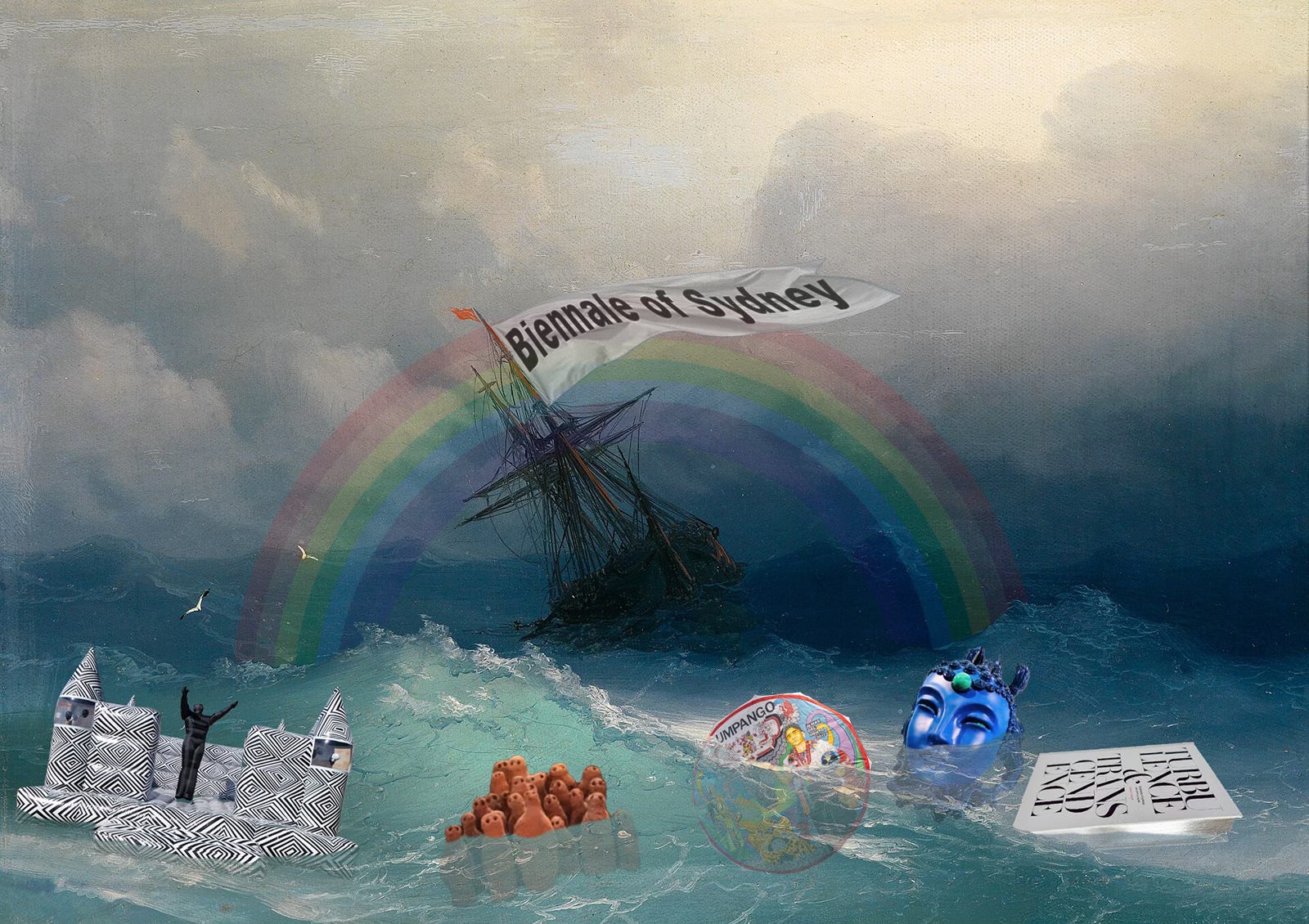
This week, in preparation for another Sydney Biennale, I finally got around to reading Brook Turner’s Turbulence & Transcendence, the book published last year to celebrate the exhibition’s 50th anniversary. The fact that this sturdy volume, produced by Black Inc. comes in a limited edition of 500, with a cover price of $299, suggests a firm belief that it holds little appeal for the general public. The target audience is institutional, supplemented by those high-net-worth individuals who might be counted on to support the show.
The title has rather a portentous ring to it. Turbulence & Transcendence? It could just as easily be called Flatulence and Forbearance.
Turner had a lot of ground to cover, necessitating crucial decisions about what to include and exclude in a brisk overview of 24 exhibitions dating back to 1973. The result is highly readable, but it’s a glorified scrapbook rather than a history. Each staging of the Biennale is given its own chapter but discussed in a different manner. Some chapters concentrate on particular artists or artworks, others focus on the issues that were topical at the time. Certain themes, such as funding problems and policy wrangles, recur with relentless regularity.
There’s broad agreement that the Sydney Biennale has played a vital role in bringing Australia into the world of international contemporary art, but there can be few people who have seen all 24 iterations, including its amateurish, low-key launch at the Opera House in 1973. Penelope Seidler is mentioned in the text, but I’m unable to think of a second candidate. I was still at school in the country during the 1970s, but I’ve seen every Biennale since then, with the exception of Tony Bond’s Boundary Riders of 1992/93, which was staged while I was living overseas. On the whole, turbulence has been a more prominent feature than transcendence.
From the 1980s onward I’ve reviewed most of those Biennales and have vivid recollections of some of them. The standouts for me were Nick Waterlow’s Biennales of 1986 and 1988, and René Block’s ‘blockbuster’ of 1990, The Readymade Boomerang. In retrospect, although I had my reservations, I’ve come to view Charles Merewether’s show of 2006, Carolyn Christov-Bakargiev’s of 2008, and Dave Elliott’s extravaganza of 2010, as important exhibitions.
If it’s taken a little while to appreciate these Biennales, this is partly because they were such huge, sprawling affairs that it was hard to get an overview at the time. With many mediocre works mixed in with the memorable ones, viewers had to strip away the weeds to find the prize specimens. Another problem was a preponderance of dreary videos that required hours of attention for little reward. Writing a review, you feel a certain obligation to watch these things rather than simply walk on by.
Other instalments, such as Catherine De Zegher and Gerald McMaster’s show of 2012, and José Roca’s rivus of 2022, were less ambitious but more focused than some of the earlier, carnivalesque Biennales. They had an unusual sense of sincerity and integrity, even if the art was less spectacular. Richard Grayson’s show of 2002 gets points for an engaging quirkiness. For sheer degree of difficulty – not counting the Biennale’s early years – Mami Kataoka’s show of 2018 deserves some sort of award. Not only did Kataoka have to deal with Ai Weiwei at his most obnoxious, but her budget was so threadbare she donated part of her fee to help secure artist participation.
The less successful Biennales were the ones that simply recycled fashionable names from the international contemporary art circuit. Although these exhibitions invariably came with a high-falutin’ theme and a complex theoretical rationale, they were essentially fashion shows in which the Artistic Director called up all the artists they had used on previous outings.
Brook Andrew’s Nirin of 2020 stands out as a genuine groundbreaker, not because of the outstanding quality of the work, but because of its variety and an overdue focus on Indigenous artists. Nowadays, that breakthrough has become a new orthodoxy, but this should not detract from the genuine vitality of a show that found its historical moment.
If I had to nominate the absolute worst of the Biennales, it would have to be Juliana Engberg’s contribution of 2014, You Imagine What You Desire. From the first media event, the Director showed she was not a team player. It was no longer “the Biennale” it was “my Biennale”. The rationale was incomprehensible, the selection of artists disappointing. The final whammy came when Engberg sided with a group of politically sanctimonious artists who threatened to pull out of the show unless the Biennale sever its ties with its founding sponsor, Transfield.
The issue centred around Transfield’s management of Nauru and Manus Island detention centres and Australia’s inhumane policies towards refugees. Although Luca Belgiorno-Nettis had very little involvement with that part of the Transfield operation, he stood down as Chairman of the Board, taking with him the exhibition’s most reliable source of long-term sponsorship.
Engberg’s egocentric actions resulted in a funding crisis that made life incredibly difficult for those directors who followed, such as Stephanie Rosenthal and Mami Kataoka. The entire episode now reads like a premonition of the recent fracas over Writers Week in Adelaide, in which a herd-like political reaction torpedoed a major cultural event.
Unsurprisingly, the proposed artist boycott dominates Turner’s discussion of the 2014 show, although there is much more that could have been said. He informs us that Engberg declined to be interviewed for the book.
She should have made the effort. One of the problems with this exercise, is that Turner seems ready to believe anything former Artistic Directors told him when they complained how their heroic efforts were met with spite and scorn from the critics. He is even willing to join in on the act, making catty comments that insinuate the critics were misguided and destructive in their comments when they suggested that a director’s golden vision might have led to a dud exhibition.
It’s understandable that an author of a specially commissioned corporate history of the Biennale should feel an obligation to put a positive spin on the story, but that need not require such a defensive approach. Turner may be an experienced arts journalist and feature writer, but there are many occasions in the book when he betrays a lack of knowledge in relation to the visual arts. The most visible signs are the clangers left in the text: calling the artist, Arman, “Armand Arman”; telling us that Sheila Hicks was educated at the Bauhaus; referring to the “NGV Indigenous Art Triennial”, when the show is held at the NGA, etc. These are simple errors. The more complex issues are matters of opinion in which Turner has chosen to believe one party over another.
Having written many thousands of words on the Biennales, including two large pieces per show over a 20-year period, I was disappointed to find a line or two extracted from these articles in order to prove what a misguided, negative, disaffected fellow I was – for no apparent reason aside from congenital misanthropy and conservatism. I’m not overly sensitive about bitchy comments, or frightened of disagreements, but when you’ve written about 3,000 words of painstaking commentary only to be summed up in one sentence taken out of context, it feels as if there is an agenda at play.
To maintain the fiction that I’ve been a relentless scourge of the Biennale, most of my positive responses have been ignored, or framed with lines such as: “even John McDonald didn’t hate the show.” One gets a little tired of being treated like a cartoon villain.
To take a single example, what should I make of a quotation from one Ossian Ward, about “Sydney’s creeping conservative attitude to contemporary art, fostered by the traditionally dominant grumpy art critics such as John McDonald and, before him, Robert Hughes”?
While it’s tempting to note that Ossian was the name of the imaginary Gaelic poet in James MacPherson’s literary hoax of the 1760s, the real issue here is the childish name-calling. It’s a mystery to me as to why Turner would consider this a worthy inclusion in his book. To say someone is “conservative” or “grumpy” is no more than a dumb slur, intended to disqualify the critic with cool readers who see themselves as radical and enlightened. Frankly, I’m flattered to be bracketed with Robert Hughes, even by way of a sneer. If trying to make dispassionate sense of a show that promises much but delivers little is “conservative”, I’ll take it any time.
What we see with our friend, Ossian, and indeed, with Brook Turner, is a textbook example of what is required of an arts writer in a post-critical world. The ruling idea is that one must be blindly supportive of an exhibition, accepting the claims of the curator or artists as gospel truth. If Lynne Cook or Jonathan Watkins or Isabel Carlos believe their Biennales were masterpieces, the critics have no right to disagree. It’s not all that different from Donald Trump telling us the US consumer has never had it so good. The official line is not to be questioned, even if it seems palpably wrong.
Perhaps the most important point to be made vis-à-vis criticism is that it must have an argument to back up a point of view. Flippant one-liners, puffed-up opinions, statements of tribal belonging, do not qualify. Because it requires a little space and time to construct an argument it’s often believed that criticism is too demanding for contemporary attention spans.
In Turner’s case, he is trying to cover an enormous amount of territory in a compact set of chapters. The book is more than 400 pages, with only a handful of images, so it’s clear that a truly comprehensive history of the Biennale would require several volumes. He has set out to make his prose lively and accessible, but the result is an extended piece of feature writing that relies heavily on interview material and ‘colour’. Although the author has done a lot of homework, his lack of familiarity with art and art history is palpable. This means that his account lacks authority, falling back on a collage of quotations that rarely add up to a convincing account of an exhibition.
Writing criticism means writing from a knowledge-based perspective, and this is another reason why critical commentary has become so unpopular in the mainstream. Today we believe data can be acquired instantly from Google. There’s little recognition that knowledge might be more than facts and figures, or whatever skewed nonsense AI can cobble together from the trash it finds online.
If one doesn’t have that knowledge it’s tempting to pretend it’s not worth having. Rather than weigh up conflicting accounts of the various Biennales, it’s easier to accept the official line and dismiss any criticisms as the disgruntled ravings of “conservatives”. This may be one way of writing a compact book on a vast subject, but it’s unscholarly and dishonest. It clings to the contemporary idea that truth is merely provisional, that it’s fine to carve out your own version if it suits your purposes.
A more determined historian would adopt a dialectical approach, weighing contrary viewpoints and arguments to arrive at a plausible conclusion. It’s obviously much simpler to throw in a handful of quotations like raisins into a cake mix, depending on whether you want to make a positive or negative impression.
The other aspect of Turner’s book that becomes tiresome is his readiness to see the past through the lens of present-day ideology. This means we are constantly being treated to tut-tut mentions of a lack of women, or lack of Indigenous content, when both those deficiencies have been remedied in the steady evolution of the exhibitions. It should be obvious that the Biennale, like all other art events, has been subject to different influences and forces over time. To look disapprovingly on the past, armed with the moral rectitude of the present, is a dismal but widespread tactic. It’s a way for the writer to distinguish himself as the right kind of person, unlike those grumpy “conservatives”.
It might have been worthwhile to interview some of the grumpy types, to hear their first-hand accounts. Likewise, Turner might have spoken with the late Michael Gleeson-White, who was brought in to sort out the Biennale board in the early 2000s when they were going through an acute financial crisis. Michael had brilliant stories about the way money was being spent and some of the simple things required to turn matters around. He doesn’t even score a mention in this book, and he is certainly not the only one who has missed out.
If there are a few strands that keep repeating in Turner’s lively patchwork narrative, it’s the constant struggle for the Biennale to secure funding, and deal with accusations of secrecy or lack of transparency. Sometimes these themes are linked, as when the Biennale board fought to stave off attempts to put the show under the banner of the AGNSW or the MCA, or to allow outside groups to have their say in who should be the artistic director, or which artists should be included.
This year is no different. Jewish sponsors have been alienated by a selection committee’s choice of Sheikha Hoor Al Qasimi, an outspoken supporter of the Palestinian cause, as Artistic Director for 2026. To make up the shortfall in funding, Al Qasimi has been able to draw on sources associated with her wealthy family in Sharjah, but this begs the question as to what money will be available in 2028.
The problem has been exacerbated by overtly antisemitic social media posts from a couple of Biennale artists, which have drawn protests from Morry Schwartz, former board member and publisher of Turbulence & Transcendence. Now, with yet another ugly conflict under way in the Middle East, there is every possibility that this year’s exhibition will be subsumed by the political controversy that has become such a corrosive feature of the contemporary art scene, both in Australia and abroad.
As Turner tells us, in chapter after chapter, the Biennale of Sydney is no stranger to controversy. In the early days, it was generally believed, even by founding sponsor, Franco Belgiorno-Nettis, that controversy was a useful addition to any exhibition. Today, we are in the strange, invidious position that any criticism of organisations, curators or artworks is viewed as purely destructive, while aggressive political statements are considered acceptable as “free speech”. The result is the earnest fairy floss we find in the mainstream media, at once so vapid, and so concerned with ticking all the right boxes.
It would be beneficial for the cultural health of this country if we could get back to a place in which we can talk freely about the pros and cons of an exhibition or a particular work without worrying about whether the artist or curator belongs to some protected species. It would be even better if we could see politics as only one potential preoccupation for artists, rather than the major reason for their inclusion in a show. The controversies generated by criticism work to the overall benefit of the art scene. The controversies that arise from not conforming to a dominant ideology have a purely toxic effect on the creative spirit. As funding sources dry up and audiences grow more disaffected, it’s time we made some fundamental choices.
Art and film columns are both back this week, the latter looking at Searchers, a problematic exhibition at the National Art School Gallery, on Graffiti and Contemporary Art. It proves to be one of those unhappy marriages that makes one feel it might be best to leave them alone so they can sort it out in private. The film being reviewed is The Testament of Ann Lee, Mona Fastvold’s ambitious bio pic about the Christian visionary who led the Shakers from Manchester to the New World. It felt like a good move until the sect’s unusual practices stirred up the same hostilities that had forced them onto the high seas. It seems religious non-conformity will always get you into trouble. Much better to join the cutting-edge contemporary art crowd, where rebellion need not interfere with lifestyle.
Turbulence & Transcendence: Biennale of Sydney, The First 50 Years
By Brook Turner
Black Inc. Melbourne, 2025, 432 pp. $299
Always an entertaining and insightful read John. Totally agree with you about. the fairy floss that passes for mainstream media art criticism, although not surprising given most arts rounds are now covered by interns or broken down hacks, - although that may be a little unfair on BDH's.
I very much like your comment, "If one doesn’t have that knowledge it’s tempting to pretend it’s not worth having." I see that all the time, particularly now during this time of art and anti-semitism. Is teaching 'that knowledge' now considered boring and uninteresting?
Having it, is what makes your columns worth reading in my opinion.
Keep it up, and never spare the sword!!
I have attended each one