

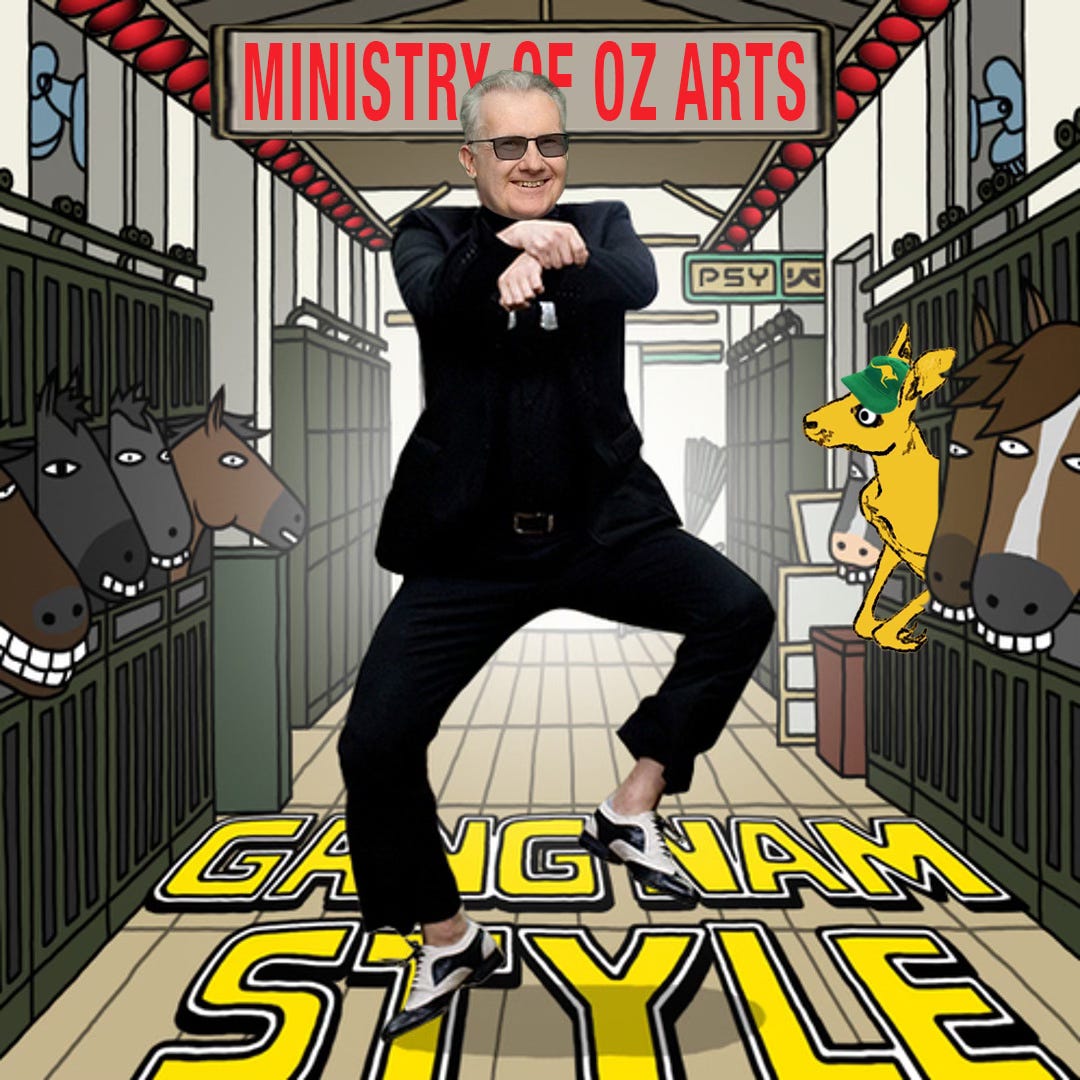
In a week in which federal Arts Minister, Tony Burke, announced a new instalment of a National Cultural Policy, I thought it might be a good time to look at the way another nation, namely South Korea, has carved out a global role for itself by means of art and popular culture.
The exhibition, Hallyu! The Korean Wave, at the National Museum of Australia until 10 May, provides a busy, broadranging survey of the products and innovations that have allowed this most ambitious of countries to propel itself into world consciousness while Australia lingers on the sidelines. If I had to name the most significant point of contrast it’s that South Korea (hence “Korea”) has had an outward-looking attitude towards culture, whereas Australia has become increasingly insular and provincial.
Hallyu – which literally means “the Korean Wave” – has conquered the world with the active assistance of successive Korean governments that have invested heavily in new technology and culture. The turning point was the Asian financial crisis of 1997, in which Korea’s roaring economy hit the skids when it was found many of the giant conglomerates, the chaebols, had been caught overborrowing and were now facing bankruptcy. Relief came in the form of a US$58 billion loan from the IMF, and massive, obligatory restructuring.
One way the Koreans pulled themselves out of this hole was to turn towards hi tech and culture. They realised manufacturing was becoming a liability, and that fast action would allow the country to become a world leader in the new digital economy. By 2010, broadband had been made available to all Korean households, five years ahead of schedule. The total cost was US $24.5 billion, of which only US$1.5 billion came from the taxpayer.
Remember what happened in Australia in 2009, when the Rudd government undertook to provide broadband for 93% of Australians by 2020? The roll-out was barely moving when Tony Abbott became Prime Minister in 2013 and expressed horror at the cost of the project. The Coalition’s changes succeeded brilliantly in making the NBN both more expensive and less efficient. We ended up spending roughly $50 billion for a second-rate service.
Maybe we needed a massive economic collapse and an IMF bailout to learn what the Koreans had figured out: that the economic spoils in this brave new world will go to the most connected. With connectedness came new ways of interacting, and new crazes such as the minirooms – a virtual environment that could be arranged and furnished to fit one’s fantasies. The Hallyu! catalogue tells us the miniroom concept was introduced in 2001, and by 2009 two-thirds of Koreans owned one.
Korea’s embrace of the Internet led to surges in online gaming and shopping. It was crucial to the growth of K-Pop, which would become one of the country’s most successful exports.
With the means of communication in place, the Koreans set about providing the content, with a new focus on the arts, subsidised and supported by government. Over the past two decades, it’s not just K-Pop, but Korean gaming, drama, cuisine, fashion, literature and movies that have made steady inroads into global consciousness - and markets. I’ll spare you the figures, but they are phenomenal. What the Koreans realised was that the arts could be a huge international money-spinner and a source of soft power. As the world became hooked on Korean drama and pop music, tourism surged. All over the world there has been a steady growth of Korean language courses, Korean Studies at universities, and dedicated Korean galleries in leading museums, from the Los Angeles County Museum of Art to the British Museum.
The Koreans have a Ministry of Culture, Sports and Tourism – a combination that makes perfect sense, and doesn’t avoid the word, “culture” in favour of that soft term, “the arts”. When Labor was elected with a landslide, it would have been an opportune time to finally coin a Ministry of Culture, with the greater aspirations that entails, instead we have Tony Burke as Minister for “the Arts”: the minor part of a portfolio that also includes Home Affairs, Immigration and Citizenship, and Cyber Security.
The difference is obvious: the Koreans link culture with sport as equally important sources of tourist revenue. We have a Minister for Sport, in Anika Wells, and a Minister for Trade and Tourism in Don Farrell. Sport is given prime importance as a freestanding ministry, whereas tourism is bracketed anomalously with trade, as if tourists were no more than imported goods.
***
In Korea, another area that has benefited enormously from government support is the film industry. In Korea, there have been two “golden ages” of cinema – the 1960s, when a variety of films received massive local support; and the early 2000s, which saw the rise of star filmmakers such as Park Chan-wook, Bong Joon Ho, and Lee Chang-dong. The pay-off came when Bong’s Parasite won best Picture at the 2019 Academy Awards.
In Australia, our ‘Golden Age’ was the 1970s. An explosion of local filmmaking was fuelled by new talent, new censorship laws, and significant government funding. Local audiences supported the homegrown product and directors such as Peter Weir, Bruce Beresford and Phil Noyce went on to forge careers in Hollywood.
Australian films would garner support from the 10BA tax incentive scheme that ran from 1981 to 2007, that allowed investors to claim a 150–100 per cent tax deduction. By the time it was dropped the scheme was considered a rort, but funding responsibilities have largely returned to state and federal governments which have imposed increasingly onerous conditions on the kinds of movies they support. The emphasis has shifted away from creativity towards making Australia a service industry for world cinema. This means we supply studios, sets and technical expertise for foreign film productions, but produce few noteworthy films of our own. The small amount of money made available to filmmakers is subject to “diversity” requirements, both official and unofficial, which results, paradoxically, in a less varied, less adventurous range of features.
It’s impossible to imagine highly successful, politically incorrect Australian films such as The Adventures of Barry McKenzie (1972) or Alvin Purple (1973) being made today.
Korean cinema has had its own ups and downs, as viewing habits, post-pandemic, have turned towards home screening platforms. Korea’s peak production era of the 2000s, which turned out 50–80 features each year, gave way to a paltry 35-37 in 2024-25. According to Screen Australia statistics, Australian film production, which fell as low as 19 features in 2002-03, came in at 34 in 2024-25.
These figures, however, say nothing about the nature and quality of films, or their success at the box office. Most Australian features struggle to get a theatrical release, and if they do get one, are unlikely to survive for more than a couple of weeks. In the 1970s there was a hunger for local product, but today there’s a widespread perception that if it’s an Australian film it won’t be any good. This is the inevitable result of too many lacklustre productions addressing themes audiences find less-than-inspiring.
Korea may be suffering from a slump in cinema attendances, but the best Korean movies, such as Park Chan-wook’s No Other Choice, are still finding global audiences. The big “Australian” films are Hollywood co-productions by directors such as George Miller and Baz Luhrmann, which don’t depend so heavily on local funding. To rebuild Australian cinema we need to reinvest in the movies as a creative activity not a service industry. This also means loosening the political strictures that channel disproportionate funding to projects that meet standards of equity, diversity and inclusion which would rule out most of the greatest films ever made.
One of the reasons Korea has been so successful in bringing its stories to the world is that it has been willing to experiment with so many styles and genres, ranging from ‘exotic’ costume flicks to a range of thrillers, dramas and comedies that give a specifically Korean inflection to plots that may originate elsewhere. No Other Choice, for instance, is based on a novel by American crime writer, Donald E. Westlake, previously adapted by Costa-Gavras. In Park Chan-wook’s hands, it has become a parable for the age of AI and globalisation, and their impact on the mentality of the Korean worker.
Although everyone in no No Other Choice is Korean, we can empathise with the characters more readily than we can with the protagonists of so many Australian films, carefully curated to represent every form of marginality. Park’s film is also a black comedy, but most Australian movies over the past decade have forgotten how to make people laugh, becoming increasingly bleak, depressing and sadistic.
The Hallyu! exhibition has a lot of material devoted to Korean cinema, which serves as a welcome reminder of the quality of films this country has produced over the past two decades. What a thrill to revisit the classic sequence from Park’s Old Boy (2003) in which the anti-hero defeats a crowd of violent hoodlums.
***
The cinema is my area, but one suspects the major attraction for most visitors will be the K-Pop material. To speak frankly, I’ve always found K-Pop to be inane and formulaic, but for fans that seems to be the source of attraction – and when I say “fans”, I’m not talking about a handful of teenagers. The fan base for K-Pop, according to the Korea Foundation, now exceeds 225 million, worldwide. Brought together, it would make K-Pop fans the 7th most populous nation on earth. The Hallyu! catalogue claims there are 2.4 million members of K-Pop clubs in Australia alone. In 2011, a major K-Pop concert sold out ANZ Stadium at Sydney Olympic Park, while our most successful entrant in the Eurovision Song Contest has been Korean Australian, Dami Im, who was runner-up in 2026.
Im is one of 160,000 Australians of Korean ancestry, which is more than enough to cause ripples in the social fabric, but this still doesn’t account for the extraordinary popularity of K-Pop, which has also driven multi-million-dollar trends in fashion and cosmetics. Most of the members of leading bands such as BTS and BLACKPINK have contracts with top fashion houses and cosmetic companies.
For my generation the punk revolution came along at exactly the right time, blowing up a music industry that had grown bloated, smug and megalomaniacal. Punk was a rejection of those long-haired guys in kaftans and their concept albums, of heavy metal stodge, disco frippery, and the sugary pop tunes that regularly topped the charts. It was raw, offensive, and defiantly D.I.Y. The massive corporations were suddenly confronted with a viral outbreak of independent labels that gave youth audiences an alternative to the slick, bland products they were offering.
It didn’t last, of course, but for a short while the music business was plunged into turmoil, as the big labels tried to work out where they’d gone wrong. When they finally got the idea, it was a simple matter to package a new group of punk-lite acts, with none of the offensiveness and amateurish musicianship. Suddenly the New Romantics came along, and all the old corporate marketing tactics began to function as per normal.
From a broadly historical perspective, the K-Pop revolution represents the ultimate triumph of corporate packaging and marketing. The bands are all created by studios, following extensive auditions and talent scouting. Successful applicants are sent on intensive courses in singing and dancing that might last years before an act makes its debut. When it does appear, the ground will have been carefully prepared by the company. Music, costumes and dance routines will have been planned with the rigour of a military campaign, while each band member will be allotted a distinctive identity to stimulate the fascination of fans. The boys and girls are all paragons of beauty, with flawless skin, immaculate hairdos and styling, and tons of make-up.
Circa 1978, this would have been seen as the last word in corporate control, the dead hand of calculation that killed any trace of spontaneity. Today, these precisely calibrated acts are tailored to fans’ desires, which in turn inform moves and adjustments in the next wave of bands. It’s a seamless process, in which the music is a jumble of styles, from teeny pop to disco to soul to hip hop, synchronised with costumes and dance routines used as part of a video clip that gets zapped around the world on platforms such as YouTube.
It’s a sobering, slightly scary vision of fandom today, boosted to new dimensions by the Internet. It’s also a picture of a largely non-critical audience, prepared to consume whatever is put in front of them. Although fans will obviously have their favourite bands or performers, it’s their devotion to the phenomenon of K-Pop itself that is so overwhelming. As one sees with other acts such as Taylor Swift, the music seems to be secondary to the experience of being part of an enormous fan subculture that extends around the planet, blurring the cultural differences between countries as diverse as Korea and Saudi Arabia.
Before writing this, I sat and watched a succession of K-Pop videos and couldn’t find an original musical or visual idea. It’s one long mash-up in which uniformly pretty boys and girls jump from one titillating scenario to the next, each video being a mini-movie, with songs pushing banal but attractive messages such as “be true to yourself”.
I thought it was profoundly empty, superficial and depressing, but the fans see this stuff as a source of pure joy, perhaps an escape from a world riven by war, inequality and a climate crisis. One of the most interesting essays in the Hallyu! catalogue is Mariam Elba’s piece which looks at the ways K-Pop fans have used their networks to raise money for charities or to generate support for protest movements. It sounds bizarre, but to celebrate some teen idol’s birthday, a group of fans in Egypt will get together and raise money for the homeless. It suggests, once again, that one of the most appealing aspects of the K-Pop phenomenon is the feeling of solidarity and the power of a group to do things that resist the ugly, brutal problems of everyday life.
If Parasite will always be seen as the film that put Korea on the world map for cinema, the pop music breakthrough was Psy’s Gangnam Style in 2012, a boppy satire about the luxury lifestyles of the nouveau riche who live in the Seoul suburb of Gangnam. It’s a deliberately silly song with a very ordinary dance beat and a hilarious video, but through the power of the Internet it became the first pop clip to register one billion views on YouTube. By 2014, hits had risen to more than two billion.
Unsurprisingly, Gangnam Style and Parasite, are all over the NMA exhibition as recognised icons of Korean culture. What would the Australian equivalents be? Something by Kylie Minogue? Crocodile Dundee?
***
The worldwide dissemination of Korean cultural product has been astonishing, and in the case of K-Pop, and the enormously successful online gaming industry, the word “product” could not be more precise. It makes me feel like a hopeless nostalgic to think of pop music as something made by aspiring musos in their garages. The consumers of K-Pop are not in the least disturbed by its shiny, corporatised image, with every band, song and video clip created by teams of people alert to each new trend. Talented but homely singers need not apply, as every K-Pop star looks like he or she was produced by a 3-D printer, working from strict templates of male and female beauty.
At the end of the 1970s, a young, rebellious generation demanded that music drop the artifice and get real again. Today, reality is the last thing the fans want, even if they use their K-Pop idols’ birthdays as an excuse for charitable deeds. I can understand the appeal of all that ostentatious prettiness and immaculate choreography, but the shallowness of the music is hard to swallow. It could all be cranked out by AI, if it isn’t already. It’s the triumph of an escapism that seems to have admitted that reality is too hard to handle.
Australia could learn a lot from the way the Koreans have spread their cultural energy across the entire planet, but the army-like regimentation of K-Pop seems profoundly at odds with local ways of thinking, even allowing for those 2.4 million Aussie fans.
What we need to recognise is the way Korea has got the world hooked on distinctively Korean themes, even when songs are being sung in a language spoken by relatively few people. It’s partly down to a willingness to “self-orientalise”, as one catalogue essay puts it, portraying Korea as a land of costume drama and hybrid glamour. The popular imagination may be tawdry, but it’s easily stimulated by bright and shiny things.
In Australia, culture has taken an inward turn. As we see with the government’s ‘First Nations First’ dictum, the guiding principle today is Indigeneity, to such an extent that every myth or story of colonial Australia is subjected to fierce scrutiny to find what evils were inflicted on Aboriginal people. We’ve lost more than the presumption of innocence - it has become virtually impossible to create significant cultural artefacts that are not overshadowed by this ideological fixation.
A similar problem was addressed by the American essayist, Leon Wieseltier, last year, when he wrote:
“From the standpoint of a liberal order… the indigeneity of the right is no more legitimate than the indigeneity of the left: both introduce a moral hierarchy where hierarchy itself is the moral problem. In a democracy we count cardinally, not ordinally. Indigeneity, moreover, is myopic, a severe narrowing of perspective, another variety of blinking originalism.”
We may consider the indigeneity of the right to be represented by the insularity of the MAGA crowd in the United States, and the surging popularity of One Nation in Australia. Both are populist movements based on emotional responses rather than pragmatic political choices. Followers believe they are true natives of the country where they were born, and resent being viewed as invaders or second-class citizens. They worry about being racially or ethnically outnumbered by newcomers, generating a hostile attitude to migration.
On the left we have the sacralising tendencies of self-styled progressives towards the indisputable indigeneity of Aboriginal people. They have created a new hierarchy in which “the last shall be first, and the first last” as Jesus said. Indigeneity is now the first consideration with every institutional cultural project, to the extent that strenuous efforts are made to insert Indigenous content into every movie, every TV drama and art exhibition. Those who support this process see it as fair and just reparation for the crimes of the past. Those who don’t have crimes on their conscience – and I’m afraid, they are the overwhelming majority – feel bored and frustrated by this political fixation, which often comes across as mere tokenism.
There may even be an argument that before the current over-the-top obsession with indigeneity took charge of Australian culture, the One Nation people were less concerned that their core identity as Australians was being demeaned or threatened. It may also be that such practices have undermined a growing natural sympathy for Indigenous people among the bulk of the local population. The resounding defeat of the Voice referendum suggested a more sceptical attitude.
Where this relates to Korea, is that Korean culture has defined itself clearly to the world in all its variety, while Australian culture has become bogged down in political anxieties that have undermined our strength and confidence. To be so slavishly preoccupied with indigeneity is to be just as insular as those who fear losing the farm to foreigners. Democracy is a messy but spacious form of accommodation that works best when it doesn’t create artificial hierarchies that put some people on pedestals and treat others as untouchables. We need to take a more open-minded approach to culture in this country. True inclusiveness shouldn’t come with a list of people who need to be evicted from the premises.
In brief, Korea’s cultural strategies are positive, up-tempo and outward-looking (almost forcedly so), whereas Australian culture has lost its way in the woods of guilt and insecurity. The mania for calling everything “colonialist” is a form of self-flagellation that does nothing for our social well-being or the way we are perceived internationally. We should take inspiration from the enterprising Koreans and try to understand what makes this country attractive in the eyes of the world.
When we return to the National Cultural Policy, we find Tony Burke’s office has just announced: “Five Expert Panels have [already] been appointed”, as well as a Policy Advisory Group. The Expert Panels “will inform the Minister and the Policy Advisory Group on key issues and themes raised through the public consultation process.”
There is no detail as to who is sitting on these Expert Panels or the Policy Advisory Group, although I could venture a few guesses. As the main priority is to build on the “five pillars” of the 2023 plan, Revive, the entire exercise appears to assume that plan was a complete success. To hold fast to this fanciful belief, it helps to skip over the long list of arts scandals and controversies we’ve negotiated since Labor came to power.
One can be sure the Expert Panels and Policy Advisory Group will contain nobody who will challenge prevailing orthodoxies or question broader government attitudes towards culture. Get ready for another few years of cultural inertia, nepotism, corruption and mediocrity, as private and public money continues to drain out of the arts. In this land of the rubber stamp we ignore the Koreans at our peril because they’ve shown that culture, properly supported and administered, represents a huge economic opportunity.
I’ve been working on other projects myself this week, which I’ll explain at some later date, but managed to post a review of Paolo Sorrentino’s film, La Grazia, a portrait of a high-ranking politician with conscience. Yes, it’s pure fantasy, but if we don’t take a more positive approach, it’s impossible to imagine a day when politics and culture will ever win back our trust.
Hallyu! The Korean Wave
National Museum of Australia, Canberra
12 December 2025 – 10 May 2026
Great piece, John. Thought provoking.
There was an anecdote going around in the 1990s that the South Korean government of the day was stunned to learn that the revenue generated by the movie ‘Jurassic Park’, was higher than the revenue generated by the export of 100,000 Hyundai cars.
Since then, they’ve created a global export industry of culture
& creativity, using private/public partnerships, building decentralised creative hubs in different cities, as well as by fostering healthy competition within creative sectors.
The South Koreans genuinely nurture their own creative talent, too.
And (gasp the horror!) they impose high standards and expect them to be met.
No bloated bureaucracy in South Korea, no unaccountable ‘grants’ system, no ideological obsessions (eg indigeneity aka return of the patronising ‘noble savage’ concept) and no blinkered ‘gatekeepers’, as sadly exist in Australia.
It’s so frustrating to see Australia’s massive creative potential being squandered in the way it has been. Too many piggies with their snouts in the trough is part of the problem - but to me, the more fundamental issue is that too many of ‘the gatekeepers’ I mentioned above seem to have lost an understanding of what creativity is, and how to unleash it.
Many simply aren’t creative people. They come across more as politicians / ideologues.
I’d even go as far as to say that in reality, many are afraid of unleashing Australia’s creative power, because it might expose them as the empty suits many of them are.
Perhaps South Korea’s experience provides us Aussies a glimpse of a better approach, and a brighter future.
Look forward to seeing who is on the panels of wise ones.