
Jeffrey Smart: Outside the Ministry (1970)
A catalogue essay for Menzies: Important Australian & International Art (7 May 2026)

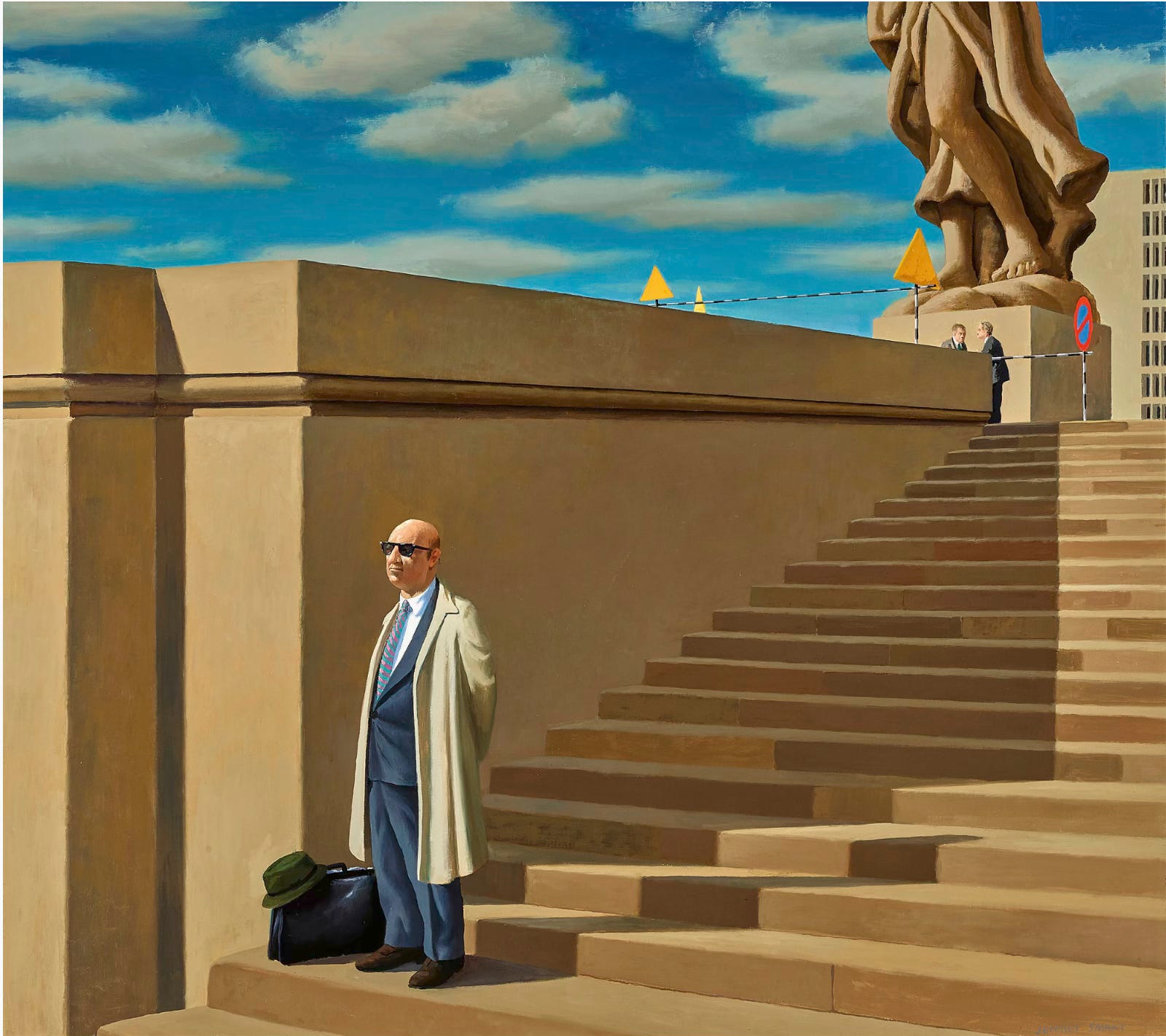
If one were to compile a checklist of motifs commonly found in Jeffrey Smart’s paintings, Outside the Ministry would tick almost every box. All it needs is a lorry to compete the set, but it’s easy enough to imagine a long strip of asphalt and a fleet of trucks on the other side of the massive stone wall that dominates the composition. As ever, Smart gives us part of a story and invites us to imagine the rest.
Walls play a prominent role in Smart’s paintings, helping to establish the geometrical frameworks he saw as an essential part of every composition. It hardly needs noting that Outside the Ministry makes precise use of the classical ratio of the Golden Mean in the division of the canvas into two rectangles, and the severe diagonal line of the steps.
Smart’s walls also enable him to excise the middle ground from a picture, a procedure he may have learned from Edward Hopper. By refusing a calm, orderly recession in the manner of a classical landscape, Smart is showing a disinclination to engage with the eternal verities of Nature. A scene by Claude Lorraine allows us to gaze into an infinite horizon, but a typical Smart painting will place a figure in the foreground and a set of buildings in the distance. There is a disconnection between these elements because the centre of the picture is dominated by a fence, a wall, a mound of earth or a road that screens out everything in between.
This creates a subtle sense of dislocation perfectly suited to Smart’s preference for urban settings. If Nature is eternal, then cities are in a constant state of flux, depending on the wealth or ambition of their inhabitants. In a busy metropolis such as Shanghai, for instance, the skyline seems to change from week to week. For Smart, the city and its surrounds provided an endless source of visual stimulation. He had no time for those who interpreted his work as a social critique or a vision of modern alienation, contending that artists shouldn’t style themselves as seers or prophets – although this didn’t prevent him from stacking his work with private jokes and satire.
Smart was unimpressed by those contemporary artists who took themselves more seriously than their art. In the studio, he felt that craftsmanship should be more important than any need to make a political statement. He would have been horrified by today’s widespread belief that the identity of the artist is more important than the quality of the work.
In Outside the Ministry, the only natural element is the sky, with its fluffy white clouds. The wall, which may be concrete or limestone, acts an impregnable barrier against the rest of the world, although there’s a warmth in the yellowish colours Smart has used. When we learn the title of the painting it seems to match the popular impression of most government ministries: entities that would like us to believe they exist only for our benefit, but whose inner workings are secretive and inexplicable. Ministries are fortresses in which decisions are made that shape our lives as citizens, not always for the better.
It was opportune to study this image shortly after viewing Paolo Sorrentino’s film, La Grazia, in which Tony Servillo plays a fictional President of Italy. For Sorrentino, it was the latest in succession of political movies, including scathing portraits of leaders such as Giulio Andreotti and Silvio Berlusconi. The message from all these films is that politics is a game largely played behind closed doors, determined by factors that are revealed to the public only when some new scandal arises.
Smart’s Ministry lives up to this reputation. Aside from the legs of a large statue, all we see are bare, flat surfaces. The bald man in sunglasses could be a politician or a senior bureaucrat, a lobbyist or a businessman. Perhaps he’s a mafioso, carrying a valise stuffed with cash to be handed over to a corrupt public servant. He must have some form of business to transact at the Ministry, otherwise he wouldn’t be found in this barren location, waiting for a car or a contact. Like most characters in Smart’s paintings, his identity and motives are inscrutable, although there are many tantalising clues.
This imposing setting conjures up thoughts of the totalitarian ministries in George Orwell’s 1984 – Ministries of Truth, Love, Peace and Plenty, which stand for their exact opposites. It’s a disturbing fact that the second Trump administration has done an excellent job in turning these fictional departments into reality.
It would be interesting to know if Smart has modelled the bald man, or the two small figures engaged in discussion at the top of the stairs, on any living persons. Faces such as those of Giorgio Morandi or Alma Mahler have made sly appearances in his paintings, although the artist always claimed to use figures in a purely generic manner, as indicators of scale rather than keys to the meaning of a work.
The most famous generic figure in Smart’s œuvre is probably the portly bald man with one arm, in Cahill Expressway (1962). The bald protagonist in Outside the Ministry could be an Italian relation. In both pictures, the anonymous figure stands beneath a public sculpture that seems to have some heroic purpose but appears only in fragmented form. For Smart, all such statues could be the offspring of the ruin in Shelley’s Ozymandias – a monument to human vanity, mocked by time. There is a wry humour in these throwbacks to a classical world inserted into a cosmopolitan landscape being constantly remade by people whose values are forever changing.
One of Donald Trump’s more fanciful ideas is for a garden of American heroes featuring statues of important people, but this would be essentially a gallery of celebrities. The more grandiose monuments such as The Statue of Liberty, (or to use the title bestowed by its creator, Frédéric-Auguste Bartholdi: Liberty Enlightening the World), are based on abstractions. This is the kind of statue Smart gently mocks in the form of a leg of a giant allegorical figure protruding from a robe or toga. The obvious disjunction is between the lofty ideals embodied in the sculpture, and the grubby realities of politics and bureaucracy. The statue, in its way, is no less of a barrier against reality than the wall.
We might also consider the two yellow triangles, a no entry sign and the black-and-white striped poles at the top of the steps, to be another kind of artwork. These items bear the same resemblance to modern sculpture as the garden hose Smart would use as a model for The sculptor with work in situ (1984-85). In many of his other paintings, a traffic sign doubles as public art. These parodies of the avant-garde act as a vein of absurdist comedy in Smart’s work, a running gag on the legacy of Duchamp’s readymades.
The obvious architectural reference for Outside the Ministry, is the EUR – the site for the Esposizione Universale Roma of 1942, which was waylaid by the Second World War. Commissioned by Mussolini, the EUR was intended as a showcase of Fascist architecture. Today, after numerous changes, it’s a fashionable business and residential district.
I visited the EUR with Jeffrey Smart as part of a day-long tour of the archtectural highlights of Rome, courtesy of a knowledgeable taxi driver named Francesco, whom Jeffrey had befriended. The EUR was our final stop, its monumental, rationalist design a vision of a future that never eventuated.
The building in the background of the painting, which we assume to be the “ministry” appears to be loosely based on the EUR’s most iconic structure, the Palazzo della Civiltà Italiana, often referred to as the Square Colosseum. It was intended to encompass Italy’s past, present and future in one design, incorporating a sleek, repetitive façade with a massive flight of steps and a collection of classical-style sculptures, representing aspects of Italian history and culture. The effect is weirdly reminiscent of one of Giorgio di Chirico’s metaphysical paintings.
Smart has drawn on these diverse elements, squaring off the rounded arches on the front of the Palazzo. Although made from concrete, the building is clad in travertine, lending it a creamy appearance Smart borrows for wall and steps. Conceptually, it exposes historical artifice and pretension, disguising a modern building material with a thin layer of stone favoured by the ancient Romans. It tells us that Mussolini’s dream of Italian glory was merely skin-deep.
A readymade movie set, the EUR has appeared in numerous films by a roll call of directors that includes Rossellini, Fellini, Antonioni and Bertolucci. This connection was not lost on Smart, who greatly admired the Italian movies of the 60s and 70s, and counted Bernardo Bertolucci as a friend. The cinematic influence is reflected in Outside the Ministry, which resembles a film still in which a mysterious man in sunglasses acts out a scene from a story we’ll never know, from a movie that only ever existed in the mind of the artist.
JEFFREY SMART
(1921-2013)
Outside the Ministry 1970
oil on canvas
80.0 x 90.0 cm
signed lower right: JEFFREY SMART