
Jeffrey Smart: Four Seats, Venice Biennale (1983)
A catalogue essay for Menzies: Important Australian & International Art (7 May 2026)

When Jeffrey Smart left Australia to make his home in Italy in 1965, he had already fallen out of love with the cutting-edge art of the day. Pop Art, Op Art, hard-edged abstraction were all the rage, but he could never see himself following any of those trends. As he recounts in his autobiography, Not Quite Straight (1996), Smart had found his direction in the National Archaeological Museum in Naples, gazing upon the Alexander mosaic retrieved from Pompeii. The mosaic is based on a Hellenistic painting, long since lost, but the artist took heart in confirming that the painters of ancient Greece had been realists.
Smart had no time for Clement Greenberg’s doctrine that art progressed by stages, jettisoning aspects of theatricality until it became an ‘object’ in its own right. He felt that realism was timeless - a manner of making art that recurred throughout the ages, albeit in different guises. He saw the fashionable movements of the 1960s as flimsy and ephemeral, enjoying a burst of celebrity that would be extinguished when some new fad came along.
By 1982, Modernism had sputtered to a conclusion, and the short-lived moment of Postmodernism was fading fast. It seemed as if time’s arrow had missed the target, and all artistic tendencies had to learn to live together.
That was the lesson to be taken from the Venice Biennale of that year, which Artforum saw “at best as disorganised and at worst as a disaster.”[i] One feature the magazine’s reviewer particularly disliked was “a nightmare of figuration — a warehouselike amalgam of heterogeneous works, primarily realist in persuasion and marked, in general, by bathetic emotional states.”
That ‘nightmarish’ figuration – including work by Lucian Freud, Avigdor Arikha and Antonio López García - may have piqued Smart’s interest, but he would come away from the Biennale feeling disenchanted by the chaotic spectacle of so much incompatible art crying out for attention.
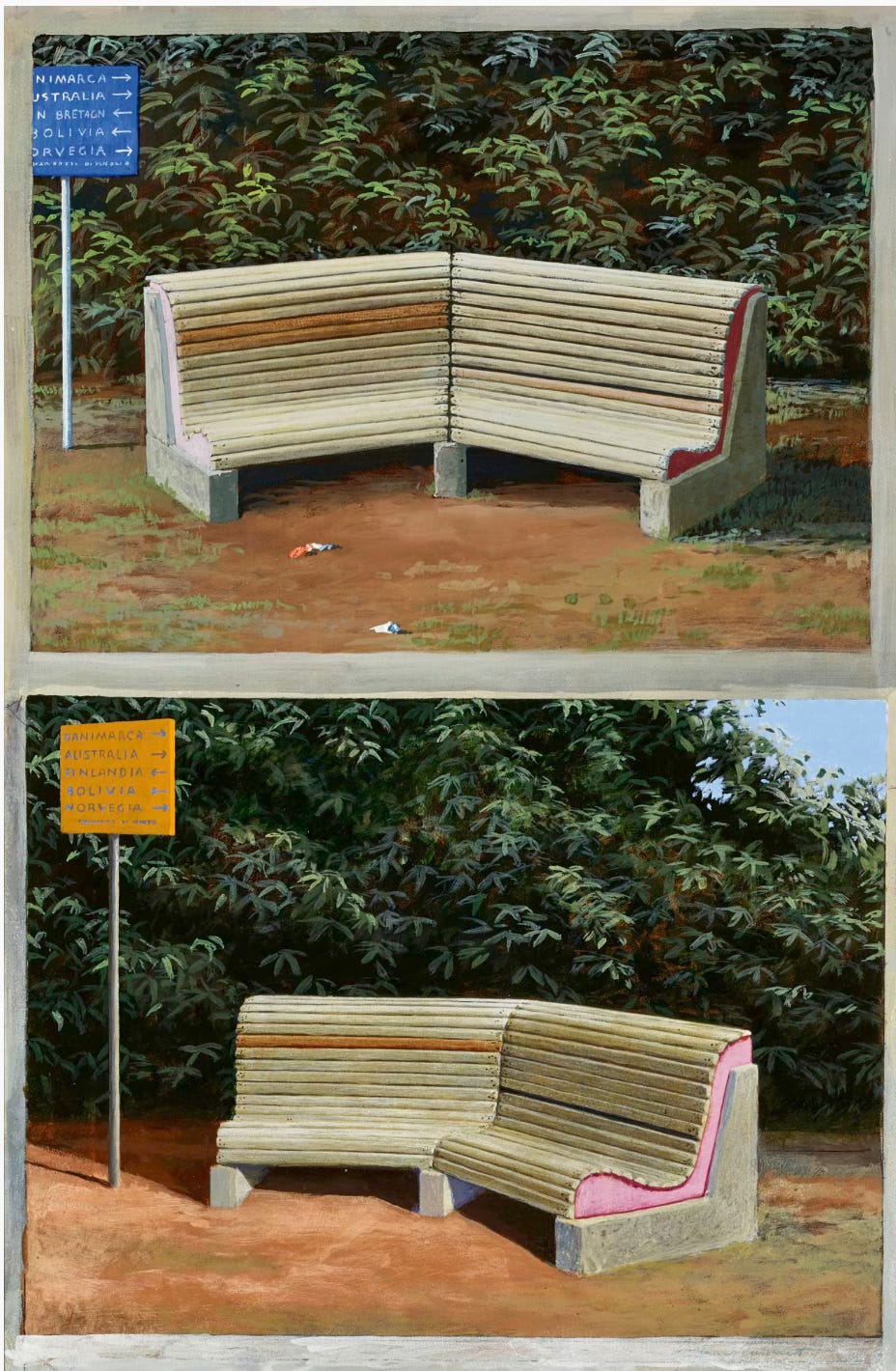
Four Seats, Venice Biennale is his response to that experience. Smart has depicted four ugly seats arranged in pairs in the Giardini enclosure where the national pavilions are located. No artist but Smart might have visited the Biennale and found the most inspiring sight to be a set of park benches chiefly notable for stolid design and drabness of materials.
This is characteristic of the artist’s habit of finding “beauty” or at least something of interest, in scenes most people would barely notice. His paintings of highways, traffic signs, flyovers, lorries, and bare concrete structures invite us to look more closely at things we take for granted, implying that nothing is so utilitarian it doesn’t contain some faint trace of an aesthetic impulse. Smart brings the ‘non-spaces’ of the world to life, reinforcing the idea that one of the functions of art is to add an unexpected new dimension to everyday experience.
Not the least puzzling aspect of these pictures, which may be seen as a diptych, is whether we are looking at two pairs of seats or the same one in a different setting. Although the sign in the top panel is blue, and the one in the bottom yellow, the benches look remarkably similar. The litter in the top panel has been cleaned up in the bottom, while one wooden slat is slightly darker in colour, but it’s possible Smart used only a single pair as a model.
He lists Australia on the blue and yellow signs as a nod to the land of his birth, accompanied by Denmark, Bolivia and Norway. Great Britain appears on the blue sign but is replaced by Finland on the yellow. As Bolivia has never had a pavilion in the Gardini, and was not represented at the 1982 Biennale, one may see this as a gag.
The Russian formalist, Viktor Shklovsky, famously argued that art’s role was to “make strange”, and these seats Smart found at the Biennale certainly fit that category. They give the impression that the designer has tried to create something for the Giardini that resembles modernist sculpture. Henry Moore made figures out of concrete, but these benches seem more closely aligned with Carl Andre’s minimal arrangements of concrete blocks or firebricks.
Rather than isolating the seats as misunderstood objects of beauty, Smart may simply be using them for satirical purposes, as in paintings such as The sculptor with work in situ (1984-85), in which the abstract “sculpture” is modelled on a garden hose; or Playground at Mondragone (1998), which features a bright red climbing frame that resembles a Minimalist public sculpture. This painting, in the collection of the Art Gallery of NSW, served as an unwitting prophecy for for a gigantic milk crate Sydney City Council considered erecting in 2014 as a $2.5 million adornment for Belmore Park. The project would be scrapped in 2016, when costs blew out to $9 million.
The satire may be seen double-edged, as a whimsical comment on a Biennale so lacking in substance that Smart found more to admire in the park benches, and a sly dig at the art (and furniture) displayed in public spaces. In Venice, a city in which much of the architecture dates back to Renaissance times, one glance at these seats makes us suddenly, sadly, aware of the gulf that separates past from present.
JEFFREY SMART
(1921-2013)
Four Seats, Venice Biennale 1983
synthetic polymer paint on fibreglass canvas
71.0 x 46.5 cm; 88.5 x 64.0 cm (framed)
signed lower right: Jeffrey Smart
[i] Kate Linker, ‘Venice Biennale 1982: No Form, Little Commitment’, Artforum, November 1982, p.84