

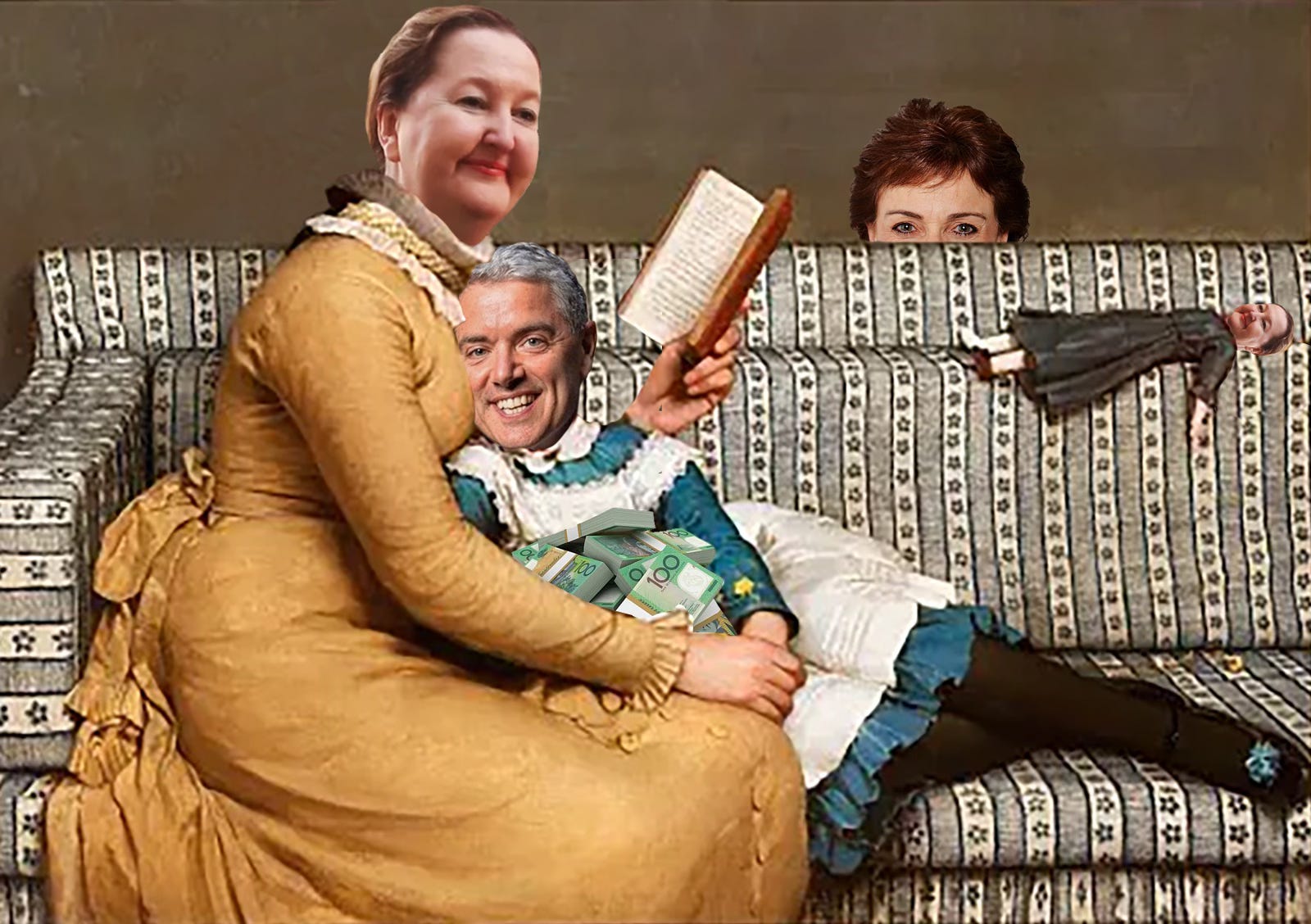
This editorial has been slow to arrive because of travel and other commitments, but there’s never any shortage of subjects competing for attention. I was thinking of writing on another topic until I read the latest instalment in the agonising saga of the Powerhouse, delivered by the Sydney Morning Herald’s arts scribe, Linda Morris. The resulting buzz means the time to respond is now.
This week we find Linda building on what has become a growing tendency to include a few queries and criticisms. Little by little, the critical voices are making themselves heard in these articles.
This may have something to do with the departure of the editor known as BS, who seems to have been sent back to the ranks, with buttons missing and sword broken, after a few ignominious years in the top job. Who can forget his quisling editorial, ‘Let’s all get behind the Powerhouse Museum renovation’, of Feb. 2024, which sneered at “special interest groups, including some patrons, critics and unions” who “complained and carped” about the “renewal”. His rousing conclusion was “the time has surely come to bite the bullet and support the government’s sensible preservation plan.”
If BS had done nothing else but write this utterly foolish, misleading editorial, he would have richly deserved the boot. Let’s hope the new editor, Jordan Baker, takes a sceptical line with the Powerhouse, and with the virtuous claims of the Minns government that her predecessor found so congenial. Let’s hope we never hear of Powerhouse CEO, Lisa Havilah, saying: “I’ll just get Jordan on the phone…”
The signs of change are there in Linda’s most recent piece, but despite the flurry of excitement among Powerhouse supporters who feel the tide may be turning, I’m not at all persuaded. Please note the way La Havilah’s plan to “upend the hierarchy of the museum” is presented as a reasoned proposition, when it’s the kind of thing the Huns and Visigoths would find alarming.
Criticisms of this “plan” are raised, but the fiction of a balanced argument is doggedly maintained. By now, it should be clear we’re not dealing with a carefully plotted strategy for growing audiences and extending the boundaries of museology. The Powerhouse “renewal” is a bloated mess that gets messier by the month as further expensive, hare-brained initiatives are added to the package, and large sums of money are channelled into the pockets of friends and “Associates”. When we read of Havilah boasting she has “102 collaborators from western Sydney, 117 from NSW, 90 nationally and 97 internationally,” one wonders how many of them are on the payroll? How many have been gifted trips, residencies or other perks? Vincent Namatjira may live in Central Australia, but the NSW taxpayer has just paid for him to spend three months at the Cité des Arts in Paris.
The Powerhouse project has become the cultural equivalent of driftnet fishing, scraping up all the funding that previously sustained an entire arts ecosystem. For this monster to indulge its megalomaniacal schemes, the Australian Design Centre has been effectively defunded, the Art Gallery of NSW has been financially crippled, the Museum of Contemporary Art has been virtually assigned to oblivion, and 18 regional galleries have either lost their state government lifelines or been given a slimmed-down handout, for which they are expected to be grateful.
The Havilah “plan” isn’t for a radical new “museum of the 21st century”, it’s for no museum at all. Whatever is being planned by way of performance spaces, function centres, contemporary art shows, artist residencies, rave parties, story writing competitions, dormitories, market gardens, demonstration kitchens, and science fiction blockbusters, have nothing to do with anything we might expect from a museum. As former PHM curator, Kylie Winkworth, is quick to remind us, it’s all outside the museum’s legislated remit. Call it what you like, but the Havilah Powerhouse is no museum. As to what it actually is, well that’s a mystery Sherlock Holmes would struggle to solve.
For once, the title of the SMH article, ‘Is our new ‘museum’ brilliant, bonkers or just a big box?’ provides a relatively accurate description of its contents: a whole lot of fence-sitting, as criticisms of the Powerhouse are matched with comments from supportive ‘experts’.
When one of those experts is David Borger, the chairman of the PHM Board, and a blind supporter of this plan, one should not expect objectivity. Another fan is Gus Casely-Hayford, director of the Victoria & Albert’s new East London branch, who has been a dependable source of praise, although he doesn’t seem to understand – or prefers not to acknowledge - the massive differences between his institution and the Powerhouse.
Gus gushes: “Powerhouse is in the vanguard, part of a generation of institutions around the world who are enfranchising young and diverse audiences through transformational contact with wonderful things. I salute them.” Really?
The third expert is Alex Poots, director of The Shed, New York, – “an early inspiration for the Powerhouse and leader of community engagement and ‘democratic’ programming’” The big question is: “Who brought Mr. Poots to Australia, and for what purpose?”
Answer: Powerhouse and the University of Technology, Sydney, brought him out to speak at a conference. It would be pure discourtesy were he to say the project sucks.
As Winkworth observes in an email she sent me this week: “The Shed is NOT a museum. The Shed at Hudson Yards is a commercially focussed event space designed for art fairs, commercial functions, theatre and performance. Like Carriageworks. To my knowledge there has never been a museum exhibition at The Shed. It has no collection and no remit for museum exhibitions.”
I’ve been to The Shed and can confirm this description. Alex Poots is a venue manager, not a museum director, and this may be how Havilah ultimately sees herself. The Shed styles itself as “a cultural institution of and for the 21st century,” which is very similar to the rhetoric Havilah uses to describe her “vision” for the Powerhouse. One might also note that The Shed has been beset with financial problems since its opening in 2019. The significant difference is that Havilah is responsible for the care and display of one of Australia’s largest and most important museum collections of close to 500,000 items.
When the CEO says “2,500 objects from the Powerhouse collection will appear in the opening shows,” she doesn’t give any indication of the way these works will be used. Current form suggests they will be incorporated into ‘creative’ displays devoid of history and context, treated largely as ornaments. The underlying assumption is that audiences are bored with traditional museum displays and need to be constantly titillated by arty juxtapositions of disparate items devised by ‘creatives’ rather than curators.
This strategy, which presents itself as a radical new approach to museum display, is already a cliché that has worn out its welcome. When a museum decides to abandon scholarship and chronology in favour of spectacle and novelty, don’t be surprised if – rather than getting excited - audiences quickly lose interest. As I write, I’ve just seen a LinkedIn post by Dolla Merrillees, Havilah’s predecessor as CEO of the Powerhouse, who sounds a warning in precisely these terms. In contrast to Gus Casely-Hayford, she argues “this is not a debate between ‘traditional’ and ‘progressive’ museology,” but between a museum and an entertainment centre.
Linda Morris tells us that Havilah’s strategy “is primed for the TikTok generation, for audiences who may have felt excluded from traditional institutions, and for multicultural communities largely absent from the museum’s collection.”
On the surface this sounds generous and inclusive, but the base assumption is that today’s museum visitors have had their attention spans eroded by social media to the point where they can’t concentrate on reading a descriptive label. The ‘TikTok generation’ seem to be mostly on the lookout for cool places to photograph themselves.
Is this the vision of the museum Havilah favours? A selfie magnet? An indigestible mixture of political correctness and mindless fun, of zero educational value? From the very beginning, education has been one of the core missions of the public museum, but Havilah’s model for a museum of the 21st century is, as Merrillees observes, an entertainment complex.
Havilah has form when it comes to treating education with disdain. Outlining her management philosophy in a public forum in Adelaide in 2021, she boasted about “…never explaining or trying to educate.” When it came to consultation, she was similarly brusque. “I didn’t ask the audience what they want,” she said. “I ignored the data.” (This speech has subsequently been taken down from the relevant website at the speaker’s request).
Now, this person who doesn’t ask audiences what they want, and ignores the data, is talking about reaching those who feel “excluded” from traditional museums. “Is this the real life? Is this just fantasy?” as Freddie Mercury sang. If people feel excluded from museums, surely the best strategy is education and outreach, not dumbing down the exhibits in the hope that hypothetical visitors won’t find them too intimidating.
Every museum has a natural audience of educated, middle class people, 45 years and older. Debraining the exhibits is an excellent way of alienating this core constituency while gambling that new visitors will come running. The search for a new demographic has proven to be a costly failure for many museums, and the Powerhouse is already burning public money on a whim and a prayer.
I’d argue that most people visit museums to be educated as well as entertained. They expect a certain standard of expertise and wish to learn from the displays. This is what makes the museum experience more rewarding than a visit to a video parlour or a shopping mall. Yet Havilah is so unwilling to accept this distinction that one of her inaugural exhibitions in Parramatta will be about shopping malls. Morris writes: “The Mall is a $15 million-plus deep dive into the psychology of the shopping centre, showcasing Australian brands.”
This conjures woeful memories of the opening exhibitions at Sydney’s Museum of Contemporary Art in 1991: Caravans of the Future and TV Times, but neither of those dopey shows cost $15 million. Add to this the $18 million budget for the Task Eternal “space” exhibition, and we find $33 million being spent on two events that promise to be incredibly tacky. The National Gallery of Victoria does the biggest and best designed exhibition presentations in Australia, but none have cost anything remotely like $15 million or run for more than a few months. If Havilah were prepared to look outside her own thought bubble, she could learn a lot from the NGV’s success. Instead, she is pursuing a costly model that can only end in disaster. And we’re paying for it.
The Powerhouse’s opening shows are set to run for up to two years, but as the novelty wears off, attendances will slow to a trickle. The mammoth initial expense will be joined by skyrocketing financial losses, until the government is forced to do something drastic.
Although shopping for merchandise is now part of the standard museum experience, I confidently predict the Powerhouse will find the public views the museum as a place of wonder, and the shopping mall as one of utilitarian consumption. To transform the museum into a celebration of the shopping mall is to strip it of its identity. As Australian shopping malls are among the ugliest and most formulaic in the world – try comparing them with their Japanese counterparts! – the exhibition risks being a festival of mediocrity.
As for that furphy about “multicultural communities” supposedly “absent from the collection”, are we expected to believe there will be a massive increase in attendances if there are more displays devoted to particular ethnic groups? It needs emphasising that the PHM has always paid attention to these communities, as a vital part of the changing nature of Australian society, but this was done without conspicuous virtue signalling.
Havilah’s “vision” as outlined by Linda Morris, is a thoroughly patronising one. She seems to believe that people in the western suburbs never come into central Sydney to see exhibitions or attend cultural events. Or perhaps she thinks they’re desperate to avoid this onerous journey and get all their artistic thrills in Parramatta.
She also imagines that people in multicultural communities are so immersed in their own practices they can’t appreciate input from other groups. If this were true the entire nation would be nothing but a collection of ghettos and tribes, filled with fear and hostility towards their neighbours. Yet the success and vitality of Australia as a multicultural society is based on the ability of different groups to live together and appreciate each other. The over-emphasis on communities and ethnicities could be seen as a recipe for division rather than harmony. Not everybody wants to spend their lives within the boundaries of ethnic traditions which may not suit their needs or ambitions. Life in Australia allows choices, not demanding that individuals stay within ethnic subcultures or assimilate to a dominant model.
The spiralling costs of Havilah’s “vision” raise questions about whether Powerhouse Parramatta will need to charge attendance fees, which would seriously undermine the rhetoric about “communities” and disenfranchised groups. Nothing is more discouraging for those who feel “excluded” from the museum than a hefty admission charge. But without such charges it will fall to the NSW government to subsidise attendances, pouring more of taxpayers’ money into this cultural sinkhole.
Finally, one of the most fanciful – and revealing – comments in the SMH article is when Linda blandly accepts that Powerhouse Parramatta “will probably exceed its 2 million-visitor first-year target.” This is the most fatuous claim La Havilah is peddling, and the only person who seems to be buying it, apart from Linda Morris, is NSW Arts Minister, John Graham. Guggenheim Bilbao reputedly got 1.35 million in its first year. The Art Gallery of NSW is claiming attendances of 2,034,098 million over 2023-24. It will be a miracle if one million people make it through the doors at Parramatta in its first year. Whatever it gets in Year One, in its second year, those numbers will plummet. There may not be a third year.
When Havilah speaks about “upending the hierarchy of the museum so it’s in the service of story, in service of the community and in service of industry,” the operative word is “story”.
In a recent book, the American critic, Peter Brooks has spoken out against “the mindless valorization of storytelling” that we see everywhere today. “Story” as a concept has become so overused and all-encompassing, we need to stand back and rethink what it entails. If everything is a story, does that mean all stories are of equal value? Can we speak of true and false stories? Important and trivial stories? Interesting and boring ones? When the response to a critical review of an exhibition or a film is: “Well, lots of people really liked it!”, the thinking is that your story is no better than my story, so why do we need to make value judgements? Why should we believe the latest Marvel superhero flick is inferior to Citizen Kane?
One can already see the impact of this tendency in the way the Task Eternal exhibition is shaping up as a mishmash that threatens to put astronomy on the same plane as science fiction and Indigenous ideas about the heavens. If one story is as good as another, we may as well forget about any progressive accumulation of scientific knowledge and say the Sun revolves around the Earth.
While every writer sets out to tell a story of some kind, the tendency to call everything a “story” is closely related to Trump-era tropes such as “alternative facts”. When we select which facts or stories we choose to believe, we are in dangerous territory, accepting that lies are as good as the truth. Placing a new museum “in the service of story” puts an undue emphasis on narrative, because an item of material culture may raise more questions than it answers. Experience is complex, and museums need to reflect that complexity, not construct stories with clearcut heroes and villains. Museums should be in the service of truth not fiction, but it’s fiction that holds a special fascination for Ms. Havilah.
In an ideal world, political speech would also be judged by its truth content, but John Graham, like so many of his peers, prefers propaganda and fables - in a word, “stories”. Today the successful politician is not the one with the best policies, but the one who tells the best stories - narrative being more persuasive than facts and figures. The claim that two million people will visit Powerhouse Parramatta in its first year is a fairy tale that attempts to justify the outlandish sums of public money that are being squandered.
Another story in the process of being sold is the “Culinary Archive” being put together by former publisher, Julie Gibbs, one of Havilah’s favourite “Associates”. For the past few years this project has been widely regarded by many in the gastronomic community as a bit of a joke. As more details have emerged, it’s looking like an out-and-out folly, with a price tag that would make any commercial publisher gag.
An archive is one thing, a book another. Imagine a publication of more than 1,000 pages, packed with old Sydney restaurant menus, beautifully shot pictures of wooden spoons and whisks used by such luminaries as Gibbs’s former husband, Damien Pignolet, and profiles of many inconsequential people in the food industry. It’s hard to know exactly how much Ms. Gibbs has received so far, but if we average out the combined Associates payments disclosed to Budget Estimates, we get annual figures of $35,524, $106,480, $136,204 and $153,68, or $431,889 in total. I have no way of knowing the actual figure, but it could be much higher. In a different institution a staff curator or a professional archivist might have undertaken this task for a lesser sum.
According to Leo Schofield, who declined to contribute to the book, the project came along at the right time for Julie Gibbs, who has greatly appreciated the boost to her finances - as anyone would!
I doubt that many of the authors Julie worked with during her years at Penguin, received more than $400,000 for a work in progress. One experienced food writer suggested to me that if this massive tome had any market potential, “the very savvy Ms. Gibbs would have taken it to a commercial publisher.” It doesn’t require a sage-like understanding of the publishing industry to know you are unlikely to score the jackpot for a thousand-page compendium of old restaurant menus. The Powerhouse is where the money is!
As I don’t have a clear idea about the full contents of this book, I may be caricaturing it somewhat, but I’m not exaggerating the soaring costs of this exercise, or the likelihood that it will struggle to find a market. This is obviously not a worry for the CEO, who has never been concerned about whether anybody ever buys a Powerhouse publication. Under Ms. Havilah’s leadership I seem to recall that the cost of publications one year was well over $300,000, against a return of approximately $18,000. What a luxury to be able to “ignore the data” knowing the Minister has complete confidence in your free spending ways and will keep supplying the cash, even if it sends other organisations to the wall.
Dreary facts, spreadsheets, expert opinion, public submissions, historical precedent, economic modelling, can all be cheerfully discarded so long as you have a good story to tell. There is no arguing against a story, because – unlike an argument - it can’t be refuted, disproven, won or lost. One sentence buried in the SMH article provides an insight into the way Havilah views her role: “Opening up the museum to create worlds are [sic] part of our legitimate mission that the government has given us to do.”
A Creator of Worlds, no less! I thought instantly of the lines from the Bhagavad Gita spoken by Robert J. Oppenheimer, after the first atomic bomb test: “Now I am become Death, the Destroyer of Worlds”. Oppenheimer’s thought might serve as a more accurate reflection of the impact of the Powerhouse project on the cultural life of NSW, but that’s a different story.
The only extra piece I have for you this time around is an art column on Harrie Fasher’s exhibition, Before Dawn, at the Orange Regional Gallery. It’s a bold and ambitious show by an artist who actually did something constructive with a Creative Australia grant of $50,000, starting her own bronze foundry in a country town, making herself the centre of a network of friends, assistants and collaborators. This exhibition is Fasher’s first museum survey, and it’s winning her a lot of admirers. If you’ve got the talent, you don’t need to be on the Powerhouse payroll.
John you have once again hit the nail repeatedly on the head. Congratulations.
If the Parramatta Powerhouse is even half as good as the V&A East London Storehouse it would be excellent. The new branch of the London institution is exemplary - intelligent and deeply rooted in an understanding and demonstration of what a great collecting institution is about. It is housed in the repurposed 2012 London Olympics Media Centre. Essentially an open store it includes many perfectly crafted small displays based around three broad themes - Collecting Stories, Museums as a Sourcebook for Design and Working Museum which explores how the V&A looks after its collection and provides access to it. There are views into conservation laboratories and special study rooms where museum practice can be closely observed.
The whole place is like a three dimensional demonstration of the value and work of a great collecting institution. It’s free, takes effort to get there, but was full of people when I recently visited. It is exemplary in every respect, and seems the antithesis of everything I hear about the Powerhouse Parramatta.