

Last week I received what I thought was an irresistible invitation: to attend a first screening of the National Theatre Live presentation of Hamlet at the Hayden Orpheum. As Shakespeare’s tragedy is arguably the most famous play ever written, I thought it would be a packed house. This seemed to be the case when we met with a foyer full of people, but upon entering the cinema found a mere handful of elderly viewers. Apparently, everyone else was going to the Elvis movie, or Wuthering Heights.
One might think that with Chloë Zhao’s Hamnet sending moviegoers a reminder of Shakespeare’s brilliance, there would be plenty of people eager to reacquaint themselves with a recognised masterpiece. Instead, there were barely a dozen attendees. This was odd for Sydney – a city in which audiences will queue up for a cultural event that means zero to them, just to say they saw it first.
Such a poor turn-out begged the question: “Have people lost interest in Shakespeare, or was there something about this production that kept them away?”
I wouldn’t discount the first proposition. Anybody who could say they enjoyed Emerald Fennell’s Wuthering Heights, would be unlikely to sit through a single act of Hamlet. We appear to be so far gone in our taste for trash that even the greatest works of literature need to be turned into Marvel comics to make them acceptable for a mass audience. This may not be true, but it remains the working assumption that drives the big studios and those directors who believe everything needs to be mulched into pop cultural form for easy consumption.
As for the second idea, it requires a steely nerve to look at the way Robert Hastie’s NT production differs from previous Hamlets. First and foremost is the casting of Hiran Abeysekera - almost certainly the first Sri Lankan actor to play Hamlet on the London stage, or probably anywhere outside of Sri Lanka. The role of Ophelia was played by Francesca Mills, who has dwarfism, although I believe we now talk about “little people” - a euphemism that immediately conjures up thoughts of leprechauns.
Horatio was given a gender reassignment, being played by Anglo-Chinese actress, Tessa Wong, while the role of Queen Gertrude fell to Indian actress, Ayesha Dharker. Everyone else was more-or-less what might be expected in any standard production, so long as we accept a suitably multicultural cast of extras.
Having scanned a swathe of reviews of this production it was noteworthy that most critics never felt it necessary to mention the heterogeneous nature of the cast – although it’s (unavoidably) the first thing that strikes any viewer. Most people will do a little homework before shelling out to attend an expensive NT production, or even a cinema broadcast, so one can only speculate whether this exercise in diversity casting acted as a discouragement.
I know no-one will say they didn’t want to see Hamlet played by these actors, but then most people will cheerfully lie rather than admit a lack of interest in something considered politically virtuous. In surveys at art museums, visitors always say they’re eager to see more Indigenous shows, but when those shows are staged, the supposed enthusiasts don’t turn up.
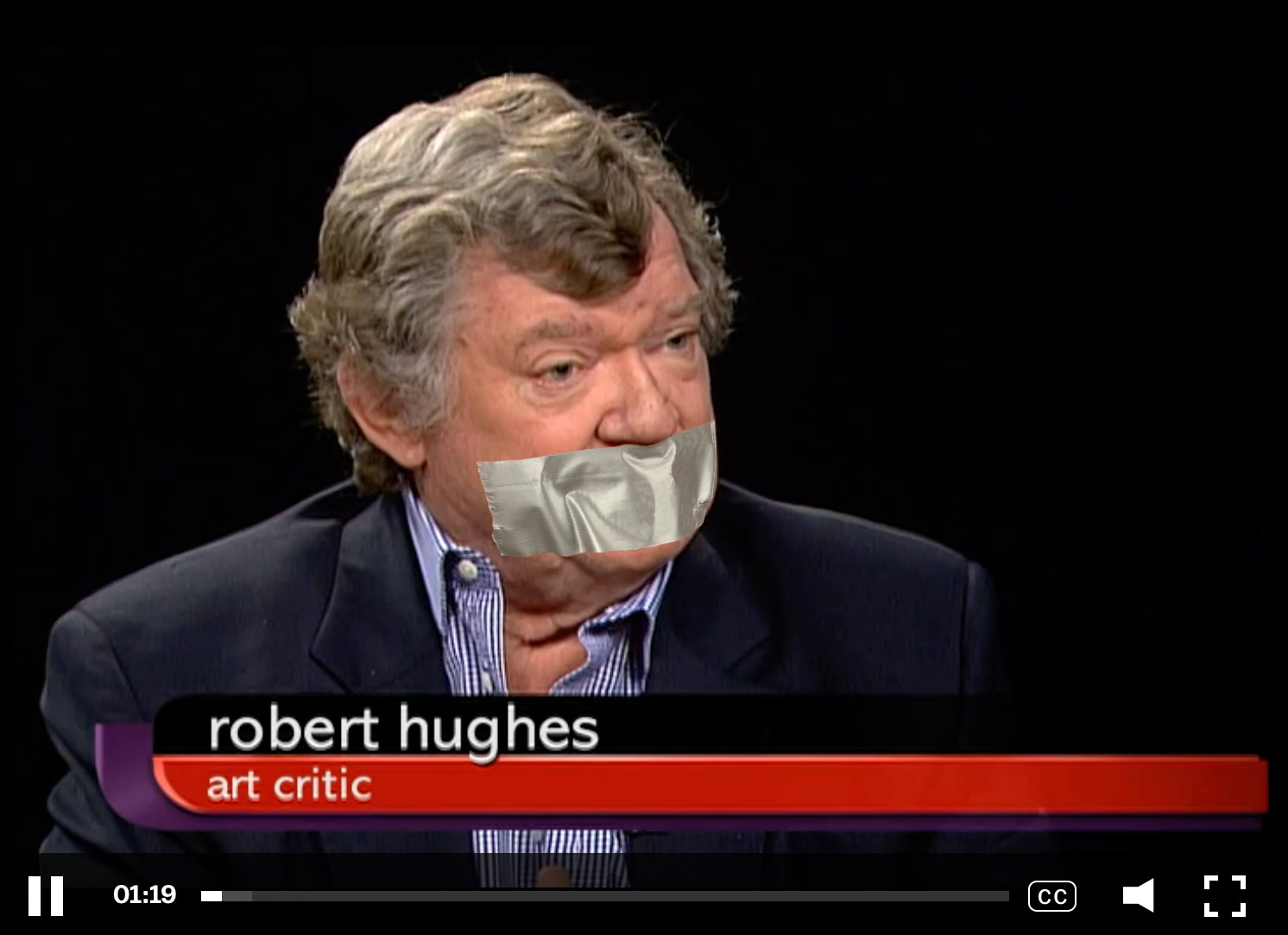
The contemporary cultural sphere is saturated with hypocrisy and moral blackmail, largely due to our efforts to ‘decolonise’ art galleries, movies, theatre and TV. It’s no coincidence that this trend coincides with the abandonment of criticism in the mainstream media. In place of a rigorous assessment of some cultural event, written by an experienced, knowledgeable critic, we get puff pieces and softball interviews that wouldn’t risk a harsh word – partly because the writer doesn’t have a clue about the topic. Evidence may be found in any issue of the Sydney Morning Herald or The Age. A critic as forthright and outspoken as Robert Hughes seems no less of an historical figure than Dr. Johnson - one of his heroes.
There’s an unspoken assumption that it would be wrong to criticise a production that has been radically inclusive in its casting, as if we are obliged to admire the latest Hamlet because of the cast’s ethnicity rather than their performances. To suggest there is anything unusual or inappropriate in the choice of actors is simply unthinkable – running the risk of being called a bigot and a racist. But why do we go to the theatre? To enjoy a play, or to feel we are being ‘supportive’ of someone’s idea of social justice?
Great works of literature, like Hamlet or Wuthering Heights, can sustain any number of interpretations, but one would hope that each variation illuminates parts of the work we haven’t considered, or shows its ongoing relevance to our times. The tactic of using a diverse cast of actors is the simplest and most reliable way of winning ‘critical’ approval, if gushing praise may be considered to be criticism. We are expected to be so delighted that Hamlet is Sri Lankan or Ophelia a “little person” that the quality of the portrayal or the niceties of the production are barely discussed. The cast and the director are cocooned from negative judgments, but also insulated against positive comparisons with other productions.
With this Hamlet, only a handful of reviewers timidly suggested that Abeysekera raced through the soliloquies too quickly, chewing up those sentences that great actors of the past have savoured. He tossed off famous lines for comic affect, draining scenes of any sense of drama or tragedy. It seems he had decided to play Hamlet in a Chaplinesque manner, or as some kind of slacker – sitting in a plastic chair, wearing a white beanie, gazing at poor Yorick’s skull.
His performance was energetic but scrappy, not at all emotionally involving. Tessa Wong’s Horatio felt even more misguided. Not only did Wong pronounce her lines in a muffled voice, she came across as a caring & sharing big sister, looking out for Hamlet and others.
Francesca Mills showed herself to be one of the play’s most formidable actors, with great diction and a wholehearted delivery. Yet she was obliged to caper about like a manic toddler, running all over the stage wearing a set of angel wings that made her look as if she had just come from a children’s costume party. This bit of business seemed designed to emphasise her small stature, daring us not to notice. The effect was comical in an awkward way. Were we supposed to laugh with or at the actress?
I’m trying to respond only to the quality of the acting, but it’s impossible to dissociate the performance from the performer. It would require an ideological purism that few people possess to see nothing unusual in the choice of actors to play these famous roles. It’s as if we were expected to ignore a whole herd of elephants in the room.
As the production adhered closely to the text, one must consider Hastie’s Hamlet to be a textbook example of ‘colour-blind casting’. The theory behind this practice is that it allows talented actors the opportunity to play roles from which they would be excluded by dint of ethnicity. In the past, this didn’t prevent Hollywood actors from putting on ludicrous make-up to play Black people, Indians or Chinese. The most famous piece of Hollywood miscasting must be John Wayne as Genghis Khan in The Conqueror (1956), although Katharine Hepburn as a Chinese woman in Dragon Seed (1944) was also a stretch of the imagination.
When we see these films today the racial anomalies are glaring and ridiculous, but when a black actor is cast in an historical role, as when Jodie Turner-Smith played Anne Boleyn in a 2021 TV drama, we’re expected to take it seriously. It seems that casting a white action hero as Genghis Khan is an outrageous western co-option of history, but to have a black woman play one of Henry VIII’s wives, is to knowingly overturn the racial taboos of an oppressive western culture. If younger viewers who never read a book come away with the impression that Anne Boleyn was black, that’s just too bad.
It’s even more dubious to have multicultural casts in history-based dramas than in Shakespeare’s plays. A play, after all, is a fiction that allows a degree of interpretative freedom. With history, we are tampering with the very fabric of the past, giving a misleading impression that the Tudor or Elizabethan courts were full of Blacks and Asians. It makes a mockery of the narrow racial attitudes that existed in those days.
It’s been frequently pointed out that “colour-blind casting” is not blind at all. It is a deliberate attempt to subvert orthodox interpretations, to “ruin the sacred truths” of the western canon. It could be more accurately called “colour-conscious casting”, but this term has been appropriated by an even more radical fringe who believe it is the duty of directors and producers to actively emphasise topics such as race and ethnicity, to bring out the ‘hidden’ historical biases of the text. This seems like a licence to mess around with any play or story for ideological purposes, although it may be creatively more productive to upset the applecart altogether, rather than merely swap black faces for white ones. Perhaps it’s better to rework Hamlet as Grand Theft Auto or a North Carolina BBQ, (both real productions) rather than shoehorn a multicultural cast into ye olde Denmark.
Maybe, maybe not. One of my worst ever experiences in the theatre was a Kabuki version of MacBeth, which murdered everything that was great about the play. In some cases, east really is east and west is west.
I also have vivid memories of watching a low-budget Vietnamese film about the Vietnam war, in which the American generals were played by Vietnamese actors wearing false moustaches to make them look like bad hombres from spaghetti westerns. It was unintentionally hilarious, albeit not too far from the mark.
If I had to make a bold call, I’d argue that there must be some bedrock of believability if we are to approach a play in a way that allows us to focus on text, production and performance, rather than be distracted by provocative casting choices. This means historical dramas would probably be much better off sticking to the ethnic mix that applied at the time. Hollywood actors do not tend to feature as Bollywood heroes or Kabuki performers. Nobody has suggested it would be a great idea to get white actors to play the lead roles in The Color Purple. In Cairo a couple of weeks ago, I found myself talking to a local professor who told me the Egyptians were so incensed by the “historical revisionism” of a Netflix series with a black Cleopatra that they’ve made their own documentary to correct the record. One wonders what they’ll make of a forthcoming film with Israeli, Gal Gadot, in the lead role!
Plays, novels and other cultural artefacts are expressions of their time, and to play fast and loose with them is to sow discord in our already fragile understanding of history. There are ample opportunities for talented actors of all ethnicities to feature in plays and movies in which historical accuracy is not an issue. Why impose a false ideological grid upon the past, pleasing some viewers but – if my screening of Hamlet is any indication - alienating a much larger number?
When it comes to working out how criticism should address plays, novels and exhibitions that make ethnicity a central part of their program, there is no clear path. I found confirmation of this in an essay by curator, Clothilde Bullen, in the first issue of Blue Art Journal, which has grown from the ashes of the old Art Monthly Australasia. According to the editors of this new venture:
For too long, First Nations art has been under-reported, misrepresented or framed by non-Indigenous perspectives. This has constrained dialogue and left broader audiences without the depth of understanding our cultures demand. Blue Art Journal exists to correct this. We centre Indigenous authority, elevate Indigenous knowledge systems, and prioritise cultural safety, complexity and breadth.
Blue Art Journal creates space for First Nations writers, artists and critics to lead, critique, challenge, experiment and to tell stories on their own terms. Our approach embraces multimodal ways of reading, writing, listening and speaking, recognising that Indigenous knowledges cannot be confined to conventional forms. We champion both emerging voices and senior knowledge-holders to ensure that a broad spectrum of Indigenous thinking shapes the record of our time.
As a rhetorical exercise this is all very stirring and heroic, but it’s not clear how these aims are to be achieved. Bullen’s piece, ‘Seeing Ourselves: The Power of Blak arts writing’ attempts to address these issues, but it’s impossible to draw any conclusions from what she has written. She tells us that white critics have struggled to address Indigenous art but offers only the banal example that it’s wrong to ask whether a work is “resolved” or not. Having written millions of words on Indigenous and non-Indigenous art, I can note that I’ve never worried about whether a work is ‘resolved’. For the most part this is no more than a piece of formalist jargon.
Bullen confesses that it’s just as hard for Indigenous writers to find an authentic Blak critical voice. It all appears to be the fault of colonialism, or perhaps the English language:
Being forced to learn and speak English – the language of the coloniser – was a brutal tool of assimilation. It changed the very brain chemistry of First Nations people, rendering our ability to represent our world view through the mechanism of oral narrative compromised, and in some cases, demolishing it entirely.
For those who are attempting a “post-colonial critique” there are some rough guidelines:
Post-colonial critique looks ‘for’, rather than co-responds ‘with’. This is hugely important, in that there is very rarely a declaration by a non-Indigenous person about their cultural background when they are critiquing Blak art forms, and what they bring to bear knowingly and unknowingly in their approach to Blak work.
If I understand this correctly, a non-Indigenous person who is writing about Indigenous art should first declare their cultural background, so we know where they are coming from. But what are they declaring? Their white privilege? Their unconscious biases? Can a writer’s race or background render their analysis of an artwork invalid or illegitimate? (Would it help if I prefaced every article by saying my ancestors came from Scotland?) Should only Indigenous people be allowed to write about Indigenous art? Are non-Indigenous people somehow incapable of learning about the stories and meanings in this work?
This seems to be where Bulleen’s argument is tending, although she never makes it explicit. She complains about how “deeply challenging” it is having to educate non-Indigenous people, let alone doing so in the language of the coloniser. She tells us:
…it feels almost unholy, as a Blak critic, to wield colonial language to dissect and decontextualise practice in an arts sector where everyone is known to you, and personal relationships abound. We all share the challenge of existing as Blak bodies in these spaces, and we have all had to undertake much transactional labour for others to be heard.
One way of interpreting this paragraph is that Blak critics are different to non-Indigenous ones because they have personal relationships with artists. This is an odd proposition because critics of all stripes and all eras have enjoyed the closest relationships with artists. In its worst incarnation we call this nepotism or favouritism, but it seems as if Bulleen is suggesting that for Blak writers this is business-as-usual. The word “transactional” has unfortunate connotations, even if used without devious intent.
When she attempts to lay down a few principles for a Blak art critique, this is what emerges:
…custodially, was that expression of storytelling accurate? Would your ancestors see this story and recognise what you were trying to say? Did your work contribute to broader aspects of recognition and representation, and who else’s voice from your community was elevated? Did the work contribute to the narrative around structural change and sovereignty?
These ‘questions’ are essentially political and moral impositions. The storytelling may be accurate, but the work of art could still be an aesthetic failure. An artist may consider their ancestors, but they cannot forget they are addressing a diverse contemporary audience. The issue of contributing to broader aspects of recognition or elevating other voices sounds like a burden on any artist who seeks a more individualistic path. Neither does it guarantee a great work of art. Ditto for structural change and sovereignty.
If criticism is to have any credibility, it cannot be proscriptive. The artist’s expression must come first. Any Indigenous artist who took Bulleen’s ‘questions’ as gospel would be following a set of rules imposed by a cultural gatekeeper. This is not criticism at all - it’s merely providing a seal of approval to those who do the right thing. It puts enormous power in the hands of the Blak critic or curator and turns the artist into a drone.
When it’s up to ‘critics’ to decide whether an artist ticks all the correct boxes, it diminishes the power of the art. The best criticism welcomes an artwork as a visual expression of a complex personality, with its own spiritual and intellectual depths. It’s unreasonable to judge a work through its adherence to a political platform, or to expect that every Indigenous artist should feel obliged to speak for an entire race or community.
It’s remarkable how often some radical, liberating gesture turns into an exercise in laying down the law, constricting expression and individual freedom. Bulleen’s ideas about Blak criticism bear little resemblance to criticism per se, which should be sceptical and open-minded, not aligned with a pre-determined set of cultural guidelines.
It would be more accurate to say that the writer likes the idea of a special ‘Blak’ form of criticism but is unable to figure out what it might entail. She blames these difficulties on the use of English, ‘the language of the coloniser’, but without English or some other major language the concept of criticism makes no sense whatsoever. English, for better or worse, is the vehicle for her own ideas, and those of her readers.
It’s hard not to feel that ‘Blak criticism’ is a fantasy, a mere shell of an idea; another term with which to beat the drum on behalf of a political ideology. Like ‘colour conscious casting’, it’s one of those things we are expected to feel morally obliged to approve, even if we struggle to understand how it enhances our engagement with a play or a work of art. By constantly emphasising the importance of “cultural background”, writers and directors are not healing the racial divisions of the past - they are opening them up, discarding the idea that critical judgements should be made on the basis of merit or quality.
I know that such terms are greeted with derision nowadays. Whose merit? Whose quality? Why should we accept the judgements of white colonialist society, etc, etc.? The answer is that such concepts, no matter how abstract or subjective, are far more conducive to dialogue, debate and analysis than those tied to a sense of ethnic belonging, or any other group-defined frame of reference – left-wing, right-wing; based on race, class or sexual preferences. Critics should strive to leave their biases at the door of the gallery or the theatre, not wear them like a set of blinkers. We can never rid ourselves of the cultural baggage than comes with education and upbringing, but neither should we accept that these influences determine our every judgement.
I’m still working on a number of art-related pieces, but none can be published immediately on this site, so please be patient. The art column will return soon. In the meantime, there’s a review of the Wuthering Heights movie that makes no concessions to fans of pop culture. If I say I’m devoted to Emily Brontë and to Shakespeare, you’ll understand what a painful week it has been to see them treated in such cavalier fashion.
Back in 1990 I shared a studio house in Spring Hill, Brisbane. Richard Bell and his brother showed up one day to get some tips on painting, for the tourist market, and was persuaded to get serious and put something in a show called Balance at the Queensland Art Gallery.
I remember talking about the abstractions that any visual artist had to deal with, aboriginal or not, and that art by Aboriginal artists was often readable in this way by Western trained artists, especially those from central Australia. It was no less brilliant, actually more so, for the observation.
I mentioned two I had seen. One was a plan view of a lizard/goanna in an obvious contrapuntal position. The short thick head had to be at a greater angle than the long thin tail, just for aesthetics. Exactly the same as Michelangelo's David. Then there is the juxtaposition of white (often) against black or a subdued ochre. You get an extra tone out of the white.
He got it. 'You mean there's no difference?'
'We deal with the same aesthetics.' I said
It became . . . Aboriginal Art. It's a White Thing.
Not surprising. We are the abstract animal. We communicate in abstractions. It's why we rely on critics to nominate those abstractions and point out their use and abuse.
Name them. Writing. Art. Theatre. Food. Dance. Music. But there is one more yet to take its place in the pantheon.
Money. It's time we admitted it's abstraction and it's power to communicate; that it is a language.
Good article Mr McDonald.
I saw a production of the Tempest by Peter Brook's company in Paris in the 1990s that was extraordinarily diverse, well before "diversity" was a thing. The company happened to be a diverse range of performers, and they took on Shakespeare, and it worked incredibly well. So I don't think a diverse cast is inherently a negative from an artistic perspective.