

There are cities around the world that are almost interchangeable in their blandness. Cairo is not one of them. One could never say Cairo lacks character - if anything it has too much character. As an outsider, in town for only a few days to see the Grand Egyptian Museum, I felt it was the closest thing I’d ever experienced to chaos-as-a-way-of-life. It’s exhilarating and exhausting.
I wasn’t surprised by the city’s infamous traffic and soon got the hang of crossing a road in small stages, but the way the Cairenes drive is symbolic of a philosophy of life. Every driver seems to be competing for the smallest space, pushing through tiny gaps, playing chicken with the cars to their left and right, blowing the horn constantly, brushing pedestrians who are too slow to scramble across several poorly defined lanes. You’d think drivers would be in a constant state of hypertension, but one of my Uber drivers was calmly texting on his phone while he executed these daredevil manœuvres.
In Cairo I did something I never do in Sydney, taking the higher bracket of Uber, the so-called ‘Uber Comfort’. Invariably the car would be beaten up, dirty, and devoid of seatbelts or at least of seatbelts that fasten. I didn’t dare sample the standard UberX ride. Nevertheless, one can only express a First World relief that Uber has taken away the haggling and arguing which previously attended every taxi ride in places such as Cairo, Jakarta or New Delhi. Now one gets charged such a ridiculously small amount that tipping is a moral obligation. As most of the homegrown taxi companies have made crude attempts to rip me off over the past year or so, I’m thinking that Sydney should be added to the list of Uber-only cities.
In Cairo, driving, like life in general, is a matter of muddling through. With at least 23 million citizens the city has one of the highest population densities in the world. Up to one million have made their homes in historic cemeteries! In her book, Cairo: City of Sand, Maria Golia notes that eighty percent of Cairo rests on precious arable land, built up over thousands of years by silt deposits from the Nile. The land that could feed the hungry hordes is used to house them.
In this human beehive it seems impossible that so many people manage to find ways to earn an income, support their families and basically survive. Almost two-thirds of the dwellings in Cairo are reputed to be outside of any building code. They collapse with regularity, reverting to the yellow-grey sand that colours everything. Look left, look right, there are thousands of shabby, decrepit-looking apartment blocks teetering on the brink of oblivion. Roads have been chainsawed through slums, leaving buildings that look as if they have been sliced in half. This squalid vista is broken by magnificent mosques and handsome public buildings of a bygone era, still clinging to shreds of their former dignity.
The Egyptians’ propensity for treating life philosophically may also explain their tolerance for supreme leaders. Although none of have enjoyed the adulation showered on Gamal Abdel Nasser (in office: 1954-70), the Egyptians have largely accepted a succession of authoritarian governments as a way of controlling a teeming, diverse population. The only exception to the pattern may have been the election of Islamist, Mohamed Morsi, whose reign of less than a year was ended by a coup d’état in July 2013. Notwithstanding revolutionary flare-ups such as the mass demonstrations in Tahrir Square of 2011, there has not been much evidence of democracy in action. On the way from the airport to the city, I counted no fewer than 62 pictures of current President, Abdel Fattah el-Sisi, usually looking wise and benevolent. Taking a different route on the way back, I only managed 38. Can you imagine encountering 38 pictures of Albo’s mug as you drive to the airport in Sydney or Melbourne?
To walk down the street in Cairo is to step over piles of sand or rubbish; to negotiate broken pavements and holes that could break an ankle; to breathe in air filled with off-the-charts levels of pollution. The noise never lets up. The surprise is to descend to the subway and find a clean, modern train network. It’s almost an oasis after the life of the streets.
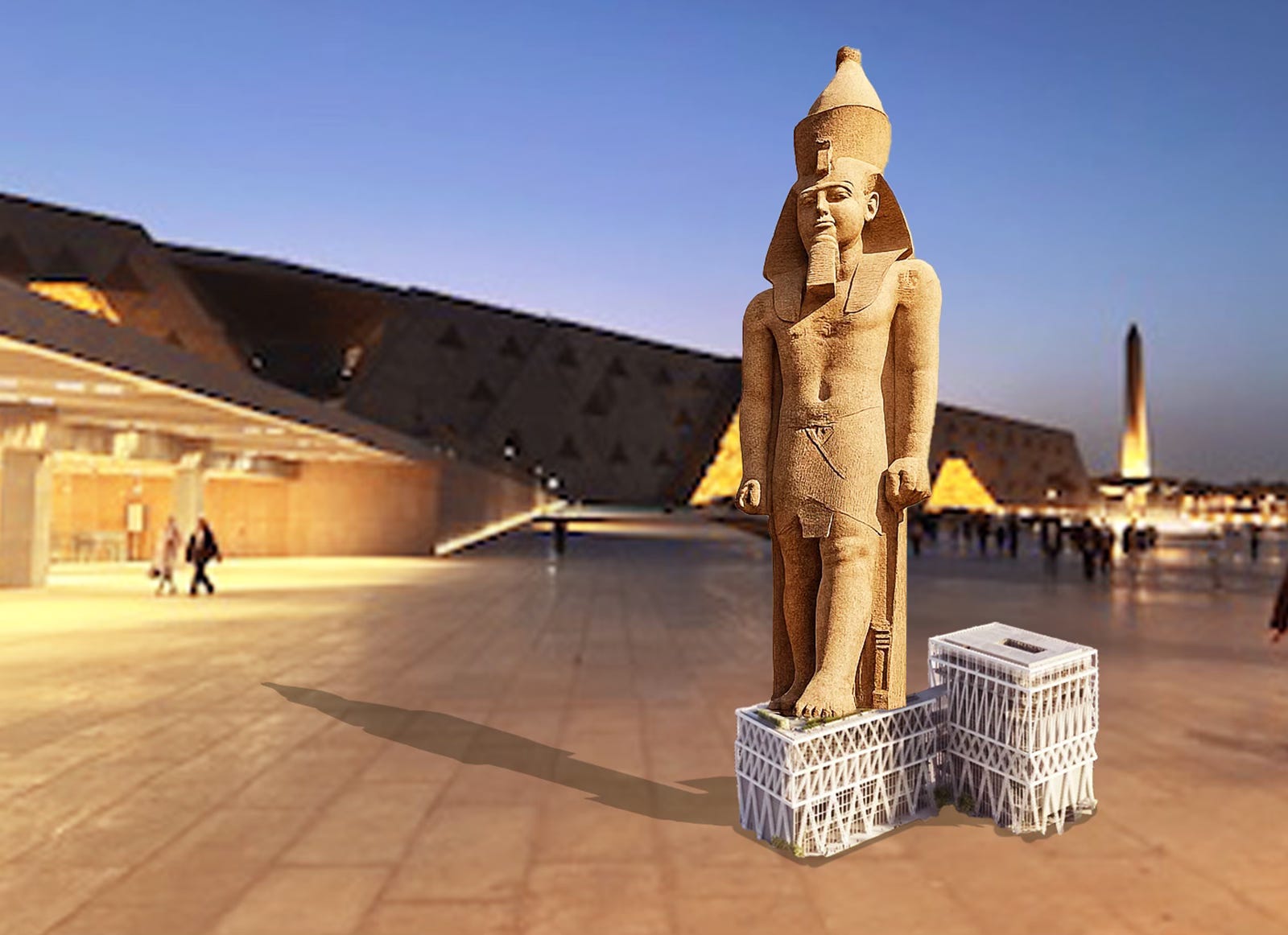
As for the Grand Egyptian Museum, which I’ll be writing about soon, it’s a stupendous feat. In terms of the quality of exhibits and the careful planning that has gone into the building, it’s already one of the great museums of the world, and easily the greatest museum project of the 21st century. At a reputed cost of a billion US dollars, it’s almost as expensive as the Powerhouse Museum ‘revitalisation’ in Sydney. One of the chief differences is that in a city bisected by the Nile, the GEM wasn’t built on a flood plain. Neither did it choose to launch with a $13 million exhibition on shopping malls. A more incisive point of comparison is that the GEM is a supreme tourist drawcard that will pay for itself in no time at all, while the tripartite Powerhouse is destined to be a relentless drain on the public purse until some future government pulls the plug.
It’s sobering to think that the Great Pyramid of Khufu has been standing for almost 5,000 years, but last week the Minns government began demolishing the Wran building at Powerhouse Ultimo, which has only been in place since 1988, when it won awards for architect, Lionel Glendenning.
Australian politicians’ love of cultural vandalism knows no bounds. Had Uluru been situated on Sydney Harbour it would have been turned into rubble by now. It’s a wonder the Harbour Bridge hasn’t been replaced with something a bit more up-to-date.
In the kind of article we’ve come to expect from the Sydney Morning Herald, Linda Morris recently addressed those people who were “impatient for reopening” the Powerhouse in Ultimo. The problem is that nobody is impatient to see this useless, expensive rebuild. The public is mourning the Powerhouse, not looking forward to a dazzling future.
Back in Cairo, in comparison with the GEM, the old Egyptian Museum on Tahrir Square is a sad relic – full of antiquated vitrines covered in scratches and cracks, labels peeling off walls, layers of dust, and whole rooms full of junk. But if one looks only at the objects that missed out on relocation to the GEM, it’s an astonishing treasure trove. Even the smallest pieces would be valued highlights in most Australian galleries.
Perhaps the only non-Egyptian artefacts on display were a pair of boomerangs - a remnant of a time when someone had noticed that the ancient Egyptians had used similarly shaped ‘throwing sticks’. One crucial difference was that the Egyptians fashioned their boomerangs from stone and ceramic, which made them less likely to come back, but perhaps better suited to accompany a hunter on his journey to the afterlife.
This mini-travelogue is by way of partial explanation as to what I’ve been doing over the past week – in Saudi Arabia, then Egypt. I can see by the news there’s plenty of issues to grapple with on Australian soil, but more on that when I get over the jet lag. The most recent art column looks at Data Dreams: Art and AI, at Sydney’s Museum of Contemporary Art - a show that wasn’t all that it might have been, but a step in the right direction for an institution that needs to build its audience. The film being reviewed is Nuremberg, in which Russell Crowe proved to be just perfect for the role of Hermann Goering. One hopes it didn’t come too naturally.
John, I love your description of Cairo.I was there briefly as an 11 yr old in 1971 where people thought my long red hair and maxi black Biba dress meant I was a witch or young prostitute and threw Little Rock’s at me.
I loved the Cairo museum then ,each room was pitch black and you would hear the rattling of coins in the darkness from a poor guard who would only turn the lights on if you gave him a few coins.We gladly did and it was like discovering wonderful treasures in a tomb.
Your writing and wit always engage John.🧠🙏