

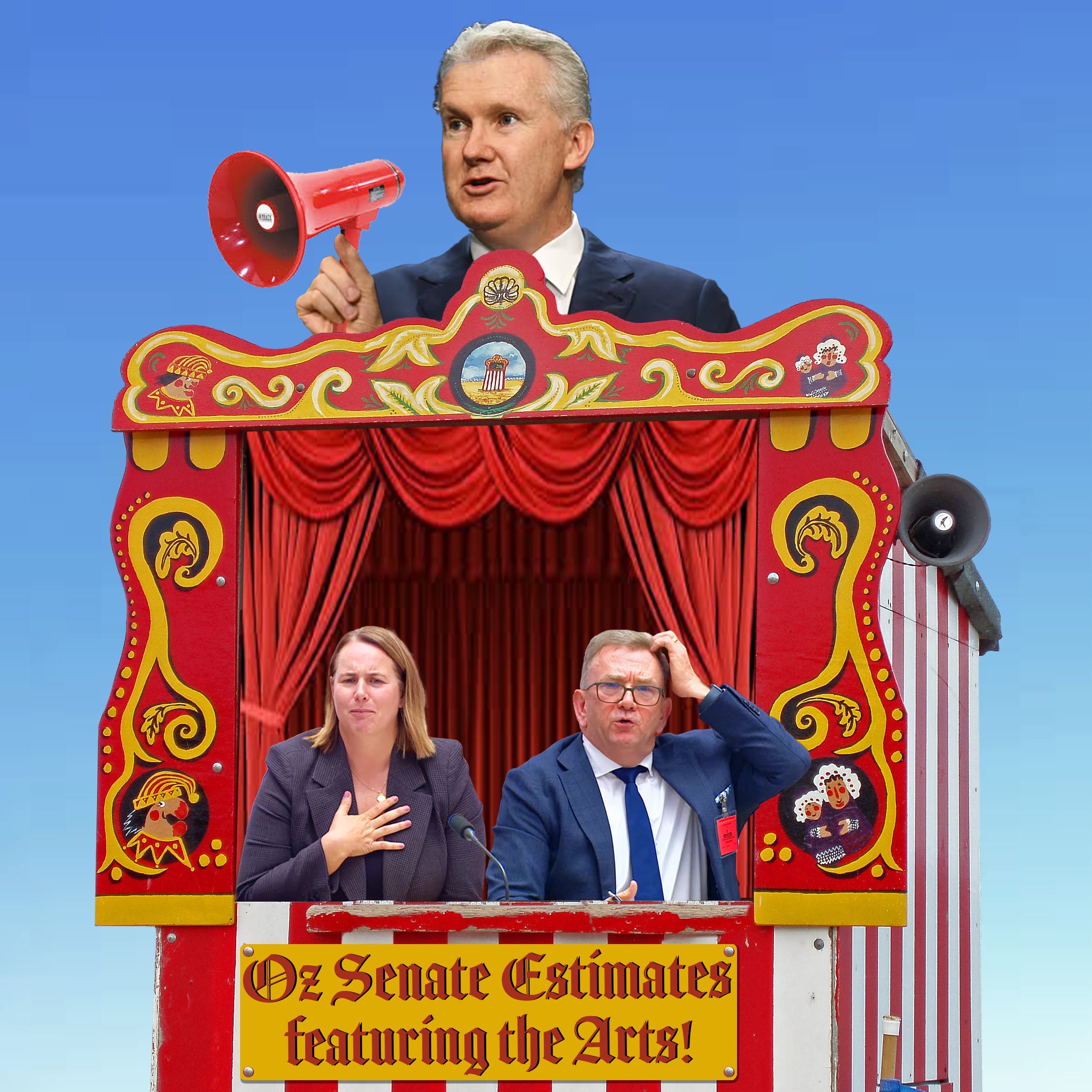
Last week I was wondering aloud who paid for Ahbab Al-Mustafa, “an all Australian born Islamic Nasheed group”, to fly to Venice for the opening of Khaled Sabsabi’s exhibition in the Australian pavilion. Now, thanks to Thursday’s Senate Estimate hearings, we know it was none other than Creative Australia, although some might follow the money trail and say it was the Aussie taxpayer. The estimated cost of airfares and accommodation for the ten musicians came to $100,000, presumably incorporated within the $1.7 million CA spent on the event.
The good news, according to Tim Blackwell, CA’s Executive Director, Corporate Resources, was that the group’s performance was “an integral part of the artwork”, and the feedback he got from staff was that it was “an absolute highlight”. We also know from an Instagram post that Liz Ann Macgregor, former director of Sydney’s Museum of Contemporary Art, thought it was “lovely”. When Liberal Senator, Sarah Henderson, asked the obvious question: “How was it an integral part of the artwork?”, Mr. Blackwell had to disappoint us, because he “wasn’t an artist”, but he believed it had “something to do with “singing the work in.”
Like Tim Blackwell, I’m in no position to pass judgement on the performance, but it certainly wasn’t cheap. Neither was the rest of the package, which also saw luminaries such as Michael Brand, the former director of the Art Gallery of NSW leaping on board the gravy gondola, along with Franchesca Cubillo, former Senior Curator of Aboriginal & Torres Strait Islander Art at the National Gallery of Australia, now CA’s Executive director, First Nations Arts and Culture. Michael, as you may remember, was well known for his globetrotting on the public purse during his years at the AGNSW, so it’s good to see him keeping up the Frequent Flyer points. He is now on the CA Board, and according to Tim Blackwell, was brought over to Venice as “a visual art expert of some renown.” Happily, when Tony Burke is the presiding minister, travel expenses are not a big issue.
Franchesca too, was a “visual arts expert” who had a “specific role at the opening”, although that specific role was never specified. Was it a Welcome to Country? To the ancestral lands of the Venetian people? CA is short on detail with such matters, just as they were largely silent on Ahbab Al-Mustafa’s participation. Anyone of a suspicious frame of mind might note a certain reluctance to divulge details as to how the budget was carved up.
Having ventured some idle speculations about the pavilion last week, I won’t be trekking back over that topic. The basic issue remains unchanged: it’s a very strange proposition that the Australian pavilion should be turned into a celebration of Islam – or indeed, any religion.
The other part of the Senate Estimates that proved surprisingly gripping, came when One Nation Senator, Malcolm Roberts, asked the CA folks about some of the grants they had distributed to events such as the Bankstown Poetry Slam, which received $197,500 this year. Although he’s not exactly Perry Mason, Senator Roberts produced some remarkable data, detailing the large amounts of money CA had handed to various acts and the militant rhetoric in which those people routinely engaged.
Ever since lawyer and poet, Sara Mansour, co-founded the BPS in 2013, it has continued to grow in prestige and influence, assisted by regular injections of government cash. On its website we read how the organisation “champions the transformative power of poetry in all areas of life. We believe that spoken word is a vital tool for self-expression, social connection, and personal empowerment. Our mission is to cultivate a vibrant and inclusive artistic community, with a dedicated focus on empowering the young people of Western Sydney.”
This sounds like an unalloyed good. The difficulty arises when one samples the content of these slams and looks at the social media statements made by participants. One person quoted by Malcolm Roberts was poet, Bilal Hafda, the Founder and Director of Guest House Publishing, whose focus is on Muslim writers in Australia. Hafda believes that “any Australian who fails to support Palestinians who attacked Israel is a white supremacist.” There was also lawyer and poet, Sarah Saleh, “who celebrated the Hamas terrorist aerial attack on Israel on her social media.” Saleh’s memorable line, not quoted in Estimates, was “looking at Israel’s psychopathy today, October 7 should make a little more sense to y’all.”
Roberts went on to quote Ali Al Haj, AKA. the Poetic Ninja, who has praised Hezbollah, as “Men of God”; announced that the seventh of October murders were “just the beginning”; and promises “to drag the Israeli people to the deepest pits of hell.” Allegedly the Ninja has also called for “the downfall of the western empire and all its debauchery.”
I’m very far from supporting One Nation on almost anything, but what we see here is a textbook example of government funds being handed over to people with stated views most Australians would find abhorrent. When Malcolm Roberts, an engineer by profession, can raise these statements in Senate Estimates it dramatises the gulf between CA’s vision of the world and a more general or ‘populist’ view. In brief, it adds fuel to those Culture Wars that have proven so destructive to political stability and to Albo’s beloved “social cohesion”. In the name of “freedom of expression” it gives One Nation an ideal rallying point.
The only comeback Roberts received from Labor Senator, Nita Green, who has degrees in Creative Arts and Law, was that it was wrong to imagine art couldn’t or shouldn’t be political “otherwise we might have lot of pictures of fields, but we wouldn’t have any generation of debate and discussion through the use of art.”
Roberts’s predictable comeback was that he was in favour of freedom of expression, but not of “ideology” funded by government.
Senator Green said this was not funding ideology, it was “funding for artistic expression projects that are artistic.”
She continued: “The law that was passed in 2023 made it very clear that the government has no role in the funding decisions… any type of government that is in power can’t influence the independent funding decisions to particularly alleviate the issues you’re talking about.”
At this point let’s freeze frame and unpack the implications of this exchange. Malcolm Roberts is taking the man-in-the-street line: Why are you funding people who say things that appear to glorify terrorists, sow seeds of division in the community, and contradict the government’s own statements on such matters?
Nita Green replies by denigrating the value of non-political art (“a lot of pictures of fields”), then defending the right of art to make political statements. The latter point is, or should be, uncontroversial. In a liberal democracy, artists should be free to make political statements. There is, however, no such thing as pure freedom. You are free to say any extreme or offensive thing you like, until it becomes clear that your statements are having a destructive impact on the community. Most people will rein in their worst impulses because of the opprobrium such comments attract.
The problem arises when there is a large, supportive group of people encouraging those extreme outbursts. Speakers are emotionally rewarded for their courage, they feel empowered and justified. Today, thanks to social media, one need never bother reading any point of view that differs from your own, allowing you to remain within a bubble of opinion that reacts with outrage when someone raises an objection. Instead of “debate and discussion” we have a contest as to who can shout loudest.
Most people would react with horror at anyone celebrating the massacre of 7 October, but within certain subcultures it’s commonplace. Trouble begins when those who hold such views make their way into the mainstream, supported by official funding bodies and a sympathetic media. When extreme positions become normalised in this way, a wedge is driven between the politicised minority, and a befuddled majority who rightfully believe there’s no justification for terrorist acts. I daresay the same majority believes that Netanyahu’s assault on Gaza and Lebanon also qualifies as an atrocity, but to invoke the oldest of clichés, two wrongs will never make a right.
This is a mess we now face on a daily basis. It dominates the news and has seeped into every part of our culture. What’s most startling about Senator Green’s response in the Estimates, is how it reveals the calculated approach the government has taken to these issues – calculated to absolve it of any responsibility, even while it bankrolls people who have no qualms about saying the most inflammatory things.
When the Senator tells us: “The law that was passed in 2023 made it very clear that the government has no role in the funding decisions,” she is passing the entire buck to Creative Australia. She’s saying it’s solely the responsibility of CA to prove they are impartial and objective in their decision-making processes.
The way they “prove” this, is to assert they have “robust” processes in place to ensure there is no bias and no conflicts of interest. Nobody seems to have explained to CA boss, Adrian Collette, that an assertion is not a very promising way of defending oneself when a mountain of evidence exists to the contrary. This week I’ve been able to view a hefty dossier of research compiled by critics of CA, who point out numerous - indeed, systemic - conflicts of interest built into the way committees are constructed and grant applications assessed.
I’m not going to go into detail here, because this will all come out in good time. It’s axiomatic there is no transparency in the way some people are chosen to be on committees and others rejected. The very fact that one can apply to be on a committee is a red flag, as few people would be applying out of an advanced sense of civic duty rather than simple self-interest.
The percentage of members of visual arts committees who also received grants was 30.3 percent, which should be a source of concern. With literary committees the percentage was 49.1 percent, which is off the charts. These figures give a strong impression that friends and colleagues are handing (taxpayers’) money to each other. In the funds allotted to those who make extreme statements, and the multiple grants bestowed on lucky fellows such as Khaled Sabsabi over the past decade, we can sample the opaque nature of CA’s “processes”. Everything is within the rules and perfectly legal, even if it’s easy to see how such practices could open the door to forms of collusion and soft corruption.
It’s not credible for the government – or more precisely, Tony Burke’s Ministry for the Arts – to claim it plays no role in funding decisions independently adjudicated by CA and its committees. CA’s funding comes from the department, and is one of the few arts organisations to get a boost in this year’s Budget. Its procedures are approved by the Minister, its executives are chosen by and answerable to the Minister. If CA consistently acts in a way that generates public anger and controversy or is accused of bias, this is a matter for Mr. Burke’s urgent attention.
To fall back on “a law that was passed in 2023”, to suggest that “any type of government that is in power can’t influence the independent funding decisions” is errr… unacceptable – although I’m tempted to use a few stronger terms. Without venturing into profanity, it’s sneaky, cowardly and guaranteed to torpedo any sense of “social cohesion” that the government claims to be championing.
More worryingly for Labor, these devious manœuvres are politically counterproductive. They open the door to attacks from the Libs and One Nation that are hard to answer, no matter how skilled Mr. Burke may be at avoiding issues, remaining silent, and pretending there’s nothing to see here. The criticisms and complaints are building up to a point where they are attracting public attention, handing material to a right-wing media which knows a juicy line of attack when it sees one. At a time when the latest poll shows that One Nation has surged ahead of Labor as Australia’s most popular political party, CA’s funding priorities add fuel to the bonfire.
One suspects Labor is less concerned with appeasing the public than with mollifying the left wing of its own party, which has gone over wholeheartedly to the Palestinian cause.
To reiterate my personal position: while not being at all religious, I believe religion to be a matter of personal choice in which everyone should be free to practice their own beliefs, so long as they don’t break the laws of the land or threaten injury to others. I also believe that mingling religion and politics almost always leads to unhappy outcomes. Throw art into the mix and misery is assured.
The progressive normalisation of religious hatred, notably antisemitism, that we’ve seen over the past year or two should be treated as a social crisis. Instead, we’re faced with the reality that artists and writers who declare themselves radical opponents of Zionism have become so used to living off government handouts that they claim to be silenced, censored and oppressed when the funding tap is turned off or momentarily diverted.
By now everyone is alert to the comedy of sociologist, lawyer and author, Randa Abdel-Fattah and her chums sitting on a panel at the Sydney Writers’ Festival called ‘Silenced’, that sold out and was given a second run. If Abdel-Fattah thinks she is being silenced, I’d hate to see her definition of “over-exposed”. After the fracas in Adelaide, she is now the hottest item for literary festivals around Australia, who view her as a sure-fire way of selling tickets. While she has refused to debate her ideas with any opponent, this doesn’t seem to trouble organisers.
Meanwhile, Matt Chun, who greeted the Bondi massacre with the line “We don’t mourn fascists”, was hailed as a victim and a martyr when University of QLD Press dumped a project for a children’s book. Anyone might think it a little strange to publish a children’s book by someone who could refer to the victims of a terrorist act, including a ten-year-old girl, as “fascists”, but this didn’t prevent another orchestrated campaign of walkouts over “freedom of speech” concerns. Reading the media reports, one would think Chun had suffered a grievous injustice, the poor, sensitive soul. What he was suffering was a publicity coup.
If you exercise your freedom of speech to call people fascists, imperialists, zios, and other choice names, you should also be prepared to discover that not everyone views you as the ideal dinner party companion. Or wants you associated with a business that is intended to reach a broad audience.
If an artist or writer asserts their freedom to be offensive, then a funding body, a literary festival or a publisher has an equal right to decline to have anything to do with them. This is not censorship, it’s common decency - or a precaution against reputational damage. Being refused a grant, being dropped from a festival program or a booklist, does not make you a hapless victim of an oppressive power structure, it makes you a victim of your own bad behaviour.
I was struck by Janet Albrechtsen’s recent story about Catherine Lumby being dumped from a rally against sexual assault because she had spoken up for Jewish students at Sydney University. It seems a new generation of feminists are more concerned with Middle Eastern issues than women’s issues. Aside from this one article, I didn’t notice anyone else in the media protesting about Lumby’s treatment, when all she had done was act humanely. Perhaps being dumped for doing the right thing is deemed insufficiently newsworthy.
I’d intended to write about another subject this week, but the Senate Estimates was too good to ignore. It made me feel that those who are appalled and frustrated by the spending priorities of Creative Australia and the Ministry of the Arts, are finally getting their act together and asking the right questions. There must be a point at which it becomes clear that the political obsessions which have engulfed the arts are not a sign of nobility, but a cancer that is metastasising rapidly. There must come a time when the inappropriate allocation of funds and the confection of outrage become insupportable. The first cracks are appearing in the wall of silence and secrecy that has been constructed around the fortress of Australian culture. It will take a lot longer to get all those crocodiles out of the moat.
The most recent art column looks at the Salon des Refusés at the S.H. Ervin Gallery, bringing to a close my engagement with Archibald Prize season. I know these columns are popular, but they are also an exercise in futility, as nothing ever seems to get any better. If I were looking for positives, I can say with confidence that the Sulman was a distinct improvement on recent years, and the Salon a worthy competitor with the main shows at the AGNSW.
The movie being reviewed is The Richest Woman in the World, in which Isabelle Huppert stars in a tale based on the real-life follies of Liliane Bettencourt of L’Oréal, who went head over heels for an obnoxious, self-serving photographer eager to live the high life on her millions. At least he wasn’t taking it from Creative Australia.
Brilliant, thank you John! So many international exhibitions and biennales, yet $1.7million spent on one artis, one event…and all with big question marks attached to it.
Well said, John.
It must be a total coincidence that both the ‘Bankstown Poetry Slam’ and ‘Guest House Publishing’, are both based in Tony Burke’s seat of Watson.
“The fish rots from the head down”, as the saying goes.